
Steel boat as a long-term liveaboard (in a warm(er) climate).

Status
Not open for further replies.
Brent, you can twist and squirm and make up accusations all day but firstly, you’ve no idea how much cruising and living aboard a yacht I’ve done so don’t guess. Secondly don’t project aspirations onto other people and make sweeping generalisations.

Others might not want to cruise in agricultural style boats. Others might want more room and might want guests to cruise with them from time to time. Our current boat is 39’ and we have a nice aft cabin with its own heads and shower plus EVERY hatch and port light opens for ventilation. Three of them with bug screens available if necessary.

The rest of the boat has similar ventilation and it’s needed.

Just because you survived with two hatches open to the breeze in your 31’ boat doesn’t prove anything as a general case. It’s interesting that instead of acknowledging the problem you resort to justifying your 31’ boat and deriding anything bigger.

Bit like extolling the virtues of your home made self steering but never answering questions about what you proclaim as best on boats with different styles of rudder to the only sort you’re will fit. You make definitive claims but can’t substantiate them when faced with other people’s real problems.

John, I think I can guess how much liveaboard cruising you've done but rather than making those of us who don't know you personally guess, would you like to let us know? Just for balance?
 
John, I think I can guess how much liveaboard cruising you've done but rather than making those of us who don't know you personally guess, would you like to let us know? Just for balance?
It's actually not relevant and doesn't achieve any balance at all. Lets just say that I've been sailing offshore boats for over fifty years and sailed more miles across more oceans N and S of the equator than I care to recount. I'm very fortunate inasmuch as I was allowed huge chunks of time away from my main job to take people sailing. Literally months at a time sometimes.

The problem is that when Brent is challenged over something that he finds difficult to answer, his response is either to suggest that the other party lacks experience, or that they don't know what they are talking about and lack the right sort of experience, or he belittles the sort of cruising that most others enjoy or he simply avoids the question and points out how he does it on his boat (even when his solution doesn't apply to other boats at all.) His latest argument seems to be that the problem would go away if only we chose to cruise in his size boat and in his style. This may be true, but it's a nonsense argument as it means we all have to suffer the privations of a small boat with lack of ventilation etc etc or we're somehow up ourselves and waving our ego's about with our larger boats.

(What's even more amusing is that he doesn't know who paid for the 67' boat I was sailing on and how that boat is now scrap and waiting to be made into razor blades having succumbed to corrosion after being sailed two or three times round the world... but that's another matter.)
 
John I do sail in the tropics and have my home base in the sub tropics.

My steel boat is 50 ft wit a deck saloon with big glass and I have 10 hatches including the companionway and 14 opening windows and still some times it can be too hot/humid.

The while hull and deck is insulated with 50/60mm spray in polyurethane foam. The light gray deck get too hot to walk on most of the day in summer without a full sun shade over ALL the deck

I have a permanent sun cover over the cockpit area due to both the tropical sun ans tropical rain storm's.

I do get the impression that Brents boats/designs are very agricultural and my suit Brent and his life style but would not suit me or my SWMBO so I don't think we are talking similar quality of boat.

Brent made a comment to stick welding stainless and polishing the stainless while sailing of at anchor. That would not be possible on my 50 ft let alone a 31ft due to the mains power needed and the proper polishing equipment. Also parts of some assembled need polishing before welding as they cannot be polished to any decent standard before hand.

I would also like to see drawings of Brents hull construction method to see if the drawings give patterns or lofting dimension for the special shape of the flat hull plates before pulling and welding the flat plate to form the 3 D hull.

Having done pattern development for sheet metal formed structures like cones, hoppers and cyclones I know its not that easy. There may be software to do that these days but we had to do it by hand in my apprentice days

Even a hint of gray in deck paint makes it much much hotter. Paint a bit of it white ,and check the difference.Yes you may need sunglasses, but who doesn't ,in the tropics.
I define "quality" in terms of practical and functional. My first boat had the other priorities .Never again!
Some go "agricultural" some make them indistinguishable from a custom plastic boat.That is determined by the owners priorities.
My polishing equipment uses 6 amps. My alternator welder puts out 100 amps.
The nice thing about it is, by slowing the engine down, I can make any tool into variable speed (nice for polishing things.)
My drawings give all the loftings anyone has needed to build the boat, with no further help from me. Many have , and continue to do.
 
Last edited:
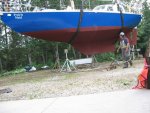
IMG_2151.jpg
This owner, a first time boat builder, built this boat entirely on his own, from my plans, with no help from me.
He is one every happy cruiser.
This photo gives you good idea of the hull shape one gets with an single chine origami boat.
 
It's actually not relevant and doesn't achieve any balance at all. Lets just say that I've been sailing offshore boats for over fifty years and sailed more miles across more oceans N and S of the equator than I care to recount. I'm very fortunate inasmuch as I was allowed huge chunks of time away from my main job to take people sailing. Literally months at a time sometimes.

The problem is that when Brent is challenged over something that he finds difficult to answer, his response is either to suggest that the other party lacks experience, or that they don't know what they are talking about and lack the right sort of experience, or he belittles the sort of cruising that most others enjoy or he simply avoids the question and points out how he does it on his boat (even when his solution doesn't apply to other boats at all.) His latest argument seems to be that the problem would go away if only we chose to cruise in his size boat and in his style. This may be true, but it's a nonsense argument as it means we all have to suffer the privations of a small boat with lack of ventilation etc etc or we're somehow up ourselves and waving our ego's about with our larger boats.

(What's even more amusing is that he doesn't know who paid for the 67' boat I was sailing on and how that boat is now scrap and waiting to be made into razor blades having succumbed to corrosion after being sailed two or three times round the world... but that's another matter.)

There is no denying that the bigger and more complex the boat, the more maintenance it requires, and the harder it is to ventilate her.
My current boat, 34 years old this April , requires less maintenance than my last one required after only ten years. The difference is what I learned from my first one.
If your hatch coamings, hinges, cleats, corners , wear points, and all deck gear is welded down stainless, and your winches are bolted down on stainless, and all wood is below decks, with none on deck, you drastically reduce your maintenance, as you do if you keep your boat small.

Tell us if you had any wood trim on your 67 footer, and how much.
How much of the small detail stuff was stainless? How many of the corners were trimmed with stainless? How many coats of epoxy was inside, under the spray foam, or on the outside ? How many zincs ? What size?( far more important than a "yotti" finish! Real quality!)

As I have posted many times, a steel boat is a specialty item, ideal for certain uses, and if you just want to day sail ,and cruise the odd three week holiday, then a stock plastic boat is all you need, and I highly recommend going that route.

Seems my critics are incapable of reading, or remembering the above statement, and will, no doubt, continue to deny I made it.

If you are heading off shore, off the beaten path, as a full time way of life, then steel has huge advantages.
If you are determined to have a steel boat, have no interest in used plastic, and want all new materials, and enjoy building your own stuff, but don't want to take forever, then my methods have huge advantages over the alternatives.

Any stock plastic boat would be a wreck after three circumnavigations. They certainly would, after going thru what British Steel went thru ( with no hull damage whatsoever.)

This is one of only two sites, where my critics have any serious, hands on steel boat, long distance, long term cruising experience. The rest had mostly none. Bob Perry has zero.
 
Last edited:
Apologies, I thought you'd said you'd done four circumnavigations. I must've misremembered. Obviously if your next circumnavigation is the first you'd want to visit the touristy places not the cold & wet parts of NW Europe. Although I still reckon bouncing over the Brambles undamaged would be a good marketing ploy for your designs, especially if the red glow of a contained fire was also visible through the portholes. You'd become a Solent legend.

Never claimed a circumnavigatioin ,just 9 Pacific crossings, singlehanded. Others have done 4 circumnavigations in my boats.
Friends have flow to Europe this winter.I told them "If I am going that far, I like to be warm at the end of it."
If I want to see Norway, or Chile style scenery ,I can stay here and do that.
Travel is for change. Preferably of the warm kind .
I can find anything I want in the Pacific.
 
Brent, you can twist and squirm and make up accusations all day but firstly, you’ve no idea how much cruising and living aboard a yacht I’ve done so don’t guess. Secondly don’t project aspirations onto other people and make sweeping generalisations.

Others might not want to cruise in agricultural style boats. Others might want more room and might want guests to cruise with them from time to time. Our current boat is 39’ and we have a nice aft cabin with its own heads and shower plus EVERY hatch and port light opens for ventilation. Three of them with bug screens available if necessary.

The rest of the boat has similar ventilation and it’s needed.

Just because you survived with two hatches open to the breeze in your 31’ boat doesn’t prove anything as a general case. It’s interesting that instead of acknowledging the problem you resort to justifying your 31’ boat and deriding anything bigger.

Bit like extolling the virtues of your home made self steering but never answering questions about what you proclaim as best on boats with different styles of rudder to the only sort you’re will fit. You make definitive claims but can’t substantiate them when faced with other people’s real problems.

You are down to 39 feet, from 67. That must be a huge relief. My point exactly!
As I have pointed out, the solution to simplifying self steering is an outboard rudder.They could be easily added to many existing designs, like the Vega, etc.
That is why I don't design boats with inboard rudders. Ignore what I suggest ,and the resulting problems are your problem, not mine. Paint your self into a corner and getting out is your problem.
When I pointed out the benefits of an outboard rudder on an offshore cruiser ,Bob Perry ridiculed my post , then copied my advice on his million dollar 37 ft carbon cuter, saying he "always liked" outboard rudders.
This was the first outboard rudder he had ever designed on an offshore cruiser!

When the trailing edge of the rudder is close to the transom, I think the Saye's Rig, or something similar, is a good way to simplify things.
 
Last edited:
Those of us myself included who know JM personally know that the grp 39 footer and steel 67 footer are different beasts altogether, one owned for family use and the other skippered professionally over multiple long ocean passages in several oceans in north and south hemispheres. Knowing JM's considerable experience and abilities makes your incredibly stupid accusations even more laughable. You would do well to stop digging ever deeper holes and simply withdraw How about another nice slow Pacific crossing, perhaps with a video camera this time to record any fire control incidents and whale rammings ?. :p
 
Last edited:
The weather in eastern england was particularly cold today.
To quote , cold enough to freeze the balls off a brass monkey, this something to do with guns.
To quote again , monty python, hot enough to boil the balls off a brass monkey.
This whole thread has drifted into a parallel universe , where it is Brent Swain against the world.
Best we get back to where it started, steel boats , cold in winter and hot in summer; my modest little plastic tub was quite toasty inside living in the lazy winds of the english east coast today.
In the med last summer she was not un pleasantly hot.
If she goes up in flames I will die plastic or metal.
Have hit a whale in plastic boat; am still here.

Best you all go off sailing and enjoy life.

As a by word, and I know I cannot post it; a few summers ago I was sailing around mid north atlantic looking for a lost boat, the boat would not have sunk if it was steel; but it would not have been there as the job it was doing was for a fast race boat.
Four people died in that boat , it was plastic, I say again the job the boat was being asked to do , steel would not have worked.
Can everyone on this thread step back and show a little love.
 
Wouldn't it be nice if we all had rich friends boats to play with, with them paying the bills, and a job which let us go cruising for long periods of time. For those who do, then posts from those who do, are relevant. For those who don't ,they are far less relevant. It is those who don't, who I try help, having been in this position my entire cruising life.
Seems that constitutes the majority of cruisers I have met. Few have rich friends to buy them a big boat to play with ,or a job they can leave or months at a time.

Yes, an uninsulated steel boat would be totally miserable. That is why we insulate them, which makes them far more comfortable than stock boats, few of which are properly insulated, or have any insulation at all.
Insulation also makes a huge difference in the tropics, where I have not been uncomfortably hot ,even in hurricane season. On my last boat, I didn't insulate the galley. In Tahiti, when I walked from the insulated part to the uninsulated part, I could feel the difference in temperature, quite distinctly .

Several of my friends, former house owners, for many years ,have said their steel boats are the most comfortable homes they have ever lived in.(No deck leaks). If yours is not, then you are doing something wrong.
Two factors are critical. Thick sprayfoam insulation, and a good wood stove.
Works well on plastic boats too.

Been a warmer than normal winter on this coast. Driving rain today, melting the last of the brief snow. I have comfortably lived aboard in much colder winters.
We have been lucky.
On the Canadian prairies, it has been so cold that teenagers have actually been seen with their pants pulled all the way up, and lawyers have actually been seen with their hands in their own pockets!
Now that's cold!
As I mentioned already ,several steel boats which were properly sealed, survived fires with minimal damage . Those opened up to fight the fires , were gutted.
 
Last edited:
Wouldn't it be nice if we all had rich friends boats to play with, with them paying the bills, and a job which let us go cruising for long periods of time. For those who do, then posts from those who do, are relevant. For those who don't ,they are far less relevant. It is those who don't, who I try help, having been in this position my entire cruising life.
Seems that constitutes the majority of cruisers I have met. Few have rich friends to buy them a big boat to play with ,or a job they can leave or months at a time.

Yes, an uninsulated steel boat would be totally miserable. That is why we insulate them, which makes them far more comfortable than stock boats, few of which are properly insulated, or have any insulation at all.
Insulation also makes a huge difference in the tropics, where I have not been uncomfortably hot ,even in hurricane season. On my last boat, I didn't insulate the galley. In Tahiti, when I walked from the insulated part to the uninsulated part, I could feel the difference in temperature, quite distinctly .

Several of my friends, former house owners, for many years ,have said their steel boats are the most comfortable homes they have ever lived in.(No deck leaks). If yours is not, then you are doing something wrong.
Two factors are critical. Thick sprayfoam insulation, and a good wood stove.
Works well on plastic boats too.

Been a warmer than normal winter on this coast. Driving rain today, melting the last of the brief snow. I have comfortably lived aboard in much colder winters.
We have been lucky.
On the Canadian prairies, it has been so cold that teenagers have actually been seen with their pants pulled all the way up, and lawyers have actually been seen with their hands in their own pockets!
Now that's cold!
As I mentioned already ,several steel boats which were properly sealed, survived fires with minimal damage . Those opened up to fight the fires , were gutted.

You do know that John used to drive a Battleship.
 
Newton’s Third Law? “For every action, there’s an equal and opposite reaction.” So we all wave our manhoods in Mr Swain’s face; why? Because for all the £’000s and $‘000s we’ve spent; well he’s basically done it on a shoestring with a welding kit and a heap of sheet steel. And that’s kinda cool.

So I did something pointless today; sized the Navionics webapp to just fit the British Isles, then scrolled West to Vancouver. Try it. Read some bits and bobs about uncharted rocks and uncharted bays; a vast and wild country out there with different folks and different strokes.

So are we reacting to Brent, or is he reacting to us? I think we’re being quite mean actually and I find that a bit sad.
 
Newton’s Third Law? “For every action, there’s an equal and opposite reaction.” So we all wave our manhoods in Mr Swain’s face; why? Because for all the £’000s and $‘000s we’ve spent; well he’s basically done it on a shoestring with a welding kit and a heap of sheet steel. And that’s kinda cool.

So I did something pointless today; sized the Navionics webapp to just fit the British Isles, then scrolled West to Vancouver. Try it. Read some bits and bobs about uncharted rocks and uncharted bays; a vast and wild country out there with different folks and different strokes.

So are we reacting to Brent, or is he reacting to us? I think we’re being quite mean actually and I find that a bit sad.

I take it i am not included ,I supported bs when the Bish and batmans friend, wanted him shut down. He does himself no favours though,however I find him an interesting person and an asset to the forum.
 
Last edited:
I take it i am not included ,I supported the op when the Bish and batmans friend, wanted him shut down. He does himself no favours though,however I find him an interesting person and an asset to the forum.

Yup, to be fair I think you were the first to step in against the mob. Don’t really think any of us are covering ourselves in glory here and no idea how this War and Peace thread ever started. One can only wonder how Leo might have wrapped it up ;)
 
So are we reacting to Brent, or is he reacting to us? I think we’re being quite mean actually and I find that a bit sad.

It depends a lot on whether you look upon BS as a newbie poster or someone who has been through most of the main English-language sailing forums. I think he is getting a more of a hearing here than he'd get on any of the others he used to frequent. I doubt he'll be discouraged so he may as well keep posting in this thread.
 
Status
Not open for further replies.
Top