Steel boat as a long-term liveaboard (in a warm(er) climate).

Status
Not open for further replies.
My posts are based on over 40 years of building, cruising full time in, crossing oceans in, maintaining and living aboard steel boats, which gives me far more credibility than those with none of the above experience, who claim that, that which has worked well for over 4 decades 'Wont work ",or those who claim that a fire can burn without oxygen, or that the way to fight a boat fire is to cut off the oxygen, then climb inside a sealed boat ,with the products of combustion of foam, plastic, etc, and fight the fire from within!
Someone has claimed that, doing that which as worked every time I have seen it done, warrants" no respect" but doing that which has failed every time I have seen it tried, is "The respectable way" of doing it.
Who needs "respect" from someone like that?

Claiming that your '40 years of living on board a steel boat' trumps everyone else experience and makes your opinion right doesn't really wash. There are some hugely experienced sailors on these forums and you aren't being very respectful of their experience and opinions.

Brent, show me the post where anyone has said that a fire can burn without oxygen.
 
Last edited:
My posts are based on over 40 years of building, cruising full time in, crossing oceans in, maintaining and living aboard steel boats, which gives me far more credibility than those with none of the above experience, who claim that, that which has worked well for over 4 decades 'Wont work ",or those who claim that a fire can burn without oxygen, or that the way to fight a boat fire is to cut off the oxygen, then climb inside a sealed boat ,with the products of combustion of foam, plastic, etc, and fight the fire from within!
Someone has claimed that, doing that which as worked every time I have seen it done, warrants" no respect" but doing that which has failed every time I have seen it tried, is "The respectable way" of doing it.
Who needs "respect" from someone like that?
Oh Brent! And you had been doing so well over the last few days, with many contributors feeling sympathetic and coming over to your side. Why shoot yourself in the foot with this? Can it be that you just like stirring up trouble?
 
Last edited:
Oh Brent! And you had been doing so well over the last few days, with many contributors feeling sympathetic and coming over to your side. Why shoot yourself in the foot with this? Can it be that you just like stirring up trouble?

Possibly Brent is conditioned to a lot of negativaty due to his attitude on his ideas of steel boat construction. Reality is, the hull is a % of the build, the rest is similar to other styles of construction, so a quick shell is only a part of the story. I have to say his timescales on hull construction are bit 'optimistic' in the real world.
Also, he does not help his corner, by repeating, endlessly, stories of the epic survival of boats dragged over reefs;etc. These bits need a bit of a longer story about the detail.
 
Yes, a hull in plastic is a small percentage of a boat.
When I have finished the metal work on a boat, I have done the cleats (5 minutes each) , mooring bits, handrails, hatches, tanks, engine mounts, thru hulls ( a minute each, for under$2 each) etc etc, all stuff you have to go out and buy for a plastic boat.
Reducing the time to get a shell together by 90% is a huge help in letting the original owner finish the boat.I don' buy the argument that "It is going to take a long time , so why not add an extra year?"
One way to make things easier, is to pre-build anything you can, before starting the hull ( Cleats, handrails, bow roller ,mooring bits , chocks, rudder fittings, windvane, anchor winch stove, hatches, stanchions, bow pulpit ,stern rail ,chain plates, furler, etc, etc, etc.. The list is long. You can do all that without a building site, without being tied down, as a hobby ,drastically speeding things up ,when you dive into the main part of the project, minimizing burnout.
 
Last edited:
Yes, a hull in plastic is a small percentage of a boat.
When I have finished the metal work on a boat, I have done the cleats (5 minutes each) , mooring bits, handrails, hatches, tanks, engine mounts, thru hulls ( a minute each, for under$2 each) etc etc, all stuff you have to go out and buy for a plastic boat.
Reducing the time to get a shell together by 90% is a huge help in letting the original owner finish the boat.I don' buy the argument that "It is going to take a long time , so why not add an extra year?"
One way to make things easier, is to pre-build anything you can, before starting the hull ( Cleats, handrails, bow roller ,mooring bits , chocks, rudder fittings, windvane, anchor winch stove, hatches, stanchions, bow pulpit ,stern rail ,chain plates, furler, etc, etc, etc.. The list is long. You can do all that without a building site, without being tied down, as a hobby ,drastically speeding things up ,when you dive into the main part of the project, minimizing burnout.

trouble is here in the UK, space to even put a dinghy is at such a premium it would be out of the question to grab some land to lay out and build a large steel hull. The coast here is overcrowded and expensive. As much as I disagree with so much you assert, I like some the things I have seen online about your style of boat building, and the DIY go for approach, but it is just so difficult to do here with the economy you can there. That is not a state of mind thing, it simply isnt do able here. I am ashamed to say that after your rantings on here, some great, some frankly beyond eccentric, I was pretty much convinced there was a market here for steel boats. So I did the maths. As a man who works in steel. It just does not add up here, even less so for DIY guy than a commercial venture. So when we choose to go another way to do the same as you, and get out on the water in a way that will allow enjoyment in just the same way as in a steel boat then maybe that should be enough. I take your point about the durability of steel in an impact, and that is part of the original purpose of this thread.
 
Brent, realistic times for these jobs would help your case. A through hull in in a minute is just wishfull fantasy, unless you are discounting the prep work. You might just manage to weld it in in one minute, but that ignores the work required to get it ready.
ANY basic hull is small % of the boat, not just plastic. You are ignoring real life. But, no doubt, will continue to fight your corner.
 
Even then, the increased work of breathing through a 24ft long 1 1/4 inch tube must be considerable.

Edit:

I wish I'd seen this before I did the sums.:ambivalence:[/QUOTE]

Having used this since the early 80's I can assure you that there is very little resistance sucking air thru 24 feet of 1 1/4 inch hose, probably less than thru most filtres. It is called 'Sump drain hose" , in most hardware stores, around$7 last time I looked.
Don't take my word for it, try it. Far more accurate than speculation, unless, like some here, you consider speculation more accurate than experience( anecdote).
 
Brent, realistic times for these jobs would help your case. A through hull in in a minute is just wishfull fantasy, unless you are discounting the prep work. You might just manage to weld it in in one minute, but that ignores the work required to get it ready.
ANY basic hull is small % of the boat, not just plastic. You are ignoring real life. But, no doubt, will continue to fight your corner.

Torch a hole, grind it , zip cut an end off an SS pipe nipple and weld it in. Yes some can make it take a very long time, but I don't work that way.
 
This is a site showing building one of swains boats.

http://www.sv-mom.com/construction.html

Lots of pics linked in the text.


PA250024.JPG


PA300003.JPG


PB210093.JPG


P2100009.JPG


This is another built in a similar way to Brent's

http://www.duckworksmagazine.com/04/s/designs/muller/yago/index.htm


Untitled-10.jpg

I have got a hull to the stage shown in the last photo in two days, starting from plate delivery, working only with the owner ,outside .He used the plasma, and I the cutting torch.
CNC would make it much faster. Unlike the one in the last photo, I weld the longitudinals in before pulling it together. On one, I welded the chock liners in while it was flat on the ground, eliminating some overhead work.
The gray primer is zinc cold galvanizing primer , much better than the red stuff. The nice thing about the gray primer is ,you can't chip it off. If you chip the paint, the primer holds the fort until you can touch it up with epoxy. Without the primer, you have bare steel, which starts to rust immediately.

I have cut out, fabricated and put the decks on a 36 in 8 hours. Building deck panels on a work bench before installing them, is so much easier than traditional ways, building them in the overhead position.
 
Last edited:
Claiming that your '40 years of living on board a steel boat' trumps everyone else experience and makes your opinion right doesn't really wash. There are some hugely experienced sailors on these forums and you aren't being very respectful of their experience and opinions.

Brent, show me the post where anyone has said that a fire can burn without oxygen.

John, for the sake of balance could you post photos of some of the boats that you have designed and built?
 
Brent, how do you tackle the stern gear arrangement? Is it bolt in or weld in? Do you just let a tube in to the hull? Genuine question, not trying to catch you out, interested in a simple low tech approach.
Also you mentioned somewhere about your prefab method of construction of superstructure/ topsides. How do you ensure a good fit when you offer it all up, or do you just adjust/grind/gas axe as you fit? What kit do you use to cut the plates, gas I am assuming? Do you spend ages making the faces good before welding, or do you get a clean enough cut in a straight enough line? Fascinated to hear how it is done "in the field" so please do tell. But let us know what goes wrong, what does not work so well, and where mistakes are easiest to make, that is all genuinely useful. A lot of steel narrowboats still get built here, some of them are not hugely dissimilar to your "origami" concept. I have helped out a couple of local fellows and companies with internal steel fitments but never got involved before in the hulls. No, I am not thinking of taking up steel yacht cobstruction, as I said before, the figures just dont add up here, and I am winding down from work work work to pottering and sailing now ;-)
 
Brent, how do you tackle the stern gear arrangement? Is it bolt in or weld in? Do you just let a tube in to the hull? Genuine question, not trying to catch you out, interested in a simple low tech approach.
Also you mentioned somewhere about your prefab method of construction of superstructure/ topsides. How do you ensure a good fit when you offer it all up, or do you just adjust/grind/gas axe as you fit? What kit do you use to cut the plates, gas I am assuming? Do you spend ages making the faces good before welding, or do you get a clean enough cut in a straight enough line? Fascinated to hear how it is done "in the field" so please do tell. But let us know what goes wrong, what does not work so well, and where mistakes are easiest to make, that is all genuinely useful. A lot of steel narrowboats still get built here, some of them are not hugely dissimilar to your "origami" concept. I have helped out a couple of local fellows and companies with internal steel fitments but never got involved before in the hulls. No, I am not thinking of taking up steel yacht cobstruction, as I said before, the figures just dont add up here, and I am winding down from work work work to pottering and sailing now ;-)

Brent does need to explain how he can make items so quick.

I was interested in his statement that he cam make a cleat in 5 minutes.

I can make a simple horn clear from 8mm or 10 mm dia rod by cutting the rod and bending in my bending machine. It would han no bolt on fixing so would have to be welded on amd no polishing as that would take a great deal longer then 5 minutes to hey a reasonable quality polish.

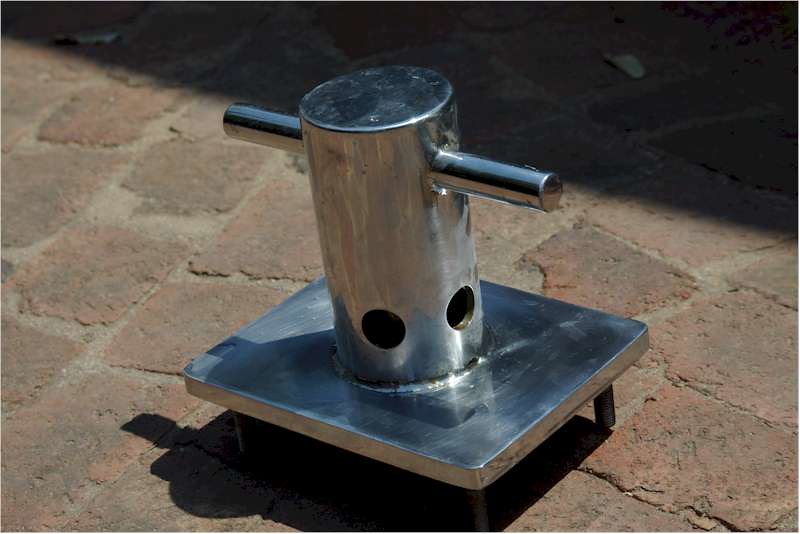
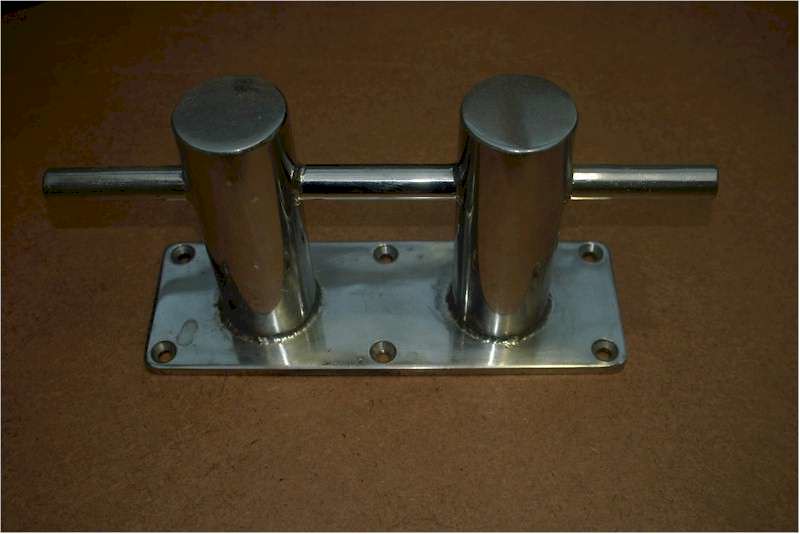
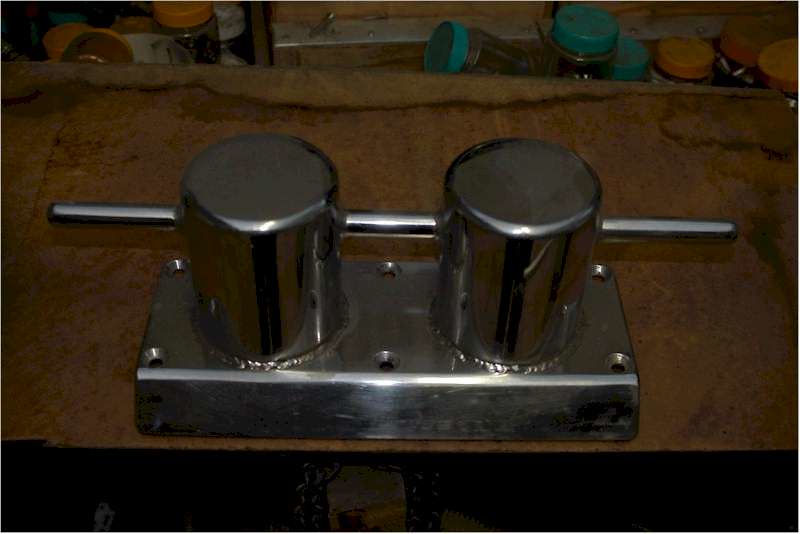
This pic as one of my mooring cleats shown partially at the top. This was made of 3 pieces of 18mm stainless bar and a flat bat with 2 16mm dia holes for bolting on.

It took me longer than 5 minutes to cur the 18 mm dia bar with a bench cut off disc grinder. Not hand hended. and my be 10 minutes to stick weld but the longest job was drilling the 16 mm dia holes in 6 mm thick stainless with no polishing

36086312575_d62603151e_b.jpg


35953247111_b79793baca_b.jpg


2 clears at top of pic. The mild steel anchor turning link is 25 mm dis and bent by heating with oxy-acetylene torch.

These types of cleat bollard thai I generally make for mooring cleats would take much much longer than 5 minutes being sched 40 tube 6 mm or 3 mm ss plate and 16mm dia bar. All hand polished and tig welded.

35953149321_821bb2c8af_b.jpg


36086123445_e47a57df83_b.jpg


35696465420_e315e98035_b.jpg


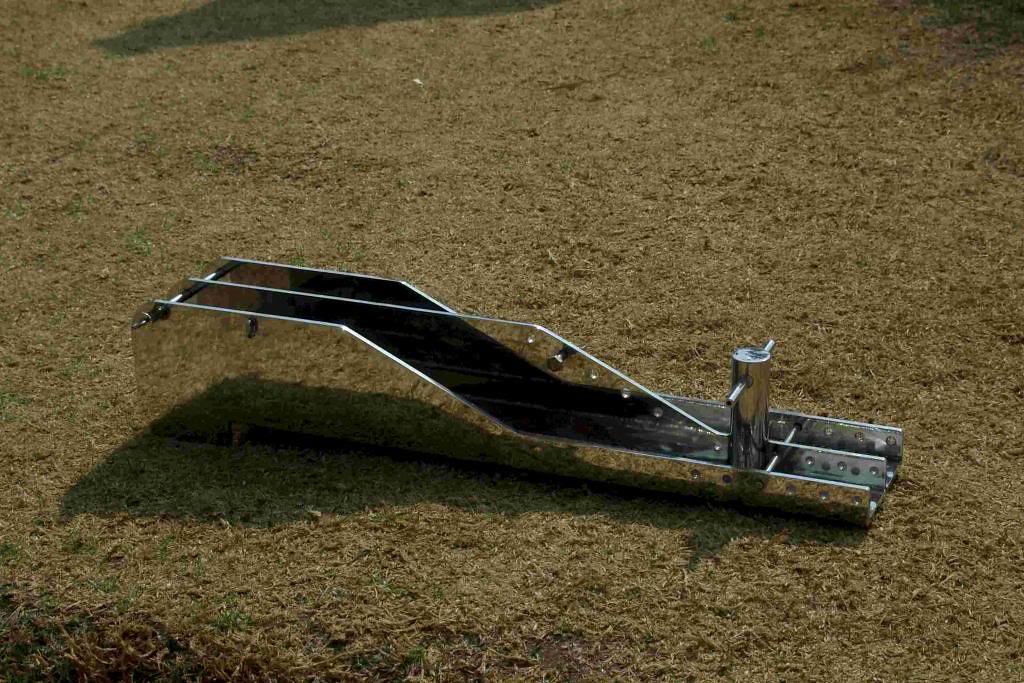
I would also like Brent to estimate how long it take him to make a bow roller fitting like this

36086147765_b8aac6b96e_b.jpg


35953186271_c38506666b_b.jpg


Being a steel fabricator yourself, time to manufacture depends on complex ability, quality of workmanship and skill.

It can take longer to prepare a but joint for welding than the welding itself and a properly prepared joint is needed to ensure proper penetration and joint strength.

I suppose someone could assemble a steel boat hull in the time Brent claims but what would the quality of the welds and the fair shape of the hull be.
 
Brent, how do you tackle the stern gear arrangement? Is it bolt in or weld in? Do you just let a tube in to the hull? Genuine question, not trying to catch you out, interested in a simple low tech approach.
Also you mentioned somewhere about your prefab method of construction of superstructure/ topsides. How do you ensure a good fit when you offer it all up, or do you just adjust/grind/gas axe as you fit? What kit do you use to cut the plates, gas I am assuming? Do you spend ages making the faces good before welding, or do you get a clean enough cut in a straight enough line? Fascinated to hear how it is done "in the field" so please do tell. But let us know what goes wrong, what does not work so well, and where mistakes are easiest to make, that is all genuinely useful. A lot of steel narrowboats still get built here, some of them are not hugely dissimilar to your "origami" concept. I have helped out a couple of local fellows and companies with internal steel fitments but never got involved before in the hulls. No, I am not thinking of taking up steel yacht cobstruction, as I said before, the figures just dont add up here, and I am winding down from work work work to pottering and sailing now ;-)

I just fit and weld in a sch 40 pipe. I used to use stainless ,but oxygen starvation corroded a couple out( not much oxygen that far up a stern tube on a single keeler ) Now I use mild steel, with ss on the ends.
I fit a 1/8th inch standard pipe thread in the stuffing box, or the stern tube, hooked up to a grease gun, to let me pump grease into the stern tube any time. That eliminates the corrosion problem.
On the inboard end I fit a doubler plate around the stern tube, a tight fit to the hull. That lets me take it out and fully weld the stern tube to it. That makes welding the doubler to the hull a far easier weld to get watertight. On the stern bearing end, I cut a couple of 1/2 inch by 1/4 inch slots, to let me tap the stern bearing out with a centrepunch, without removing the shaft. I have replaced the stern bearing with the boat in the water, no problem.
On the hull, any outside curve is easy to pull together, concave nearly impossible. On single chine hulls, some back yard builders have been inches out, with no negative effects on the finished boats. Multi chine are far more critical.
Most have been cut with the torch, some with plasma. On the last one we used steel cutting circular saws. Beautiful cuts, like those done with a milling machine. One blade was good for about 35 feet of 3/16th plate , costing less than the cutting gas , if you also count the time saved. I hear they can be resharpened.
 
Last edited:
Brent does need to explain how he can make items so quick.

I was interested in his statement that he cam make a cleat in 5 minutes.

I can make a simple horn clear from 8mm or 10 mm dia rod by cutting the rod and bending in my bending machine. It would han no bolt on fixing so would have to be welded on amd no polishing as that would take a great deal longer then 5 minutes to hey a reasonable quality polish.

This pic as one of my mooring cleats shown partially at the top. This was made of 3 pieces of 18mm stainless bar and a flat bat with 2 16mm dia holes for bolting on.


It took me longer than 5 minutes to cur the 18 mm dia bar with a bench cut off disc grinder. Not hand hended. and my be 10 minutes to stick weld but the longest job was drilling the 16 mm dia holes in 6 mm thick stainless with no polishing

36086312575_d62603151e_b.jpg


35953247111_b79793baca_b.jpg


2 clears at top of pic. The mild steel anchor turning link is 25 mm dis and bent by heating with oxy-acetylene torch.

These types of cleat bollard thai I generally make for mooring cleats would take much much longer than 5 minutes being sched 40 tube 6 mm or 3 mm ss plate and 16mm dia bar. All hand polished and tig welded.

35953149321_821bb2c8af_b.jpg


36086123445_e47a57df83_b.jpg


35696465420_e315e98035_b.jpg


I would also like Brent to estimate how long it take him to make a bow roller fitting like this

36086147765_b8aac6b96e_b.jpg


35953186271_c38506666b_b.jpg


Being a steel fabricator yourself, time to manufacture depends on complex ability, quality of workmanship and skill.

It can take longer to prepare a but joint for welding than the welding itself and a properly prepared joint is needed to ensure proper penetration and joint strength.

I suppose someone could assemble a steel boat hull in the time Brent claims but what would the quality of the welds and the fair shape of the hull be.

By cleat, I meant 2 uprights and one horizontal bar, the kind you pay $40 each for in a chandlers. 5 minutes seems a long time for 6 inches of weld ,or preparation. You must be being paid by the hour!
TIG is painfully slow, and unforgiving, compared to stick welding.
Polishing is something you do after heading out cruising, in some peaceful anchorage ( only if it still maters by then. Usually it doesn't. Priorities change, once you get away from "marina one-upmanship!")
Anything like cleats, which can be welded down, should never be bolted down.
The welds have never broken, even in some extreme torture tests.
Origami leaves the hull totally fair, with no need for any filler, of any kind ( the opposite of traditional, framed construction).
Those tiny tig welds look like a lot less metal thickness than the material the bit or base plate are made of. Reminds me of a broken bob stay tang someone posted a picture of, on which the tig weld looked like 1/32 of an inch of weld metal holding 1/4 inch plate ( a very common screw up with tig welding).
That is why they fail so often. People mistake shiny and smooth for strength.
 
Last edited:
Claiming that your '40 years of living on board a steel boat' trumps everyone else experience and makes your opinion right doesn't really wash. There are some hugely experienced sailors on these forums and you aren't being very respectful of their experience and opinions.

Brent, show me the post where anyone has said that a fire can burn without oxygen.
Definitely trumps the experience of anyone who has never owned, built , lived aboard or cruised extensively in any STEEL boat, when it comes to the subject of STEEL boats.
NO , PLASTIC boat experience does NOT make one an expert on STEEL boats.

The suggestion that you can't put a fire out by stopping all oxygen, IS the suggestion that a fire can burn without oxygen.
The suggestion that a fire can be come an inferno, with all oxygen sources shut off, IS the suggestion that a fire can burn without oxygen .
 
Definitely trumps the experience of anyone who has never owned, built , lived aboard or cruised extensively in any STEEL boat, when it comes to the subject of STEEL boats.
NO , PLASTIC boat experience does NOT make one an expert on STEEL boats.

The suggestion that you can't put a fire out by stopping all oxygen, IS the suggestion that a fire can burn without oxygen.
The suggestion that a fire can be come an inferno, with all oxygen sources shut off, IS the suggestion that a fire can burn without oxygen .

When a thread has run its course we let it die.
 
When a thread has run its course we let it die.

Meaning, when your argument falls flat on its face ,and cant stand the challenge of reality, it should not be challenged by reality?
When dangerously misleading falsehoods could become a matter of life or death, we have a moral obligation to expose them as the dangerous falsehoods which they are.
 
I've not been able to identify any suspects from that description. I've seen Smackdaddy posting on SA but haven't paid enough attention to him to form an opinion. Bob Perry is a professional yacht designer of many years (decades) standing and appears well respected for his expertise in the bear pit of SA. He posts his own drawings quite frequently. I'm not surprised he has challenged you coming from the point of view of having to do a lot of calculations for his own designs.

I suspect you are Smackdaddy, under a different alias.
Bob Perry is strictly a rich mans designer, who ridicules any suggestion of how to deal with the two biggest hurdles facing not so rich, wannabe cruisers, time and money, and consistently does everything possible to throw roadblocks in their way. He charges $175 an hour for advice on that which he has no hands on experience in; ocean cruising, steel boat building, maintaining, and living aboard . He has admitted to hating steel boats, and and does anything he can to make any steel boat a failure .

I recently saw one of his 37 ft steel boat designs , fully framed, with 1/8th inch plate, weighing 36,000 lbs, according to the owner. Perry calculated it at 27,000 lbs, a 9,000 lb screwup. He calculated my size, from photos , as 5ft 5 and 145 lbs, which he said is 'Very accurate." Actually, I am 6ft2 , and 220 lbs, an error of 9 inches and 75 lbs, math skills he charges $175 an hour for.
(Making him the laughing stock of anyone who has, or will ever meet me.)
He also claimed to have designed the Amazons ( A Graham Shannon design, which he had nothing to do with).
He has a great eye for aesthetics ,and says some builders seek only a set of lines and a sail plan from him , knowing his lack of hands on experience means they can do better job with the rest. He is an excellent source of a very expensive set of lines and a sail plan for a plastic boat.
His latest project is a series of 4 carbon cutter, 37 footers, costing a million dollars each, completely irrelevant to the majority of cruisers.
Given that not many would pay a million dollars for any used 37 footer, regardless of what it is made of, the 'Resale value" of such boats represent a 3 million dollar loss. Not the best source of advice on "resale value."
His older used boats can be good cruisers, if you avoid the ones covered in teak pretentiousness. His newer rudders, and other design features are nowhere near as good as those on his older designs.
 
Last edited:
Status
Not open for further replies.
Top