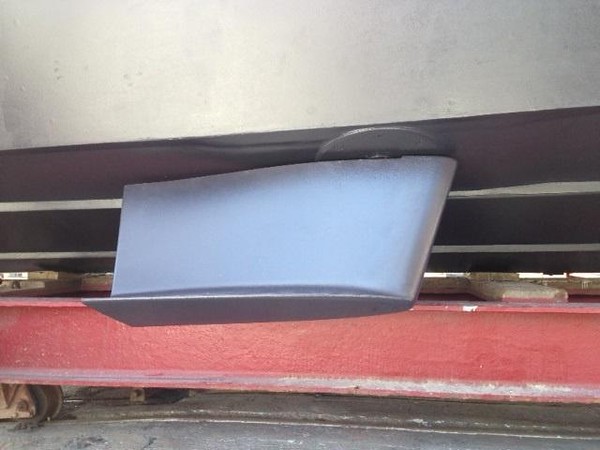
Stabilizers for Blue Angel, engineering question

B, what's your impression on the w/tight compartments which I guess you've seen on some SL boat?

yes I more or less agree with your post regarding the breaking loads #377,
because a grounding or hitting a object can be a complex impact, difficult to accurately predict the details of the forces,


but looking again at the drawings and this 70mm GRP platform fixed between some Rigid frames and stringers,
and the continuation of the metal flanges of the drives that I've seen with my own eyes;
in the event of a severe impact;
appart from some serious damage to the GRP structure, I could imagine that the weakest point is "one" segment of the fin shaft , with the smallest diameter
(right on the edge of the gear) will breack off
but perhaps a lot is depending how good the lamination is of the different GRP structures, and extra layup

now regarding boxing the drive,

when such a box is big enough, reaching from frame to frame,
in case of an impact,
the box will probably be damaged,
but probably stay partially intact, and slow down the flouding of the boat,

but actially I don't care too much, as I have just installed two brand new life rafts :)

no seriously, I'm not yet sure about the boxes, (details to be discussed later...)


(all imho, feel a absolute novice in this respect)
 
Last edited:
But CMC motors are supposed to be much more quiet than the hydraulic actuators, so maybe it's worth trying them first, and eventually do something afterwards...?

Remembers me to one of your questions about the listing of the boat with uneven left / right weight distribution (fe fuel tanks not equally levelled)

CMC electric stabs have NO absolute heel angle measurement sensor, (not enough accuracy)
They have 3 dimensional rade gyro’s ( exact model taken from a military missile app.)
So the heeling measurement is alway’s “relative”.
Therefor in case of listing you can introduce a +/- offset of list on the remote control panel.
So yes, the system can take care of such a listing as in your example.

In that other example, when the boat makes a huge long turn;
because the listing movement is slow, and because the sensors detect a change of heading direction of the boat, the algorithm reacts accordingly to this,
And the boat will be heeling as if it would do without stabs, or the heeling will be reduced only slightly,

Regarding that mechanical brake,
Actually it is a mechanical brake that engages when there is no power supply, and disengages by a 24V DC voltage. This 24V signal is controlled separately from the main control system and separate from the main supply voltage 230V. (independent 24V supply)
On the fin shaft is a “absolute position” rotary encoder, and this detects if the fin is in a zero position so that the brake can be engaged.
There is another movement encoder on the electric motor, there is a gear of approx. 1/110 between the electric motor and the fin shaft,
so a 110 times more accurate measurement is used for the fin movement processor.
 
Last edited:
Pleased to report that the installation is finished successfully
After a few very intense and stressfull weeks,
today we have started our holiday on the boat with my own family.

The yard estimated 2 weeks work for the hull reinforcement, but actually they used the full 2 weeks and a half of extra time I had counted for.
Just the last two day’s before my daughters proclamation (she became a teacher)
Were left for installing the drives, launching the boat and commissioning the system.

And if I had not spend most of my time in the yard the last 4,5 weeks, (and travelling back home a few times) the installation would not have been finished by now. (mainly due to bad management)

At the end I’m pleased with the work,
Despite the proposal from the yard, examples of Italian yards, and confirmation of the naval architect to use a cored addition on the hull,
My own preference was to use a multiple layers solid GRP addition, because of the “non” perfectly flat base surface, and because of the more solid construction, and because of the advice gained on here.
Luckily the yards GRP subcontractor agreed with my view eventually.
Although I had big questions about their approach and management of the work, (who am I in that respect!?)
I believe the end result is good, (they used vacuum bag method to fix the external extra layers….)

First week in the yard, my guy’s prepared the complete wiring, including a new electric switch board, all finished in a few day’s , a long time before the finishing of the hull reinforcement.

Last Wednesday we launched the boat and did the first sea trial with the CMC engineer (in almost perfectly flat sea)
apart from a missing GPS signal all seemed OK. Problem was cured with a separate new GPS mushroom)
unfortunately we only had a very short sea trial time, as my daughters proclamation on Thursday evening was much more important that anything else ;-)
yesterday I travelled the boat from the yard in Sanary back to Toulon, in a F4-F5, at both 10 and 20kn and can and only report that the result with the stabs is amazing !
then in the port, there is a frequent annoying swell from the tourist side seeing boats which are allowed to cross the port at semi displacement speed,
and despite the fact it’s not recommended to use the stabs on a mooring, swmbo was pleasantly amazed with the behaviour of the stabs “on the mooring”
A happy swmbo is probably the best thing after having spend about 75Keuro on the stabs.
For me the best news is that:
when I travelled to the yard 5 weeks ago, I sailed at 2000RPM, speed was 19…20kn
and now on the return trip, with a sand blasted hull, and polished props, BUT with the drag of the stabs, at 2000RPM speed of the boat was 19…20 kn.

Will post a more detailed report later with more pics, when I find time and energy,
Also on the behavior and testing, lots more experience to be gained…..
first a few day’s relaxing (mostly mentally),

i-kfqfgKm-L.jpg


i-VsZ4Zxh-L.jpg
 
Last edited:
Bart, sounds like a great result, fantastic! Even better that SWMBO has approved the mods. Sounds like no significant increase in drag at the moment.
Oh and many congratulations on your daughters success too. Proud Dad no doubt. :)
 
Well done Bart, I was wondering why we hadn't heard from you for a while. It looks like the investment and stress might have been worthwile. As you say a happy SWMBO is worth millions:) Look forward to full report and maybe a video (?)
 
+1 on what the others said :D

looking fwd to the detailed report, original grp thickness, new layup thickness, bits removed, bits added, heat builtup (if any) and detailed report on behaviour.

cheers

V.
 
Congrats Bart. A great up grade.

Have you boxed the stab drives in yet? And I guess the heat from the electric motors turned out not to be a non-issue?
 
Have you boxed the stab drives in yet? And I guess the heat from the electric motors turned out not to be a non-issue?

the stabs are nicely boxed in the bottom drawer of the master cabin cupboard, :-)

no I don't think I will ever box them,
they are fixed on a 8cm thick solid piece of GRP > 1m2 nicely joined on adjacent frames , stringers , spray rails and hull sides, so that if I want a box for extra security,
I would need a big box, ...... and complete new furniture in the master cabin,

now the drives are nicely hidden under the side cupboards, we've only lost one drawer on each side,
so I believe all will remain as it is now...

the heating is indeed a non issue,
the electric motors can get hot in a certain area, but they are designed for that,
and will probably never get as hot as in a industrial application.
Most CMC systems are boxed, and none of them has a heating issue,
mine are not boxed, the rear of the cupboards is open, / airgap with the hull sides, a lot of air volume around them...
 
actually they used the full 2 weeks and a half of extra time I had counted for.
LOL, you obviously know the golden rule of pleasure boating: always expect that any planned job will take longer, be more expensive, and the result won't be up to the expectation.
It seems that here you managed at least to avoid the latter, and that's a very good result indeed! :D

I'm curious to hear more about the reasons for using infusion for the external layers.
I would have thought it wasn't worth, for such a small surface...

Oh, and congrats to your daughter!
 
Congratulations Bart. I'm sure you'll love them, especially when you have done a few more miles and also tried some really big seas. Fabulous job. I'm glad you insisted on solid GRP not cored.

It sounds like you had a tough time on the "project management" part - I can imagine -well done in getting it done!

Vacuum bagging sounds like a proper job, becuase it is hard to make a neat well compressed lay up when working upside down. Did they actually infuse the resin, or did they just apply a vacuum bag over the wet layup to compress (but not infuse) it?

It is nice to see the top of the fin so close to the hull, made possible by the absence of a reverse chine of course. That will improve the effectiveness of the fins. Looking forward to further reports!

And congratulations to your daughter :D
 
By the way, we used Match2's stabs on Saturday night and had a bit of an near miss. A+K, and EME/Targa50, and DME were on board, in Villefranche, anchored late in the dark having dinner. There was zero wind but quite a big swell, so I had the at anchor stabs on and they were working hard. They make the boat swim forwards, but I'd forgotten this. Normally you don't notice becuase the wind keeps the boat hanging on the anchor chain, but in a night with zero wind the boat definitely swims forward.

Anyway, we were having dinner then we heard a "chink chink clink clink" noise, repeatedly. And a bit of shouting, erk. We had not noticed, becuase of the distraction of lovely wine from our guests plus a €48 chocolate cake from the new chocolate cake shop in Antibes, but we were driving (swimming) at 0.25kts into the back of a Ferretti 731 whose occupants were having dinner and looking at the bow of a s78 about to smash their chocolate cake (which I gotta say, wasn't as nice as our chocolate cake) and they were bashing our pulpit with their boat hook pole to get our attention.

A quick apology and burst of main engine reverse saved us all from any proper trouble, sheesh, but there is a lesson in here about fins when there is swell but no wind! :D
 
Vacuum bagging sounds like a proper job, becuase it is hard to make a neat well compressed lay up when working upside down. Did they actually infuse the resin, or did they just apply a vacuum bag over the wet layup to compress (but not infuse) it?
Doh! I didn't consider that, when I posted my previous question to Bart.
It might well be that they only used vacuum for better resin compression.
Still curious to hear what Bart will tell us about that, anyway.

LOL, the near miss story is funny indeed.
Talk about coincidence, the boat in front had to be gyro stabilized and hence not affected by the fins-induced thrust...! :D
 
Talk about coincidence, the boat in front had to be gyro stabilized and hence not affected by the fins-induced thrust...! :D
Yup, and the performance of her Mitsu stabilisers honestly looked about 50% of my fins. She was rolling less than the other non stabilsed boats in the anchorage, but it confirmed my view that Mitsus are not really worth it. For gyros, it has to be Seakeepers, imho.
 
JFM, Congrats on a cracking M2. Could your stabs be programmed to swim backwards after having swum/moved a few feet forwards?
The programming is easy but I dont think that's possible in terms of the water physics. Or am I missing something? How do you scull backwards in a sculling boat on the river, for example?

At least that's the case on a hydraulically stabbed boat. On Bart's electric-stabbed set up it might be possible to flip the fins 180degrees every minute, and then resume stabilisation the usual left-right swing, so sculling backwards for 50% (or 100%?) of the time

Perhaps you have just discovered a major advantage of electric over hydraulic LOL!
 
Last edited:
I thought the hydraulics went nearly all the way round no? Well there you go, there seems to be a USP for each type of stabilisation technology out there.
 
I thought the hydraulics went nearly all the way round no? Well there you go, there seems to be a USP for each type of stabilisation technology out there.

I'm sure hydraulics can only do a segment, and my electrics can do a full circle,
hey jfm inventd a nice app for that, but I'm afraid he nor cmc will earn a lot from this :)
 
Top