

You are using an out of date browser. It may not display this or other websites correctly.
You should upgrade or use an alternative browser.
You should upgrade or use an alternative browser.
Stabilizers for Blue Angel, engineering question
- Thread starter BartW
- Start date
BartW
Well-Known Member
Sounds like it was all worthwile, Bart, even though it seems to have been a stressful experience! Have you noticed any reduction in boat speed? General question to you and other boaters with fin stabs. Are you concerned about swimmers in the water getting to close to the fins when you are using them at anchor?
absolutely Mike !
seriously, you're invited to experince yourselve...
as posted in another thread, the speed loss at equal RPM is un-noticeable (less then 1kn at planing speed)
difficult to compare accurately, as the hull is sand blasted during the stab fitting.
Re. swimmers (and divers !) getting to close
I give a clear briefing about that to my guests, and usually (not alway's) switch off the stabs when many fols are swimming
I never had swimmers from other boats coming so close, but can imagine that this could happen,
but as others have sayd, there are quite a few riscs for swimmers around boats, not only the stabs,
a notice on the hull site is ofcause good practice.
again and again I'm surprised how "UNsafe' some people even MY captains act in or around their boats...
I do my best to behave as safe as possible.

Nick_H
Well-Known Member
as others have sayd, there are quite a few riscs for swimmers around boats, not only the stabs
That's true, but of course you wouldn't run your propellers at anchor whilst people swam around your boat, and it's quite obvious that a boat bouncing up and down in a swell is a hazard. It wouldn't be at all obvious to most people though that swimming up to the side of a boat could be dangerous, so I think jfm is wise to put the warning stickers on the side, and anyone else with at anchor fins should do the same.
It wouldn't at all put me off having them though, and it sounds like you've had a great result with the installation Bart. I haven't regretted fitting the gyro for a second, and it's nice to have one thing in life that's stable!


MapisM
Well-Known Member
It could actually be even worse, coming to think about it.It wouldn't be at all obvious to most people though that swimming up to the side of a boat could be dangerous
I experienced first hand that the fins are a sort of attraction for young boys snorkeling around the boat, to the point of playing with them, because you can actually move them manually (in my boat, at least) when the system is not working.
I do the same myself occasionally, to clean some fouling between them and the hull, every now and then.
Of course, that's not risky at all when the stabs are NOT zero speed, and the mains are turned off.
But with zero speed stabs, it's possible to envisage a scenario where the system is working but the fins are moving very gently - or not at all - because there's no swell.
Anyone not aware of how the things work might think that it's safe to swim near them, possibly just to have a closer look.
And suddenly, out of nowhere, the fins move at their max speed/angle to absorb a navigation wake... Go figure.
It's a worst case scenario of course, and I'm not suggesting to not fit/use zero stabs for this reason alone - far from that.
Just some food for thought.

Portofino
Well-Known Member
Wouldn't, we have heard about an " accident " by now?
Like the annual few folks who get chopped up by the props on ribs ( when tossed out without attaching the kill cord)
Happens year after year .Or the water skiers getting chopped up by props - prop guard debate
Not heard about stab accidents with swimmers ----- Yet!
Like the annual few folks who get chopped up by the props on ribs ( when tossed out without attaching the kill cord)
Happens year after year .Or the water skiers getting chopped up by props - prop guard debate
Not heard about stab accidents with swimmers ----- Yet!
MapisM
Well-Known Member
Well, the number of spinning props around is well above the number of stab fins, surely?
Not to mention that you don't need to swim towards a rib intentionally, to be hit by its prop!
Not to mention that you don't need to swim towards a rib intentionally, to be hit by its prop!
MapisM
Well-Known Member
Ok folks, there is an interesting update for this thread.
Well, I hope it is of some interest. The experience surely was for myself, anyway.
I've been onboard BA with BartW in the last few days, and I already had the opportunity to appreciate the added value of the newly installed electric stabs, both while cruising and at rest.
But today we went out for a sea trial with the founder of CMC (the company which builds the stuff) and one of his engineer, to test a firmware update and take the opportunity for a bit of fine tuning.
So, I made some clips to give an idea of the result - see below.
A few remarks to better understand the video:
We went just out of Port Vauban in Antibes, not far from the coast but in totally open sea.
Great weather and reasonably calm sea, with just a gentle swell, but more than enough to swear that I would have never even considered to overnight at anchor in similar conditions.
Therefore, it's fair to say that if the stabilization at rest is good enough for those conditions, it's good enough for just about anything.
The video starts with the stabs turned on, but at the very beginning they were stopped.
At 18 seconds, they were turned on again.
I suspect that if they would have been kept off for a longer period, the rolling would have gradually got even worse, but I think you get the idea, anyway.
As side comments, I can confirm that I was able to keep a hand on the motors after the stabs had run for a whole day at rest.
They do get warm, but I very much doubt that any hydraulic system doesn't get comparably warm, or possibly even warmer.
And that's when working at zero speed. After a 6 hours or so cruise from Toulon to Theoule at displacement speed (which is obviously the cruising condition where the stabs work more, compared to when the boat is planing), the motors were dead cold.
Bottom line, don't ask me why, but temperature is obviously a non-issue with this system.
These CMC folks are definitely into something, with their electric stabs.
I wouldn't be surprised if in 10 years we would laugh at the idea that boat stabilization began with hydraulic systems.
...ok, enough for now, I must get my coat before jfm will see this post!
Well, I hope it is of some interest. The experience surely was for myself, anyway.
I've been onboard BA with BartW in the last few days, and I already had the opportunity to appreciate the added value of the newly installed electric stabs, both while cruising and at rest.
But today we went out for a sea trial with the founder of CMC (the company which builds the stuff) and one of his engineer, to test a firmware update and take the opportunity for a bit of fine tuning.
So, I made some clips to give an idea of the result - see below.
A few remarks to better understand the video:
We went just out of Port Vauban in Antibes, not far from the coast but in totally open sea.
Great weather and reasonably calm sea, with just a gentle swell, but more than enough to swear that I would have never even considered to overnight at anchor in similar conditions.
Therefore, it's fair to say that if the stabilization at rest is good enough for those conditions, it's good enough for just about anything.
The video starts with the stabs turned on, but at the very beginning they were stopped.
At 18 seconds, they were turned on again.
I suspect that if they would have been kept off for a longer period, the rolling would have gradually got even worse, but I think you get the idea, anyway.
As side comments, I can confirm that I was able to keep a hand on the motors after the stabs had run for a whole day at rest.
They do get warm, but I very much doubt that any hydraulic system doesn't get comparably warm, or possibly even warmer.
And that's when working at zero speed. After a 6 hours or so cruise from Toulon to Theoule at displacement speed (which is obviously the cruising condition where the stabs work more, compared to when the boat is planing), the motors were dead cold.
Bottom line, don't ask me why, but temperature is obviously a non-issue with this system.
These CMC folks are definitely into something, with their electric stabs.
I wouldn't be surprised if in 10 years we would laugh at the idea that boat stabilization began with hydraulic systems.
...ok, enough for now, I must get my coat before jfm will see this post!
davo99
Well-Known Member
Not having lots of hydraulics running through the boat nor the mass of a gyro I can see electric stabs making their way down the sizes fairly rapidly
newWave
Well-Known Member
Amazing, looks like death calm when they are turned on.
It would be nice to have BA and Match side by side in the same conditions and do the test.
Any change you guys could arange that ?
It would be nice to have BA and Match side by side in the same conditions and do the test.
Any change you guys could arange that ?

Bojangles
Well-Known Member
Very impressive, I did wonder wether the roll at the start was caused by the crew running for the volume to silence Gary Glitter..
D
Deleted User YDKXO
Guest
Very impressive. Is Mrs BartW still satisfied?
MapisM
Well-Known Member
It's not up to myself to answer your question of course, but I would think it's very hard to arrange a test with any sort of "scientific" reliability.Amazing, looks like death calm when they are turned on.
It would be nice to have BA and Match side by side in the same conditions and do the test.
Any change you guys could arange that ?
The two boats are similar in size and weight, but they are still very different hulls anyway, and quite likely with different weight distribution, roll period, etc.
Besides, at the end of the day, from the user perspective what really matters is that the equipment does it job.
Which I'm sure is true for both Match and BA.
It's mostly the sheer simplicity of the electric equipment which I've been very impressed with.
MapisM
Well-Known Member
LOL, yeah, can't say I like him either, though I did add the soundtrack.Very impressive, I did wonder wether the roll at the start was caused by the crew running for the volume to silence Gary Glitter..
Just thought that the hard rock rythm was appropriate with the boat rolling...
Hope you appreciated Mario Berger's guitar, otoh!

BartW
Well-Known Member
Is Mrs BartW still satisfied?
last week she was still very satisfied, also about the stabs

this week I have to manage without her unfortunately, but on the other hand,
I'm blessed with a Italian chef onboard !
(mss MapisM)
D
Deleted User YDKXO
Guest
I'm blessed with a Italian chef onboard !
As they say
Heaven Is Where:
The Italians are the chefs
The Belgians are the lovers
The British are the police
The Germans are the mechanics
And the Swiss make everything run on time
Hell is Where:
The British are the chefs
The Swiss are the lovers
The Belgians are the mechanics
The Italians make everything run on time
And the Germans are the police
MapisM
Well-Known Member
Oi, our onboard chef is actually pretty accurate also with dinner timing, not just quality.The Italians make everything run on time
It's a matter of priorities, you know...

BartW
Well-Known Member
Before I post pics and a story in the BA rebuild thread of the works about fitting the stabs,
here is a final post in this engineering thread, answering a question that was raised long ago, about the hull thickness,
Here is a pic of the plug that came out for fitting the stabilizer drive,
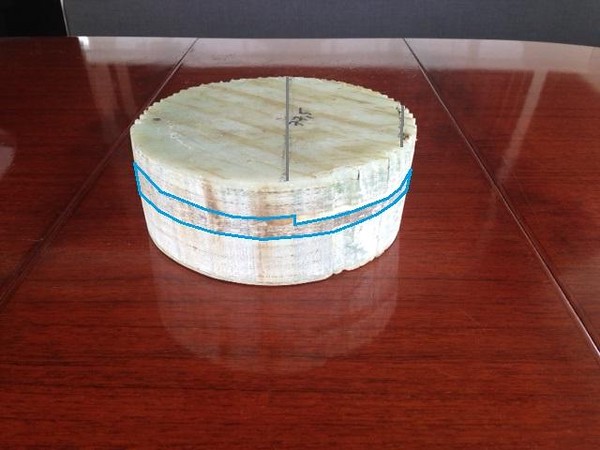
I’ve added that blue line pointing out the original GRP,
The material above and below is the added layers of glass fabric and epoxy, inside (approx. 25mm) aswell as outside (approx. 35mm) the hull,
On top of the plug I’ve drawn 2 grey lines, they show the position where originally was a stringer, made from foam with layers of GRP on top.
This was cut out completely between the 2 frames (900mm).
Below the stringer the original GRP thickness was only 10mm,
The gap that appeared when the stringer and foam was out, was filled with white filler first (visible on the pic)
the extra layers of GRP left and right, and going over the foam, and forming the stringer,
created a hull thickness between stringers of approx 17..20mm, as measured with the knitting tool remember ;-)
Towards the corner to the hull sides, the original thickness was gradually more, going up to about 35mm
and just to be complete; The total thickness of this plug is 77,5mm, and the diameter is 209mm
these drawings just as a reminder about where this plug came out
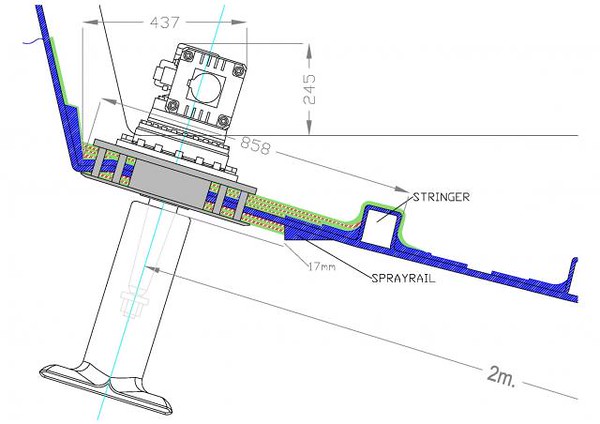

here is a final post in this engineering thread, answering a question that was raised long ago, about the hull thickness,
Here is a pic of the plug that came out for fitting the stabilizer drive,
I’ve added that blue line pointing out the original GRP,
The material above and below is the added layers of glass fabric and epoxy, inside (approx. 25mm) aswell as outside (approx. 35mm) the hull,
On top of the plug I’ve drawn 2 grey lines, they show the position where originally was a stringer, made from foam with layers of GRP on top.
This was cut out completely between the 2 frames (900mm).
Below the stringer the original GRP thickness was only 10mm,
The gap that appeared when the stringer and foam was out, was filled with white filler first (visible on the pic)
the extra layers of GRP left and right, and going over the foam, and forming the stringer,
created a hull thickness between stringers of approx 17..20mm, as measured with the knitting tool remember ;-)
Towards the corner to the hull sides, the original thickness was gradually more, going up to about 35mm
and just to be complete; The total thickness of this plug is 77,5mm, and the diameter is 209mm
these drawings just as a reminder about where this plug came out
Last edited:
D
Deleted User YDKXO
Guest
Impressively thick, Bart!

jfm
Well-Known Member
Very nice Bart. The new composite looks very nicely compacted. I can remember, but they vacuum bagged it I think. That is why it is so nice
I posted a picture with the diet coke can about 2 years ago but I reckon it was same thickness on my last boat. I think they aimed at 75mm iirc
I posted a picture with the diet coke can about 2 years ago but I reckon it was same thickness on my last boat. I think they aimed at 75mm iirc
MapisM
Well-Known Member
Slightly o/t B, but what about a "new f/b cover for BA" thread?
Not made up your mind yet?
Not made up your mind yet?
