Solar Panels

The cost of 24v fridges is shocking. I am looking now and an under counter that would be £200 for 240v is some £700 on 24v. There are plenty of forum posts on the web re running them on inverters but that seems to not get a good write up ( currentcdraw and efficiency )

we have a Bosch 230V domestic combi fridge freezer in the galley,
and small 230V fridges in every cabin.
our boat is equipped with permanent 230V supply everywhere, via invertor, and would never ever want this different anymore.
get yourself a good invertor from Victron (or Mastervolt)
imo the difference of efficiency between a 24V and a 230V fridge via invertor is neglectible,

a battery monitor will warn you or start the genny when the battery's are discharged below xx %
the big consumers, airco, dischwasher, oven, washing machine, boiler, watermaker are not connected to the invertor power
 
Hi Mike

You say:

I noted the current flow into and out of the batteries.
During the sunny periods, I was getting a net 2 amps (at 24 volts) into the batteries after taking off the ship's background running load (about 12 amps at 24 volts).
During the cloudy periods there was a net drain from the batteries of about 4 amps.

Are you saying that with the Shorepower unplugged, and normal daytime loads running including the fridge freezer, you are only loosing 4 amps during cloudy periods and are actually gaining 2 amps when the sun is out?

If so, I would think a great result that will get better and better as summer moves in, the sunshine hours increase every day and your boat is more directly facing the sun.

That slow but constant incoming current lasting for 15 hours or so a day will go a long way to getting batteries much nearer to 100% full each day, and with the same amount of generator use every day, or even less.

Well done.
 
Hi Mike

You say:

I noted the current flow into and out of the batteries.
During the sunny periods, I was getting a net 2 amps (at 24 volts) into the batteries after taking off the ship's background running load (about 12 amps at 24 volts).
During the cloudy periods there was a net drain from the batteries of about 4 amps.

Are you saying that with the Shorepower unplugged, and normal daytime loads running including the fridge freezer, you are only loosing 4 amps during cloudy periods and are actually gaining 2 amps when the sun is out?

If so, I would think a great result that will get better and better as summer moves in, the sunshine hours increase every day and your boat is more directly facing the sun.

That slow but constant incoming current lasting for 15 hours or so a day will go a long way to getting batteries much nearer to 100% full each day, and with the same amount of generator use every day, or even less.

Well done.

Yep Graham - that seems to be it.
Nothing magic but probably enough to tackle the problem that it was installed for.
 
Shoreline are quite good, they are effectivley marinised Lec domestic fridges I think and have quite a good reputation for energy efficiency and reliability. (No connection etc)
http://www.shoreline-marine.co.uk/

I bought Webasto Isotherm, expensive but they are the only ones who do the Smart energy control which includes a soft start on the motor. helps with load and also noise.

Thanks for that link - much better prices but unfortunately nothing that would fit our situation.
It was worth looking though.
An integrated domestic fridge/freezer (there seem to be lots to choose from) seems to be the best solution yet.
 
The big load is out full height galley fridge freezer.
We are thinking of replacing it next year so I'm looking at domestic fridges and a dedicated inverter.
Aha, ok. For some reason I assumed that you already had a domestic fridge (as also Deleted User has in his F630, for instance), so I discounted that as being out of DC load.

Anyhow, fwiw I agree with your idea. As BartW said, AC fridges are better in principle, and well worth the bit of inverter loss.
Not to mention their cost, as has been mentioned.
I have all 24V fridges ATM on the DP, and it's beautiful Frigoboat stuff (below the galley one, but also others are fully s/steel).
But I pray they will outlive me, 'cause I'd rather not pay for their replacement! :rolleyes: :D
Fridge.jpg
 
Sunny day today.
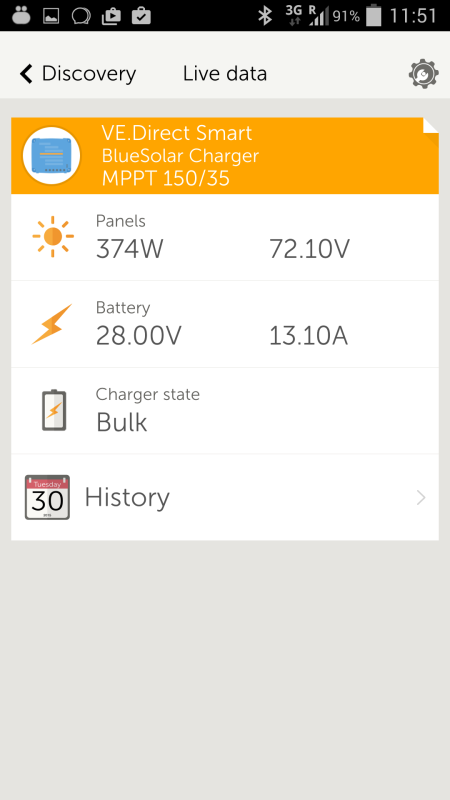
So, I thought you would like to see some screen dumps from the Victron Android App.

Taken at mid day - sun on the stern port quarter so not directly shining on the panels (I estimate the sun about about 50 degrees onto the panels)
The Victron Battery Monitor is showing a positive 2 amps (that is the panels are CHARGING the batteries) plus handling the ships background drain of 10 to 12 amps.

Screenshot_2017-05-06-11-51-56_Small_zps1uxuhbdu.png


I'm thinking that the panels might capture more watts of power if the batteries were more discharged.
This is all "suck and see" kinds of tests.
I just switched the battery charger off at about 10 o'clock to see what it would do so during the above screenshot, the batteries were almost fully charged anyway.

I am hopeful that under normal summer conditions that we will get closer to the published design of 600 watts.
All yet to be seen later in the summer when we "hit it for real"

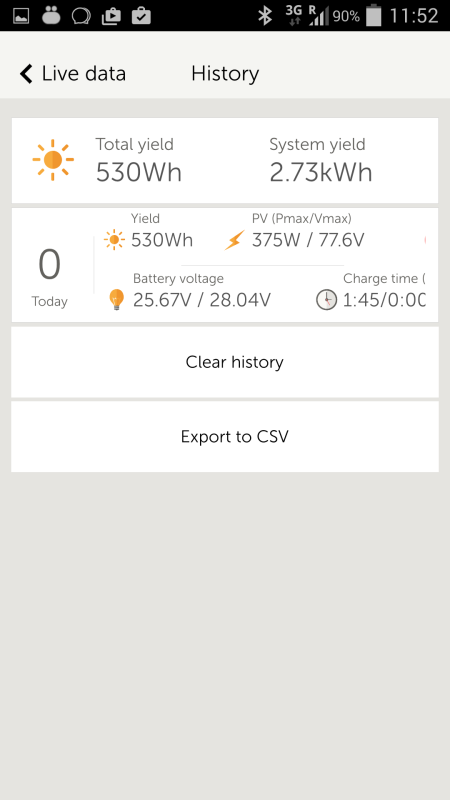
The Victron App also shows a "History" page.
I've still got to work out what all the figures on this page actually mean.
Before I reset it this morning, there was a history of "meaningless stuff" from the previous days.
This is the history page

Screenshot_2017-05-06-11-52-53_Small_zpszmwyyyzr.png


Just thought you might find this interesting.
 
Last edited:
Aha, ok. For some reason I assumed that you already had a domestic fridge (as also Deleted User has in his F630, for instance), so I discounted that as being out of DC load.

Anyhow, fwiw I agree with your idea. As BartW said, AC fridges are better in principle, and well worth the bit of inverter loss.
Not to mention their cost, as has been mentioned.
I have all 24V fridges ATM on the DP, and it's beautiful Frigoboat stuff (below the galley one, but also others are fully s/steel).
But I pray they will outlive me, 'cause I'd rather not pay for their replacement! :rolleyes: :D
Fridge.jpg

Beautiful fridge and as you say looks incredibly expensive but what is in the bottom shelf of the fridge door?
 
Beautiful fridge and as you say looks incredibly expensive but what is in the bottom shelf of the fridge door?
LOL, that's just some beverages - fruit juices and water.
The boat is sheltered and we can't sleep onboard ATM, but swmbo stocked some of her healthy stuff, to drink while we are there to follow the ongoing works.
Just in case that's the reason why you asked, no worries, there's also a wine cooler, aptly located near the p/house, which is going to be filled with more appropriate bottles! :cool:
 
I'm thinking that the panels might capture more watts of power if the batteries were more discharged.
Sounds reasonable, M.
If there's nowhere to either store or use the generated electricity, what would be the point of generating it, to start with? :)
 
The real test is can your solar panels take your batteries up from about 90% discharged (first thing in the morning your genset would bring them quickly up to about 90% after the overnight loads) to 100% during the course of a full day, whilst also powering the normal 24 volt load (fridges, radio, internet router and computers etc) that you would normally have running during a day on anchor. I presume some of those would be powered through an inverter.

Do let us know how that works out.

Graham
 
The real test is can your solar panels take your batteries up from about 90% discharged (first thing in the morning your genset would bring them quickly up to about 90% after the overnight loads) to 100% during the course of a full day, whilst also powering the normal 24 volt load (fridges, radio, internet router and computers etc) that you would normally have running during a day on anchor. I presume some of those would be powered through an inverter.

Do let us know how that works out.

Graham

I think - that time will tell, Graham.

I'll definitely let you know.
 
A word of caution from my own experiences.

Don't expect to get anywhere near to the published 600w output from semi flexibles bonded flat to the roof. The quoted figures are for ideal conditions and with the panels tilted at exactly 90 degrees to the sun etc.

With semi flexibles bonded to the roof (as I have) you'll lose 10-15% straight away because of this, plus you don't have the cooling effect of rigid panels. I checked my single 150w panel at midday in June on a blazing hot day, and the output was nowhere near 150w. I can't remember the figures now but at the time I was quite disappointed.

That said, the real measure is whether they keep up with daytime demand and restore the batteries as well, as has been said. On that score I've been really pleased, the system has been a complete success. This is however at least in part because of the efficiencies I made to the fridge installation.

Usually on arriving somewhere in the afternoon / evening the batteries are fully charged. By the next morning when I look at the kwh consumed overnight, they're down a bit (depending on ambient temp), between 5-10kwh in my case. But the panel has restored full charge to the batteries by about lunchtime, or early afternoon, then holds its own no problem. On some occasions it's fully restored by mid morning, it all depends on the weather at the time (I am in the UK where good weather isn't guaranteed).

The main bonus with it all is the fact that once it's installed it's completely automatic. It just sorts itself out. Every bit of daylight is being usefully harnessed without you having to do anything at all. Silently and reliably. Enjoy!
 
We have just had 3 days in the boatyard so on our return, we berthed the boat with the bow into her berth to finish off the hull A Glaze.
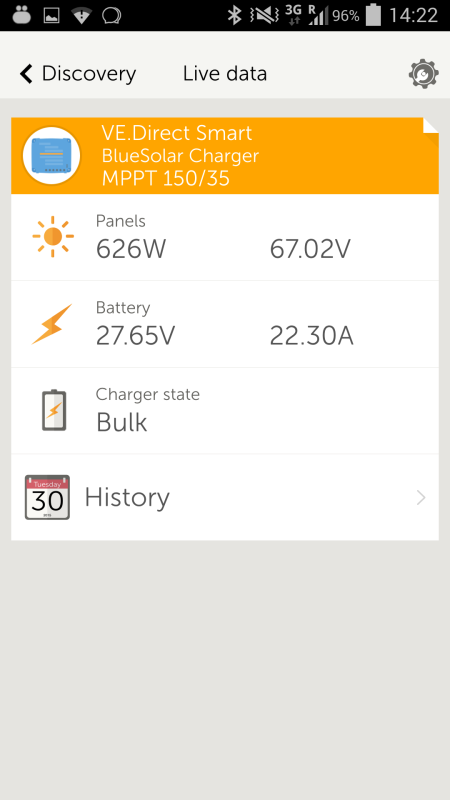
So, yesterday, the panels were south facing and whilst having lunch, I switched off the battery charger and half an hour later this was the display from the Victron App.

Screenshot_2017-05-11-14-22-45_Small_zps5y7bl1ap.png


So, it looks like we can get the full 600 watts (4 x 150 watt) that was specified by the panel manufacturer.

As said before, time will tell if the installation does what it intended to do.
 
As you know you often see higher power output than that rated, but taking average generation cycles we have also observed numerous commercial (albeit larger) arrays over the years exceeding expectations. Results all look good Mike, very promising.
 
Hi Hurricane,

Congratulations for the successful project! Can you inform the roughly cost of the project?
 
Hi Hurricane,

Congratulations for the successful project! Can you inform the roughly cost of the project?

Solar Panels were about £300 each (so about £1200 for 4)
The Vicrton MPPT controller/charger was about £220 - plus about £40 for the bluetooth interface.
£52 for the cable glands
And about £300 for wire, circuit breakers and connectors.
So about £2000 plus fitting
 
Just a quick initial report whilst at anchor in Santa Ponsa.

We arrived in Mallorca last week.
Initially, the weather was overcast and the solar gain from the panels was minimal but ok.
Over the last 4 days, we have had the usual good sunny weather.

We have been charging using the generator for about an hour and a half in the mornings and a couple of times for half an hour through the day whenever we want a cup of tea etc.
During the last couple of days, our Victron Battery Monitor has shown the batteries to be 100% by about 16:00 each afternoon.

So, although I still need to be comfortable, I am very pleased with the results of the solar panels.

The batteries are loving it!!

There are a couple of strange things going on which might be due to two separate charging systems (Mastervolt's Battery Charger and Vicrton's Solar Panel MPPT Charger/controller)
I've set them up with the same criteria but I'm wondering if there is an interaction between each of them and the Victron Battery Monitor.
For example, the Victron Monitor is reporting 100% charge whilst the current display shows charging or discharging and the battery voltage is still very slightly lower than the float/holding charge that we saw before leaving our home berth.
Also, the Victron MPPT Solar controller thinks it is Bulk charging all the time because the boat is drawing a load from it.

However, my initial findings are very encouraging.
To the point that I'm now considering a water maker (we never fitted one to JW because we always ended up in port for a few days during a cruise).
At the moment, we don't have a need to go into port (weather permitting).

All good news.
 
I've only just come across this thread, and like you I am planning to install semi-flexible panels on the eyebrow with the same idea that they would hopefully almost look like windows rather than solar panels

Do you still have photos of the finished look? Because it seems that photobucket have changed their hosting policy and none of your previous photos in this thread are available to view (at least not to me)
 
Very interesting thread. I am determined to bite the bullet and put solar panels on our boat for exactly the same reasons as you set out in your first post. I'm also concerned that our 8kw generator is running far too long at very light loads trying to get the batteries through absorption and into float. Still not sure where to put the panels but they will be 4 No. 150W, same as yours.

You mentioned watermakers - ours is one of the things we turn on to load the generator - and of course keep the boat going when at anchor. It allegedly produces 60 litres per hour when conditions are right although like all marine equipment one looks at specifications with a quizzical eye. Anyway, two or three hours per day seems to be ample for 2 adults on board and the water is better than we get in some marinas. It does seem to be a good bit of kit so I will mention the name: Desssalator . Also attracting attention on the very active Owners Group for our boat is the Schenker brand. One owner reported very recently that the 24v Smart unit is energy efficient enough to run off the solar panels and/or wind generator on his 50' Diesel Duck motorsailer with 800ah 24v bank, and he also says that their customer service is excellent. He didn't say what latitude and climate his boat operates in, but it does sound interesting. Perhaps a new thread if you do go ahead with the watermaker?
 
I've only just come across this thread, and like you I am planning to install semi-flexible panels on the eyebrow with the same idea that they would hopefully almost look like windows rather than solar panels

Do you still have photos of the finished look? Because it seems that photobucket have changed their hosting policy and none of your previous photos in this thread are available to view (at least not to me)

Here are the Photobucket photos from the previous posts that are not now available from Photobucket.
Sorry - just the pics - more updated pics and report later.

Hope this helps

*********************************************************

Here are a couple of pics of our "mock up"

DSC07544_Small_zpsj5injmdu.jpg


DSC07548_Small_zpsebeow2nr.jpg


*********************************************************

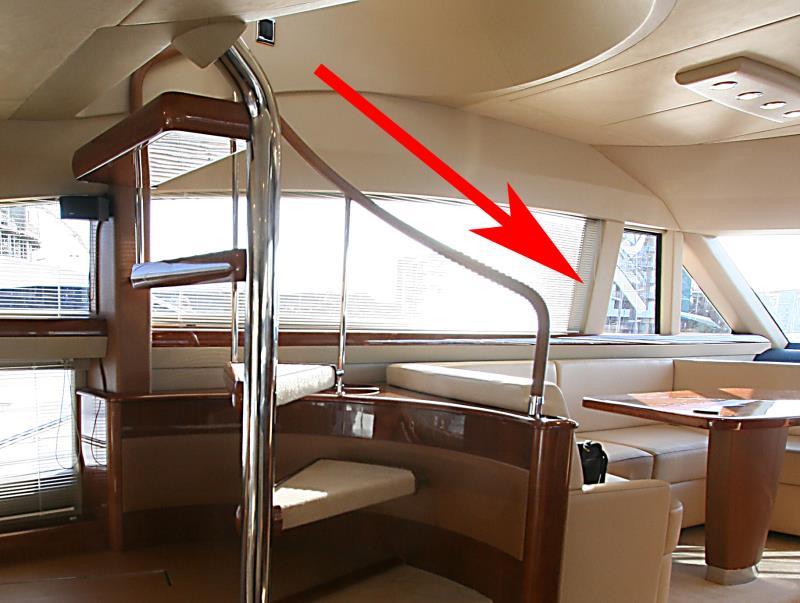
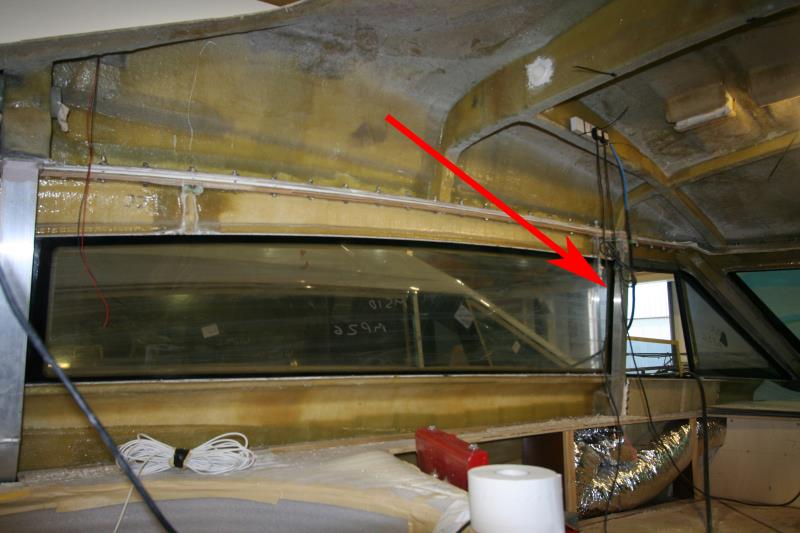
These next 2 pics show how useful photos taken during the boat build in the factory can be.

This is an old photo taken the first day that we saw the completed boat - in Sutton Harbour
The arrow is where I wanted to run the wires for this solar panel project.

solar-window1_Small_zpsvbkh6i3j.jpg


I was fairly sure that there would be space inside the mullion cladding from this shot taken whilst she was still inside the factory.
You can see that the flybridge support is a little narrower than the cladding.

solar-window2_Small_zpscvxrg8mp.jpg


*********************************************************

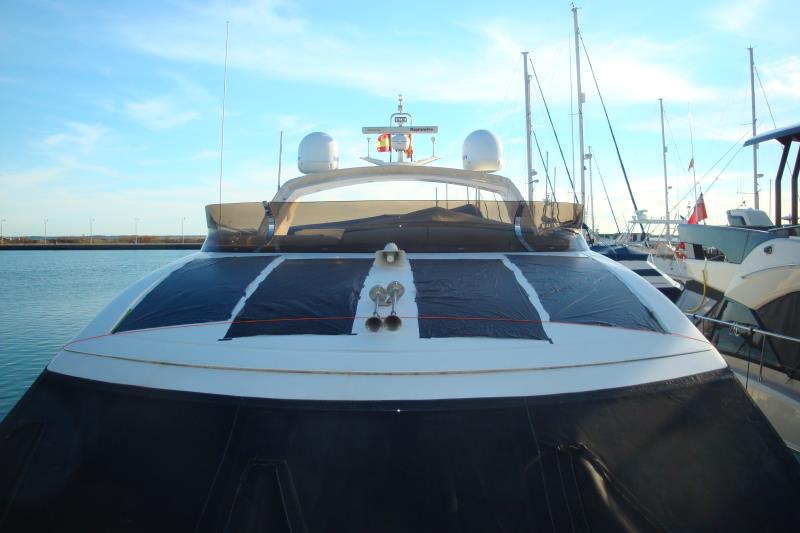
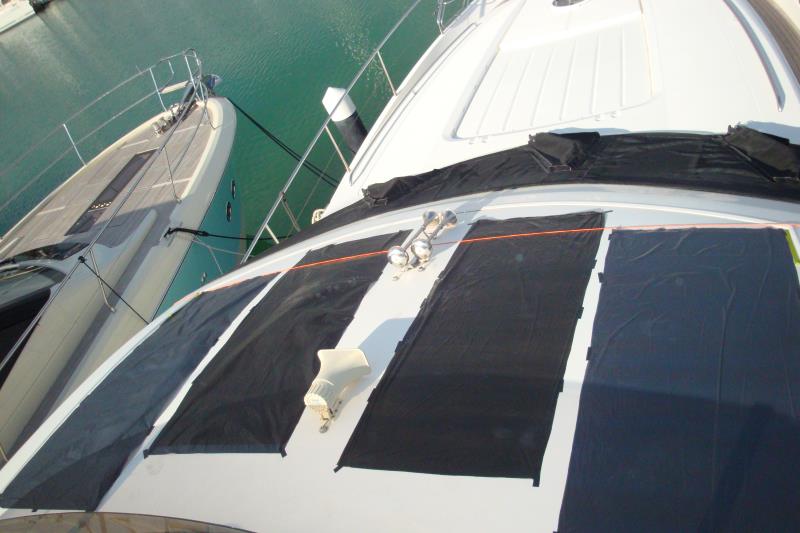
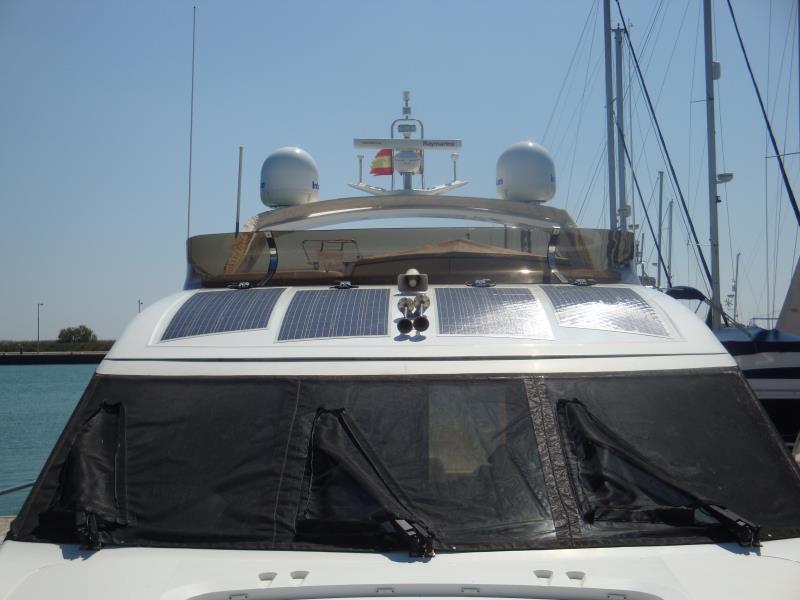
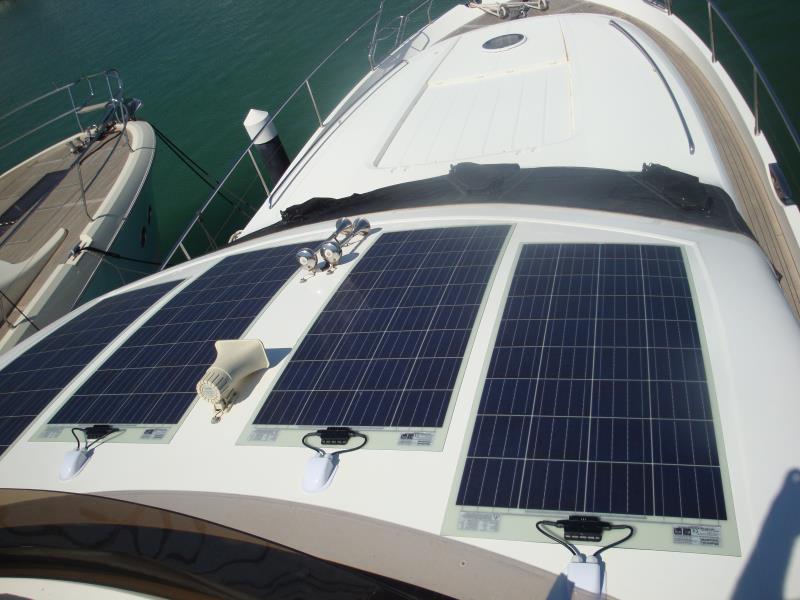
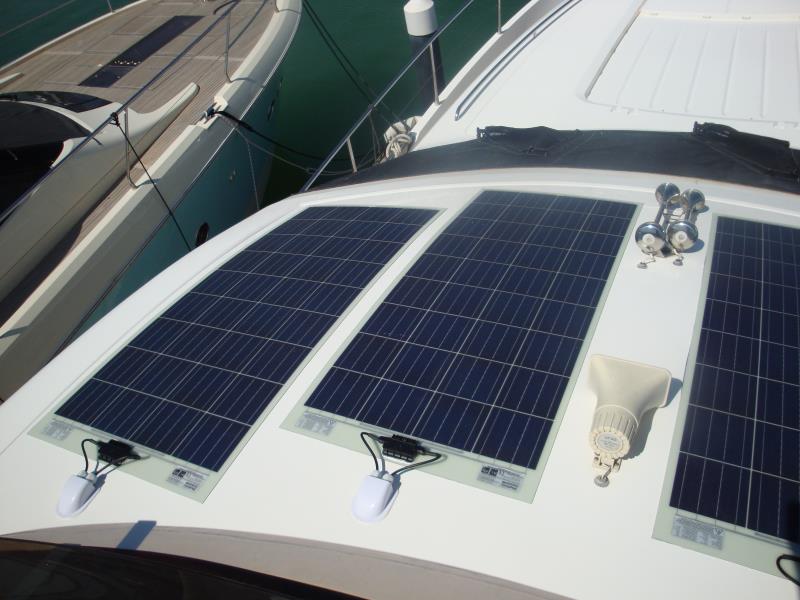
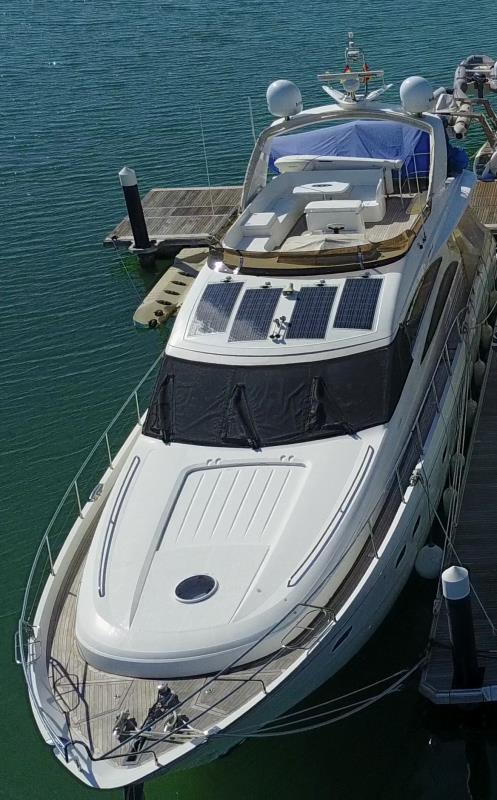
We were out for a week so after fitting some new batteries, we installed the new solar panels.
Here are some pics.

DSC07617_Small_zps7idilqwr.jpg


DSC07620_Small_zpsacdlu8nd.jpg


DSC07621_Small_zpsv6r9k7tv.jpg


I wanted them to look like windows but from above, they look more like (well) Solar Panels!!

DJI_0013.MOV.Still001e_Small_zpsozeh9u4s.jpg


*********************************************************

Taken at mid day - sun on the stern port quarter so not directly shining on the panels (I estimate the sun about about 50 degrees onto the panels)
The Victron Battery Monitor is showing a positive 2 amps (that is the panels are CHARGING the batteries) plus handling the ships background drain of 10 to 12 amps.

Screenshot_2017-05-06-11-51-56_Small_zps1uxuhbdu.png


*********************************************************

We have just had 3 days in the boatyard so on our return, we berthed the boat with the bow into her berth to finish off the hull A Glaze.
So, yesterday, the panels were south facing and whilst having lunch, I switched off the battery charger and half an hour later this was the display from the Victron App.

Screenshot_2017-05-11-14-22-45_Small_zps5y7bl1ap.png


*********************************************************


The above pics ar somewhat out of date - I'll post some more upto date pics following this post.
 
Top