Solar Panels

Hurricane

Well-Known Member
Joined
11 Nov 2005
Messages
9,901
Location
Sant Carles de la Ràpita
Visit site
I'm starting this after a discussion that developed on another thread.
This one:-
http://www.ybw.com/forums/showthread.php?467957-8-x-200ah-batteries-die-after-18-months

The problem I am trying to solve is probably not apparent to most motor boaters.
Only those who stay at anchor for more than a few days without returning to their marinas may encounter this problem.
The issue is that most motor boat builders design power boats with relatively small battery banks.
They consider that we should run our generators long enough to replace any power taken from the batteries.
Generally speaking, our on-board systems consume far more than the average sailing boat.
My boat, for example, consumes between 12 and 15 amps at 24v - mainly due to the large fridges that we have on board.
We could shut equipment down but part of the enjoyment of having a boat in the sun is to have cold drinks whenever you want - ice for the Gin and Tonic is a MUST.

When we are out on anchor, we generally like to run the generator for an hour or two in the morning and again in the evening.
This isn't enough time to replace the power in the batteries that has been lost during the night.
Battery chargers charge fastest when the batteries are fully discharged.
As the charge builds up, the rate of charge slows down.
To completely charge a battery bank after a night on the anchor will take most of the day.
I don't like leaving a 17Kw generator running all day - just to finish off the last bit of the charge.
The problem is that over a period of a few days (definitely within a week) the average battery level drops to a point where the batteries can be damaged.

So, to recap, my point is that we aren't putting back the power that we are taking out of the batteries.

This year, I am going to install enough solar panels onto the "eyebrow" to "finish off" charging the batteries during the daytime after our morning generator run.
We run the generator every morning during breakfast anyway.
The eyebrow is the roof area immediately in front of the flybridge helm (over the lower helm).

On the other thread, we discussed different types of panels.
There are three technologies of solar cell and, essentially, three methods of cell assembly.
1 - Cells can be mounted onto a film thus making them totally flexible.
2 - Cells can be mounted into glass panels thus making them rigid.
3 - Cells can be mounted onto a GRP or aluminium panel thus making them semi flexible.
Out of the three methods of construction above, the rigid panels are definitely the best.
The totally flexible one are the least efficient.
These days, the semi flexible panels are nearly as efficient as the rigid panels but there is a question that they don't last more than a few years.
Solar cells work best when they are coolest - ideal conditions will be a sunny day in winter.
Rigid panels allow air to flow under thus keeping them cool.
Fully flexible and semi flexible tend to be installed directly to a roof so will generally be hotter thus making them less efficient.

We have decided that the roof space where we are going to mount the panels has too much curvature for rigid panels.
So, for aesthetic reasons, we have opted for the semi flexible panels.
I was very much "in the camp" for rigid panels until I visited a stand at LIBS this year.
They were displaying all types of panels but their new(ish) range of semi flexible ones caught my eye.
These panels seem to be more robust than the semi flexibles that I've previously seen.

We were out on the boat last week so I had the opportunity of measuring the roof to see what would fit.
We made a "mocked up" using bin liners so that we could see what it would look like - especially from a distance.

Here are a couple of pics of our "mock up"

DSC07544_Small_zpsj5injmdu.jpg


DSC07548_Small_zpsebeow2nr.jpg


I am hoping that the final installation will look more like windows than solar panels.

So, yesterday, I ordered 4 of their 150 watt panels - here is the link to their web site - these are the ones that I ordered:-
https://www.photonicuniverse.com/en...th-self-adhesive-backing-made-in-Austria.html

Whilst on the boat, we removed some head linings and I have decided where the wires will run, where the electronic controller will be mounted and what isolation switches/breakers that we will be using.
I will probably be using a Victron MPPT controller - this one:-
http://www.es-store.co.uk/documents/product/352.pdf

Anyway, some people have asked to be kept informed of the progress so I will keep this thread updated as the project progresses.

There are others who post on these forums with similar projects so, anyone, please add to this discussion.
 
Last edited:
What's the modal angle of those proposed panels please ? Looks like 30 ish ?


If you are going for the Victorn controller, get the app and connector. It tells you when and how much you have downloaded.


I can see you rigging a clever spring to the anchor to keep the boat trimmed to the azimuth. An automated one, of course :)
 
Is there a simple formula for how much power is required to charge a battery? I assume that 4 x 150W means you have 600W going to the batteries if you had 5 x 100aH batteries 75% charged how much time will it take to get them to 100%?
 
What's the modal angle of those proposed panels please ? Looks like 30 ish ?

Don't know - I've spoken to yachtie friends that have theirs on hinges but, in reality, they don't bother to change the angle.
I'm not sure that I have to be absolutely precise to get the benefit that I'm looking for.

If you are going for the Victorn controller, get the app and connector. It tells you when and how much you have downloaded.

Yes, absolutely - the Bluetooth connector is on the shopping list.
But I also have a Victron Battery monitor that will stay connected.
The solar will be fed into the batteries through the Victron shunt so that should give me an overall flow in/out.

I can see you rigging a clever spring to the anchor to keep the boat trimmed to the azimuth. An automated one, of course :)

Or a Raspberry Pi connected to the stern thruster - only joking!!
 
Is there a simple formula for how much power is required to charge a battery? I assume that 4 x 150W means you have 600W going to the batteries if you had 5 x 100aH batteries 75% charged how much time will it take to get them to 100%?

AFAIK, it isn't that simple.
As the batteries get closer to fully charged, the rate of charge falls off - also the 600W is the maxim power that these panels will produce - the actual power will vary throughout the day.
I think the Bluetooth monitor that will be attached to the MPPT controller will give the number of "amp hours" that the panels have provided so that might be an interesting figure to report back.
 
You're right, it isn't that simple.

With brand new batteries there is very little "loss". What you take out, you put in again almost exactly.
As the batteries age, if you take out for example 50Ah, it will take 65Ah to fully charge them again. As the batteries age this process becomes less and less efficient.
I know this from practical experience with my battery monitor.

Obviously the time it takes to charge isn't an exact science either, due partly to the above but also because the charge process isn't linear - Bulk, float, absorption.

One thing I would say is I can't fault your thinking in your 1st post above. But to give yourself the best chance of success (i.e. minimising use of generator) you have to focus on reducing battery consumption just as much as you are on charging efficiency.
LED lighting throughout, Optimising fridge insulation around the main box, and ventilation of the condenser at the back (unless you have water cooled). These together will make more contribution than anything else to overall consumption.

By way of example, in spring my 85L fridge consumes just 5Ah overnight. OK it's more in peak UK summer, maybe up to 7 or 10Ah but still very acceptable. Also helped by the Webasto smart energy control,
https://www.webasto.com/int/markets...refrigeration-solutions/smart-energy-control/
 
In the past I used to think that SP’s are of no use on a bigger mobo,
Considering the limited power they can produce compared to what we need,

But now after doing some more investigation
I’m in the same process like Mike,
For us, the useage is more or less the same;
Our purpose is just a bit different;

In holliday / summer season on the boat, we sail almost daily,
But spend a lot of time at anchor in daytime and every other night.
We like to stay in small bay’s and coves, sometimes close to smaller boats,
and like the noise from nature, or quieteness,
we hate the noise of the genny, especially from big neighboring yachts.
Although our genny’s are fairly quite, our neighbours might have the same feeling about us.

We usually run the genny in the morning (automatic start around 5..6am)
And run it until I or guest have a early morning swim.
If we don’t sail out (battery’s are adequately charged during navigation) we run the genny around lunch time,
And then at evening, consumption is raising from all the lights and powerfull UWL’s.., we run them again.
Our battery monitor is a crucial instrument for showing the state of the batt’s, and giving a warning when we need to recharge.

Our main purpose of the SP’s is to bring down the running time of the genny’s,
avoiding the noise, and the smoke.

Our first plan was with Solara (made in Germany) semi flexible panels,
We could fit 10 panels (1m x 0.6m) on the roof of the eyebrow, giving 1000Wpeak
Panels have a good reputation, but are fairly expensive

With panels from the supplier that Mike has ordered from,
we would have a more elegant solution, and is A LOT cheaper
we could place 3 x 250 W panels (1.7m x 1m) on the eyebrow, giving us 750W power
we have 3 front windows, so this solution looks much more in balance, compared with a eyebrow top overwhelmed with 10 small SP’s

I will use the Victron MPPT controller, as we always’s had very good results, service and advice from Victron.
 
You're right, it isn't that simple.

With brand new batteries there is very little "loss". What you take out, you put in again almost exactly.
As the batteries age, if you take out for example 50Ah, it will take 65Ah to fully charge them again. As the batteries age this process becomes less and less efficient.
I know this from practical experience with my battery monitor.

Obviously the time it takes to charge isn't an exact science either, due partly to the above but also because the charge process isn't linear - Bulk, float, absorption.

One thing I would say is I can't fault your thinking in your 1st post above. But to give yourself the best chance of success (i.e. minimising use of generator) you have to focus on reducing battery consumption just as much as you are on charging efficiency.
LED lighting throughout, Optimising fridge insulation around the main box, and ventilation of the condenser at the back (unless you have water cooled). These together will make more contribution than anything else to overall consumption.

By way of example, in spring my 85L fridge consumes just 5Ah overnight. OK it's more in peak UK summer, maybe up to 7 or 10Ah but still very acceptable. Also helped by the Webasto smart energy control,
https://www.webasto.com/int/markets...refrigeration-solutions/smart-energy-control/

I agree with all that - and have already changed LEDs where applicable - all the bathrooms - galley - bedside lights - anchor light - I didn't change the others because I like the warmth of the light but those ones are not allowed to be on whilst at anchor.
Fridges are the biggest drain our big fridge is a fridge/freezer - 277 litres in all - I've not specifically isolated it to find its consumption but I guess it amounts to a good 9a of the 15a mentioned above (at 24v).
I could switch off the flybridge coolbox but, again, what are we out there for?
My electronics amounts to 2a at 24v - yes, I know, thats too much as well and I will be shutting some of that down but now that the boat is properly "on line", it is rather nice to keep the routers etc running.

Anyway, the point is that I have considered most of your comments.
I may be replacing the big fridge sometime anyway.
 
Is there a simple formula for how much power is required to charge a battery? I assume that 4 x 150W means you have 600W going to the batteries if you had 5 x 100aH batteries 75% charged how much time will it take to get them to 100%?

as has been said, this is difficult to calculate,
but whats important (imo) is:
when Mike has 600W coming from the SP's during a certain period a day,
that is: 600W @ 28V = 21.4 Amps, while the consuming is 12...15 amps,
that means that there still are a few amps available for topping up the battery's....

we have to see how that works out in practice,
how long there is power available for recharging, depending on:
orientation of the boat, weather conditions, battery state, actual consumption, ....
 
Last edited:
My understanding is that a 100% charge with lead acid is only a theoretical possibility and that chasing the last 10% and certainly the last 5% is a fool's errand - or the preserve of a marina dweller on a battery charger for a few weeks.

Then there's the problem that using a generator to power a battery charger is a poor deal, since each engine alternators will kick out at least 110amps but it's a mighty battery charger that pumps out 100 amps!

So adding solar will help delay the point at which you need the genny but a much more effective strategy is to also add capacity - significant capacity. Aim for a bank three times the size and for a charge state somewhere between 60% and 85% which is easy for a charger or the alternators to achieve, takes way less time and preserves your batteries.

Lead acid is a con trick, a 100 amp battery has no more than 30 useable amps in it for non marina dwellers. The very best solution is a Lithium bank but we are 5 years at least away from a safe, reliable and affordable marine solution.
 
A point on the overheating panel;

Having looked at the instructions it says you can drill through or use an appropriate adhesive. Is it not possible to use 10mm strips of acrylic/PVC up the length of the panels to lift them off the 'eyebrow' creating a small airlfow?
 
I'd be very tempted to use the industrial strength Velcro, leaves a small gap under the panels, but they can be moved or changed without too much hassle.

I've had solar panels on Eos for years, keep some the batteries nicely charged whilst on our trot mooring, and helps when we spend 3 weeks or more at anchor in the Scilly Isles. Even with the British sun I see almost 10 amps going into the batteries from my 2 x 100W panels on a good sunny day. I wouldn't be without them.

Mike, how many controllers are you planning on fitting? And your other consideration is the size of the wiring to use. It's surprising ho wthick it needs to be to avoid excessive current loss, but I expect you already know that.
 
I'd be very tempted to use the industrial strength Velcro, leaves a small gap under the panels, but they can be moved or changed without too much hassle.

I've had solar panels on Eos for years, keep some the batteries nicely charged whilst on our trot mooring, and helps when we spend 3 weeks or more at anchor in the Scilly Isles. Even with the British sun I see almost 10 amps going into the batteries from my 2 x 100W panels on a good sunny day. I wouldn't be without them.

Mike, how many controllers are you planning on fitting? And your other consideration is the size of the wiring to use. It's surprising ho wthick it needs to be to avoid excessive current loss, but I expect you already know that.

Yep - I considered using industrial strength Velcro when I first looked into this.
Initially, my plan was to only fit the panels for the summer months.
But seeing the construction of the ones that I have ordered, I am now thinking a "fit and forget" concept.

Wiring - still working through suppliers of wire, connectors, glands and isolators etc.
I'll post the whole design later.
The big thing on my last visit was to find a short route from the roof space to the battery box.
Thanks to a couple of friends (one from this forum), the difficult bit of finding a route through the windows is done - conduits already in place.


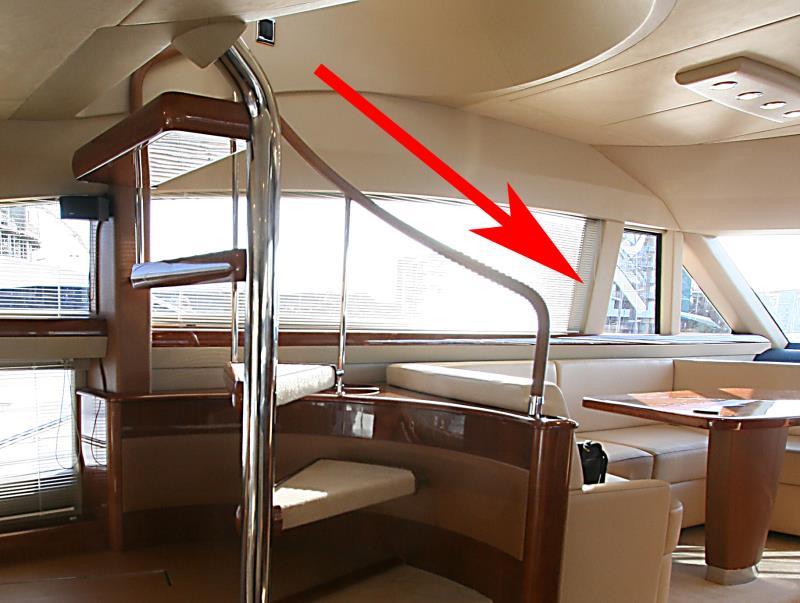
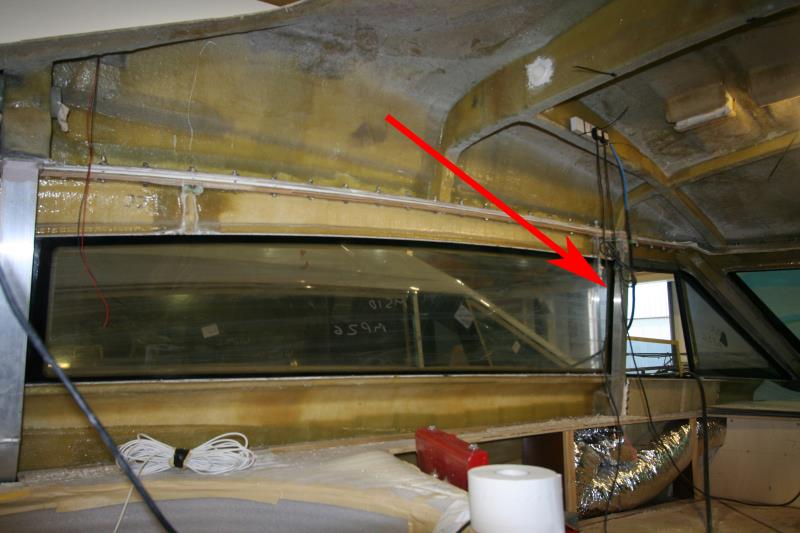
These next 2 pics show how useful photos taken during the boat build in the factory can be.

This is an old photo taken the first day that we saw the completed boat - in Sutton Harbour
The arrow is where I wanted to run the wires for this solar panel project.

solar-window1_Small_zpsvbkh6i3j.jpg


I was fairly sure that there would be space inside the mullion cladding from this shot taken whilst she was still inside the factory.
You can see that the flybridge support is a little narrower than the cladding.

solar-window2_Small_zpscvxrg8mp.jpg


In fact, with a little help from friends, we now have some suitable conduits running down the cladding.
My plan is to fit one Victron controller behind the seating area where all our navigation electronics is installed
It is a fairly easy job then to run conduits down to the batteries in the engine room.
I reckon about 3m of wire from the panels to the controller and about 4m from the controller to the batteries.
I am planning to wire the panels in series so the voltage of the wires between the panels and the controller will be several times that of the batteries.
I'll post the wire sizes later when I've decided what works best.
 
Last edited:
That would give you 150 actual amps at 24v which would require three or four times that of lead acid if you want to avoid quickly knackering them.
 
Please forgive me my ignorance but just hypothetically, would in practice a conceivable alternative be a pair of Li-Ion batteries such as these -> http://www.lithiumion-batteries.com...n-batteries/12v-150ah-lithium-ion-battery.php

Could maybe be dedicated to the fridges and recharged quickly and efficiently from the genny?

last year my business has installed 3 x small OB- Vans with Victron Li ion batt system
at this moment we are installing 2 more (Mercedes Sprinters and Vianos' with K-sat Dish)
so we have the experience, and so far no problems with it.

A few weeks ago when talking to Victron at boot messe, they tried to pursuade me to replace boat batt's with lithium ion,
advantages:
-Li-ion batt's are less weight for equal capacity
-can use the batt capacity up to 90% (so you need less total capacity)
-faster recharging
-livetime is much longer (they claim 10..12y ?)

Nevertheless I'm still not ready for the switch,
- my installation is old fashion and robust, and the Lead batt's fit nicely in their bay,
and I'm a little bit afraid for the reliability of the sensitive and complex Li-ion installation, (small controll wires going to the regulator, etc..)
in a dirty, smokey or wet invironment
- in case of a problem, solutions are much more complex, more difficult to find holiday saving solutions
- I had a very good deal on my 24 x 12V105Ah Deep Cycle (closed) lead acid batt's,
and will soon start the 5th season with the set ! so overall much cheaper,

I wouldn't consider a mixed installation, (lead + Li-ion) too complex cabling / installation / controll
but one day it will probably be all Li-ion in Blue Angel.
 
Please forgive me my ignorance but just hypothetically, would in practice a conceivable alternative be a pair of Li-Ion batteries such as these -> http://www.lithiumion-batteries.com...n-batteries/12v-150ah-lithium-ion-battery.php

Could maybe be dedicated to the fridges and recharged quickly and efficiently from the genny?

My problem isn't the capacity - its the fact that I'm "not putting back in" "what I've taken out"
As you say, Lithiums can charge at a faster rate but I'm not convinced they would be fast enough - They might be the way forward but as I said on the other forum, my batteries are in the engine room where it can get quite hot and all batteries are inefficient at those temps.

I did look into Lithiums last autumn - I don't think the ones in your link are the way forward.
It seems that Lithiums are far more susceptible to unbalanced charging so the best way is to connect each cell to a dedicated charge controller.
I haven't read it recently but see this report on Panbo http://www.panbo.com/archives/2014/...ry_bank_bob_ebaugh_has_330_cycles_so_far.html

Apart from that Lithiums are very expensive and I can knacker expensive batteries as quickly as I can cheap ones!!
When I looked into them, there doesn't seem to be a cheap option for 24v systems - just can't get the multiples of cells right without it costing a lot.
Also sticking to lead acid means that I can use all the existing chargers (that includes my spares in the shed) etc

BTW, in the end, I've settled for AGM batteries for my house set.
With these batteries, I've managed to get an extra 40ah per battery (at 12v).
 
Thank you for the replies, all understood. Unless something viable comes up to replace electric cars, the price of lithium batteries probably isn't going to go down any time soon. Shame really, as the benefits in the boat environment would be substantial in domestic use alone. Those smaller cells could be hidden away into empty voids in a boat, the capacity would easily double and there would be less need to run the genny...

Very interesting article.
 
Just got back from a delivery trip to the boat.
We often drive out when we have stuff to get down to the boat.
Comfortable ferry to Santander and then a drive across Spain - mostly motorways.

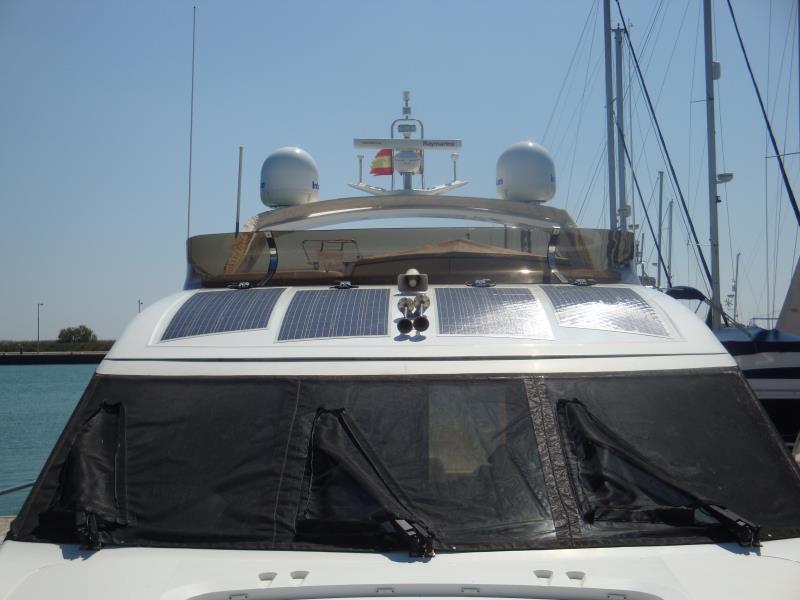
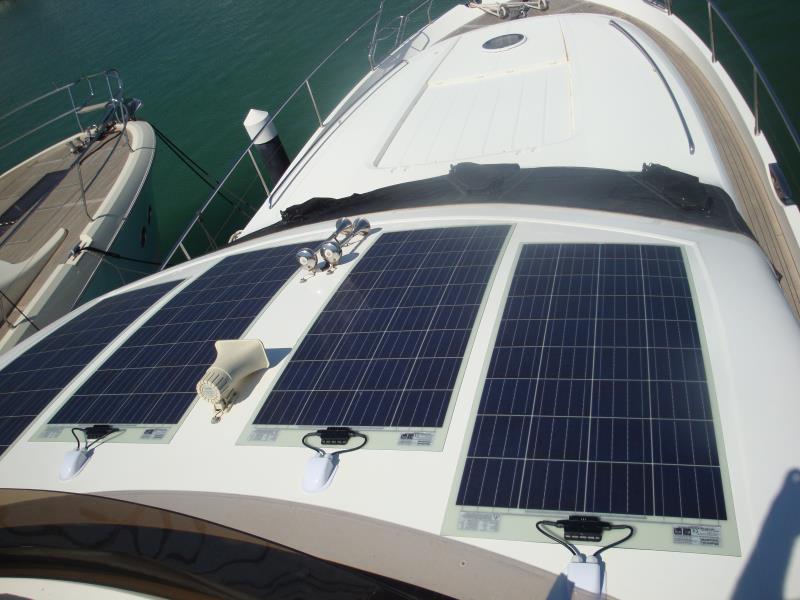
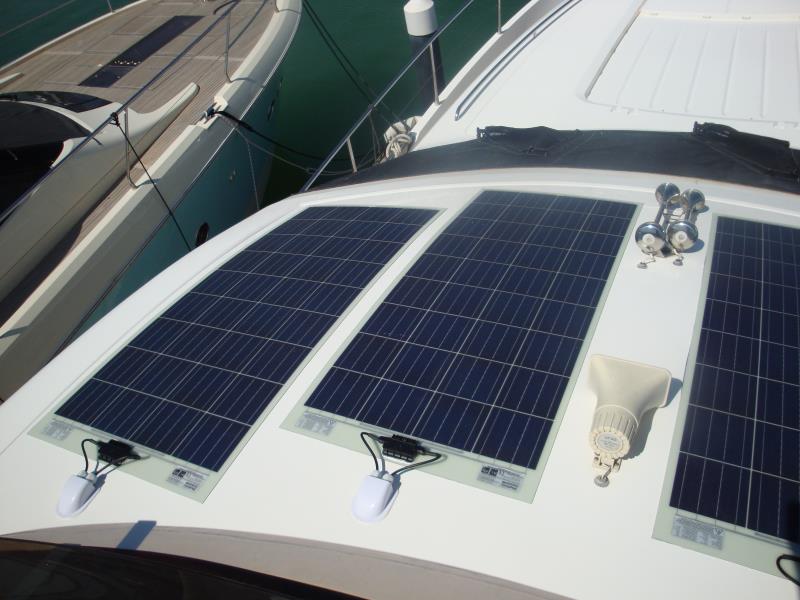
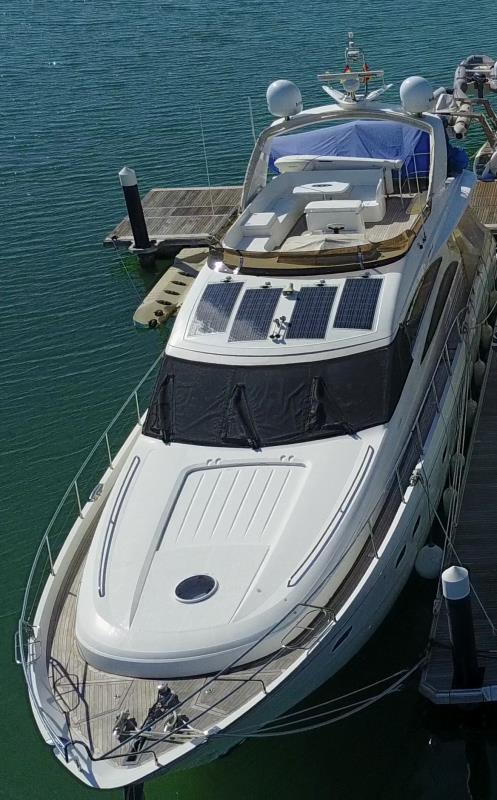
We were out for a week so after fitting some new batteries, we installed the new solar panels.
Here are some pics.

DSC07617_Small_zps7idilqwr.jpg


DSC07620_Small_zpsacdlu8nd.jpg


DSC07621_Small_zpsv6r9k7tv.jpg


I wanted them to look like windows but from above, they look more like (well) Solar Panels!!

DJI_0013.MOV.Still001e_Small_zpsozeh9u4s.jpg


With some help from friends, I have managed to get all the wires down into the engine room.
The Victron MPPT controller is all connected but there wasn't time to do the final connections/isolators etc to the batteries.

That will have to wait until early next month when we go back.

The proof of the pudding (so to speak) will be in the eating.
We won't really know if this upgrade (new batteries and solar panels) has worked until we use start using it properly later in the season.

I chose AGM batteries in the end - taller than the old ones so a bit more capacity - 144Ah (at 20h) instead of 110Ah.
So, I'm hoping that the combination of some greater capacity and the ability to replace the power that has been used overnight without running the generator all day, will be a significant improvement.
 
Last edited:
Top