Hurricane
Well-Known Member
I'm starting this after a discussion that developed on another thread.
This one:-
http://www.ybw.com/forums/showthread.php?467957-8-x-200ah-batteries-die-after-18-months
The problem I am trying to solve is probably not apparent to most motor boaters.
Only those who stay at anchor for more than a few days without returning to their marinas may encounter this problem.
The issue is that most motor boat builders design power boats with relatively small battery banks.
They consider that we should run our generators long enough to replace any power taken from the batteries.
Generally speaking, our on-board systems consume far more than the average sailing boat.
My boat, for example, consumes between 12 and 15 amps at 24v - mainly due to the large fridges that we have on board.
We could shut equipment down but part of the enjoyment of having a boat in the sun is to have cold drinks whenever you want - ice for the Gin and Tonic is a MUST.
When we are out on anchor, we generally like to run the generator for an hour or two in the morning and again in the evening.
This isn't enough time to replace the power in the batteries that has been lost during the night.
Battery chargers charge fastest when the batteries are fully discharged.
As the charge builds up, the rate of charge slows down.
To completely charge a battery bank after a night on the anchor will take most of the day.
I don't like leaving a 17Kw generator running all day - just to finish off the last bit of the charge.
The problem is that over a period of a few days (definitely within a week) the average battery level drops to a point where the batteries can be damaged.
So, to recap, my point is that we aren't putting back the power that we are taking out of the batteries.
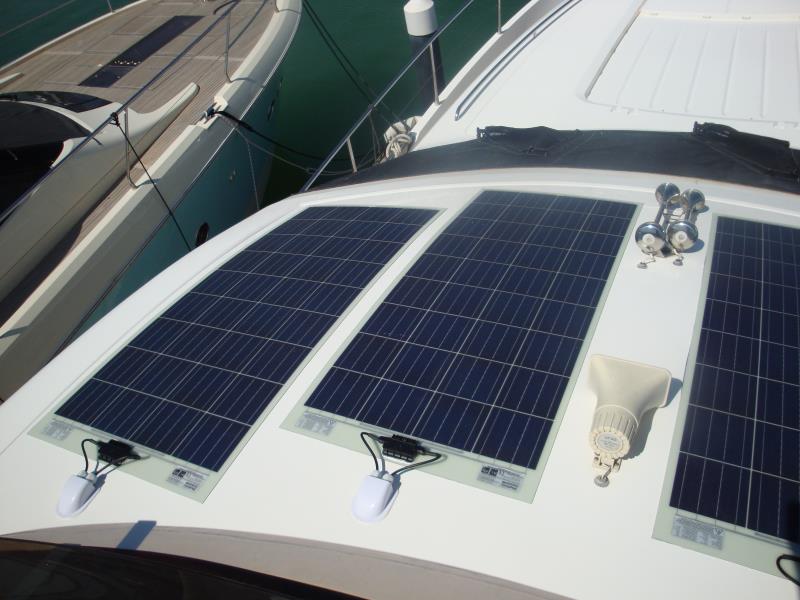
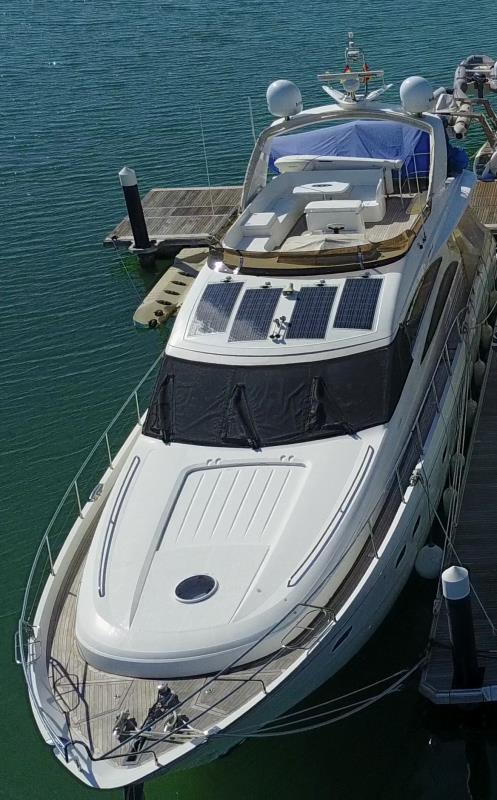
This year, I am going to install enough solar panels onto the "eyebrow" to "finish off" charging the batteries during the daytime after our morning generator run.
We run the generator every morning during breakfast anyway.
The eyebrow is the roof area immediately in front of the flybridge helm (over the lower helm).
On the other thread, we discussed different types of panels.
There are three technologies of solar cell and, essentially, three methods of cell assembly.
1 - Cells can be mounted onto a film thus making them totally flexible.
2 - Cells can be mounted into glass panels thus making them rigid.
3 - Cells can be mounted onto a GRP or aluminium panel thus making them semi flexible.
Out of the three methods of construction above, the rigid panels are definitely the best.
The totally flexible one are the least efficient.
These days, the semi flexible panels are nearly as efficient as the rigid panels but there is a question that they don't last more than a few years.
Solar cells work best when they are coolest - ideal conditions will be a sunny day in winter.
Rigid panels allow air to flow under thus keeping them cool.
Fully flexible and semi flexible tend to be installed directly to a roof so will generally be hotter thus making them less efficient.
We have decided that the roof space where we are going to mount the panels has too much curvature for rigid panels.
So, for aesthetic reasons, we have opted for the semi flexible panels.
I was very much "in the camp" for rigid panels until I visited a stand at LIBS this year.
They were displaying all types of panels but their new(ish) range of semi flexible ones caught my eye.
These panels seem to be more robust than the semi flexibles that I've previously seen.
We were out on the boat last week so I had the opportunity of measuring the roof to see what would fit.
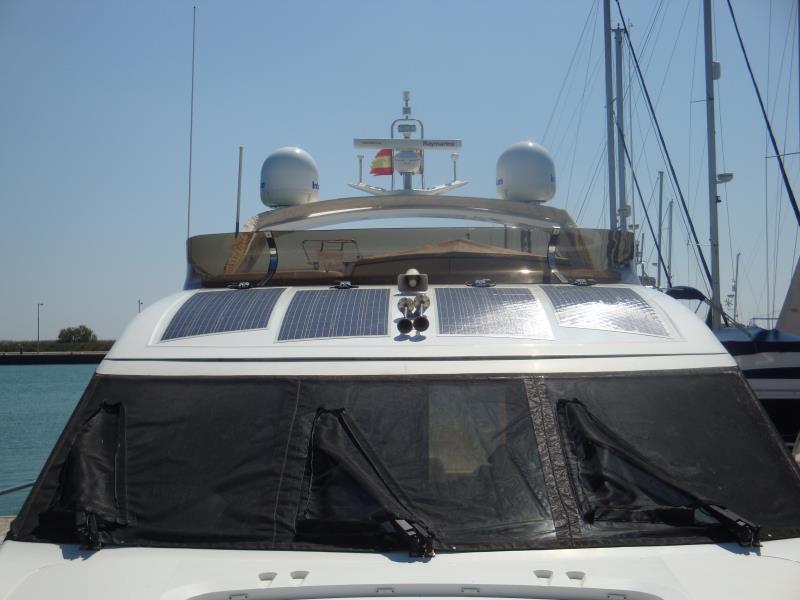
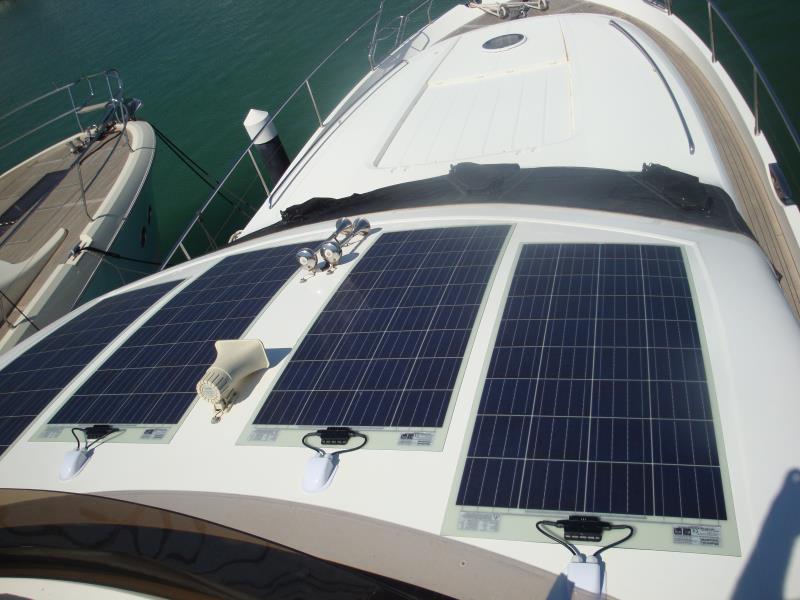
We made a "mocked up" using bin liners so that we could see what it would look like - especially from a distance.
Here are a couple of pics of our "mock up"


I am hoping that the final installation will look more like windows than solar panels.
So, yesterday, I ordered 4 of their 150 watt panels - here is the link to their web site - these are the ones that I ordered:-
https://www.photonicuniverse.com/en...th-self-adhesive-backing-made-in-Austria.html
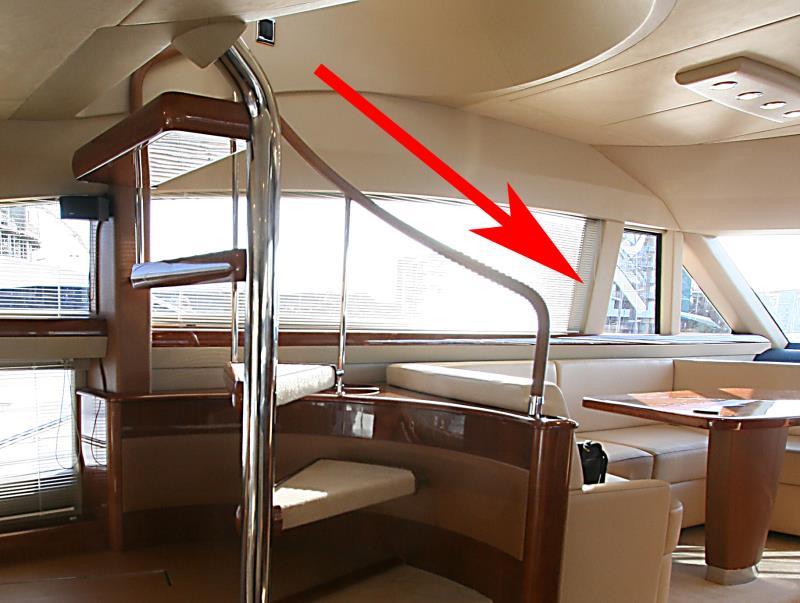
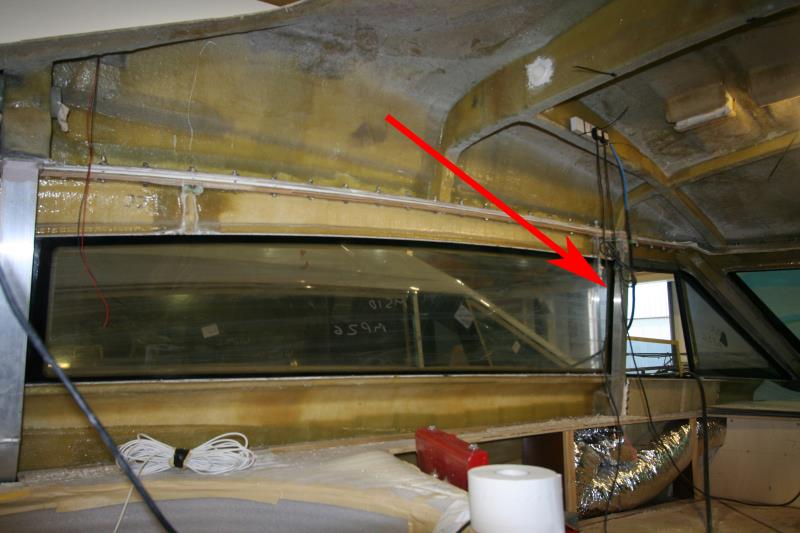
Whilst on the boat, we removed some head linings and I have decided where the wires will run, where the electronic controller will be mounted and what isolation switches/breakers that we will be using.
I will probably be using a Victron MPPT controller - this one:-
http://www.es-store.co.uk/documents/product/352.pdf
Anyway, some people have asked to be kept informed of the progress so I will keep this thread updated as the project progresses.
There are others who post on these forums with similar projects so, anyone, please add to this discussion.
This one:-
http://www.ybw.com/forums/showthread.php?467957-8-x-200ah-batteries-die-after-18-months
The problem I am trying to solve is probably not apparent to most motor boaters.
Only those who stay at anchor for more than a few days without returning to their marinas may encounter this problem.
The issue is that most motor boat builders design power boats with relatively small battery banks.
They consider that we should run our generators long enough to replace any power taken from the batteries.
Generally speaking, our on-board systems consume far more than the average sailing boat.
My boat, for example, consumes between 12 and 15 amps at 24v - mainly due to the large fridges that we have on board.
We could shut equipment down but part of the enjoyment of having a boat in the sun is to have cold drinks whenever you want - ice for the Gin and Tonic is a MUST.
When we are out on anchor, we generally like to run the generator for an hour or two in the morning and again in the evening.
This isn't enough time to replace the power in the batteries that has been lost during the night.
Battery chargers charge fastest when the batteries are fully discharged.
As the charge builds up, the rate of charge slows down.
To completely charge a battery bank after a night on the anchor will take most of the day.
I don't like leaving a 17Kw generator running all day - just to finish off the last bit of the charge.
The problem is that over a period of a few days (definitely within a week) the average battery level drops to a point where the batteries can be damaged.
So, to recap, my point is that we aren't putting back the power that we are taking out of the batteries.
This year, I am going to install enough solar panels onto the "eyebrow" to "finish off" charging the batteries during the daytime after our morning generator run.
We run the generator every morning during breakfast anyway.
The eyebrow is the roof area immediately in front of the flybridge helm (over the lower helm).
On the other thread, we discussed different types of panels.
There are three technologies of solar cell and, essentially, three methods of cell assembly.
1 - Cells can be mounted onto a film thus making them totally flexible.
2 - Cells can be mounted into glass panels thus making them rigid.
3 - Cells can be mounted onto a GRP or aluminium panel thus making them semi flexible.
Out of the three methods of construction above, the rigid panels are definitely the best.
The totally flexible one are the least efficient.
These days, the semi flexible panels are nearly as efficient as the rigid panels but there is a question that they don't last more than a few years.
Solar cells work best when they are coolest - ideal conditions will be a sunny day in winter.
Rigid panels allow air to flow under thus keeping them cool.
Fully flexible and semi flexible tend to be installed directly to a roof so will generally be hotter thus making them less efficient.
We have decided that the roof space where we are going to mount the panels has too much curvature for rigid panels.
So, for aesthetic reasons, we have opted for the semi flexible panels.
I was very much "in the camp" for rigid panels until I visited a stand at LIBS this year.
They were displaying all types of panels but their new(ish) range of semi flexible ones caught my eye.
These panels seem to be more robust than the semi flexibles that I've previously seen.
We were out on the boat last week so I had the opportunity of measuring the roof to see what would fit.
We made a "mocked up" using bin liners so that we could see what it would look like - especially from a distance.
Here are a couple of pics of our "mock up"
I am hoping that the final installation will look more like windows than solar panels.
So, yesterday, I ordered 4 of their 150 watt panels - here is the link to their web site - these are the ones that I ordered:-
https://www.photonicuniverse.com/en...th-self-adhesive-backing-made-in-Austria.html
Whilst on the boat, we removed some head linings and I have decided where the wires will run, where the electronic controller will be mounted and what isolation switches/breakers that we will be using.
I will probably be using a Victron MPPT controller - this one:-
http://www.es-store.co.uk/documents/product/352.pdf
Anyway, some people have asked to be kept informed of the progress so I will keep this thread updated as the project progresses.
There are others who post on these forums with similar projects so, anyone, please add to this discussion.
Last edited: