Yngmar
Well-Known Member
It's time to design the solar arch. For the rest of it, I've stared at my battery monitor a lot in port and under sail and applied high end mathematics like division and multiplication and concluded I want at least 400 W, and won't mind a bit more if it happens to fit up there. Haven't picked panels yet, as that'll depend largely on the shape of the arch about to be designed. Controller shall be a Victron MPPT just because it seems to work and while I don't mind being product tester for less important stuff, in this case it makes sense for me to buy something proven and reliable. But this thread is all about the arch.
Luckily there's a great stainless guy here in Brighton whom I trust to build the thing as well as it can be built. But how should it be designed?
I've had a look around image search and there's some that fit the boats well, and some that look horrid and extend a meter aft of the aft most part of the transom (do these people never go into marinas?). There's also a worrying but understandable tendency to tack as much stuff as possible onto them, leading to a solar-davit-outboard-crane-ladder-windvane-radar-generator-fishcuttingboard-seat with fore and aft rigging and clamps on the backstay to keep it from collapsing into a pile of bent steel under its own weight.
Speaking of which, should it even be made of stainless steel at all? I've seen a few made of aluminium, which is certainly good to keep the boat from getting too top heavy. But then how do you treat that to protect it so it won't all crumble to white dust in a few years and blow away?
Should it be welded/clamped to the existing pushpit or bolted next to it? Upside is the stern looks less busy and not so much additional weight, plus fewer holes to bolt it through, but if it ever gets bent or needs removing, that's a bunch of extra stuff to undo. Also the existing pushpit isn't mounted all that sturdily and may want a set of extra legs then.
Then where to mount it best? The toerail is really the only option, because just inboard of it there are two lazarette lids with hinges on the outboard edge of the deck. The toerail is made of teak and covers the deck/hull joint, through which the stanchions and pushpit/pulpit are bolted through. It isn't a very good solution for stanchions, they wobble aplenty, but I think it may be okay for something that is supported on at least four points. Where the stanchion studs are, the teak has a large hole, so the stud sits on the GRP and not directly on the (more compressible) teak.
How strong do these things have to be so they don't get bent or ripped off in a blow, with 4+ big (1m long side or larger) panels on them and the boat heeling? I also assume it's a good idea to make them at least strong enough so a fat bloke can climb up and clean the bird droppings off the panels regularly.
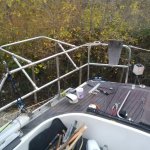
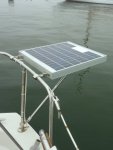
The standard design appears to be two arches joined by horizontal bars, which double as climbing steps, much like this.
Your input is welcome!
Here's a view of the stern from a broker photo (same model as mine, but without horseshoes blocking the view):

Luckily there's a great stainless guy here in Brighton whom I trust to build the thing as well as it can be built. But how should it be designed?
I've had a look around image search and there's some that fit the boats well, and some that look horrid and extend a meter aft of the aft most part of the transom (do these people never go into marinas?). There's also a worrying but understandable tendency to tack as much stuff as possible onto them, leading to a solar-davit-outboard-crane-ladder-windvane-radar-generator-fishcuttingboard-seat with fore and aft rigging and clamps on the backstay to keep it from collapsing into a pile of bent steel under its own weight.
Speaking of which, should it even be made of stainless steel at all? I've seen a few made of aluminium, which is certainly good to keep the boat from getting too top heavy. But then how do you treat that to protect it so it won't all crumble to white dust in a few years and blow away?
Should it be welded/clamped to the existing pushpit or bolted next to it? Upside is the stern looks less busy and not so much additional weight, plus fewer holes to bolt it through, but if it ever gets bent or needs removing, that's a bunch of extra stuff to undo. Also the existing pushpit isn't mounted all that sturdily and may want a set of extra legs then.
Then where to mount it best? The toerail is really the only option, because just inboard of it there are two lazarette lids with hinges on the outboard edge of the deck. The toerail is made of teak and covers the deck/hull joint, through which the stanchions and pushpit/pulpit are bolted through. It isn't a very good solution for stanchions, they wobble aplenty, but I think it may be okay for something that is supported on at least four points. Where the stanchion studs are, the teak has a large hole, so the stud sits on the GRP and not directly on the (more compressible) teak.
How strong do these things have to be so they don't get bent or ripped off in a blow, with 4+ big (1m long side or larger) panels on them and the boat heeling? I also assume it's a good idea to make them at least strong enough so a fat bloke can climb up and clean the bird droppings off the panels regularly.
The standard design appears to be two arches joined by horizontal bars, which double as climbing steps, much like this.
Your input is welcome!
Here's a view of the stern from a broker photo (same model as mine, but without horseshoes blocking the view):