Bi Facial solar panels

One of the primary applications is to mount them vertically in rows, oriented north/south. Not a boat thing.
  • Not damaged by hail.
  • Stay clean. No bird bombs.
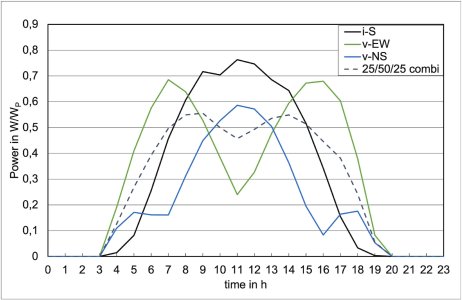
  • More power morning and evening (good if mixed with standard tilted panels--more even power through the day).
  • More power on cloudy days, when the light is diffuse.
  • No snow cover. A big deal farther north.
  • Better with lower sun angles (farther north).
  • Cheaper racks.
  • Easier to mow the grass or even grow crops.
And provides shade for grazing animals such as sheep. They keep the grass down. Win win win. Mounting them North/South can be beneficial to maximise output at times of the day when demand is higher.
 
Bifacial solar panels are quite popular on sailing yachts. The bifacial nature can theoretically improve the output by as much as 30%, but with typical marine surfaces, around 5-10% seems more typical.

This is a nice bonus, but other factors such as the overall solar panel efficiency are often more important.
The 30% increase isn't what it seems. In low sunlight conditions when the panels production is poor, thr bifacial panels will output 30% more than this relatively low output. It's not seen as a 30% increase in the peak output
 
On a yacht

So....from those that have bifacial panels..... they are worth it?

I have no idea on costs - are the bifacial panels cost effective cf normal panels. Or are you better simply having more conventional panels - if you have the space.


What surprises me is the total absence of any historic debate over bifacial panels, lots of debate on rigid vs flexible but nothing on bifacial. Geem's post a few weeks ago mentioning he had same was the first time I can recall seeing therm mentioned.

Jonathan
 
Perhaps ok for a farm or such like but for any large scale deployment the necessary space between the rows due to shading makes them less efficient than regular frame / ground mounted panels.

Interestingly our insurance provider will only provide insurance on our new roof mounted schemes when we spec bifacial panels.
A study a while ago showed that not to be the case, with vertical panels producing more power overall for a given space. Unfortunately it was a while ago so I’ve lost the link but it was in a thread here somewhere I’m sure.
Just the idea of not pointing them south was heresy at the time, but the dual peaks more than made up for it.
 
Perhaps ok for a farm or such like but for any large scale deployment the necessary space between the rows due to shading makes them less efficient than regular frame / ground mounted panels....
Apparently not really true. It depends on what you consider efficient. Is it W/$ or W/square foot? Hail damamge can destroy a farm. Snow cover is very important in many areas; I've lived places where roofs are covered for 4 months. There are many of non-farm examples of large scale installations, all the more interesting, when you consider that they are new.

20230220_111035%20-%20Copy.webp


Norways-national-soccer-stadium-Ullevaal-Stadium-installed-1242-vertical-solar-panels-1024x576.jpg


Energieversorger-Solarenergie.jpg


Vertikale-Demonstrationsanlage-Flughafen-Frankfurt_Fraport-1-scaled.jpg
 
Last edited:
Apparently not really true. It depends on what you consider efficient. Is it W/$ or W/square foot? Hail damamge can destroy a farm. Snow cover is very important in many areas; I've lived places where roofs are covered for 4 months. There are many of non-farm examples of large scale installations, all the more interesting, when you consider that they are new.

20230220_111035%20-%20Copy.webp


Norways-national-soccer-stadium-Ullevaal-Stadium-installed-1242-vertical-solar-panels-1024x576.jpg


Energieversorger-Solarenergie.jpg


Vertikale-Demonstrationsanlage-Flughafen-Frankfurt_Fraport-1-scaled.jpg
W/£, W/m^2, OpEx… all taken into account to calculate IRR! . Provided I’ve got the power demand, I generally I want to get the biggest scheme in any given area.

The best schemes over the last few years have generally been pile driven frame mounted with the panels at appropriate angle for latitude.
 
Did they provide any kind of explanation for what might appear a capricious or irrational requirement?
Bifacial have glass on both sides. Monofacial have a plastic film on the back. Our insurers POV is that bifacial therefore have a lower fire risk*

*I should point out that I won’t touch less than 250kW scheme and typically deliver >1MW schemes.
 
A study a while ago showed that not to be the case, with vertical panels producing more power overall for a given space. Unfortunately it was a while ago so I’ve lost the link but it was in a thread here somewhere I’m sure.
Just the idea of not pointing them south was heresy at the time, but the dual peaks more than made up for it.
Thanks for the heads up, I’ll look it out.
 
On a yacht

So....from those that have bifacial panels..... they are worth it?

I have no idea on costs - are the bifacial panels cost effective cf normal panels. Or are you better simply having more conventional panels - if you have the space.


What surprises me is the total absence of any historic debate over bifacial panels, lots of debate on rigid vs flexible but nothing on bifacial. Geem's post a few weeks ago mentioning he had same was the first time I can recall seeing therm mentioned.

Jonathan
I bought some new panels last year & going bifacial was a nominal extra cost - Seemed silly not to really.

In practice last season I kept them vertical on the guardrails and only raised them if the batteries weren’t topped up by late morning…
 
... The best schemes over the last few years have generally been pile driven frame mounted with the panels at appropriate angle for latitude.

That depends on what you are trying to optimize. No one answer.

For example, imagine the top illustration panels covered in snow. Or this farm destroyed by hail. They lost their investment.
Fighting-Jays-damage.jpg


(I did not suggest vertical was for boats)
 
That depends on what you are trying to optimize. No one answer.

For example, imagine the top illustration panels covered in snow. Or this farm destroyed by hail. They lost their investment.
Fighting-Jays-damage.jpg


(I did not suggest vertical was for boats)
Eh? Where in the UK do we routinely get snow lying for significant periods of time? How frequently do we get destructive hail storms?
 
Eh? Where in the UK do we routinely get snow lying for significant periods of time? How frequently do we get destructive hail storms?
  • Not damaged by hail. Not in the UK.
  • Stay clean. No bird bombs.
  • More power morning and evening (good if mixed with standard tilted panels--more even power through the day).
  • More power on cloudy days, when the light is diffuse.
  • No snow cover. A big deal farther north. Scotland.
  • Better with lower sun angles (farther north).
  • Cheaper racks.
  • Easier to mow the grass or even grow crops.
Most of these still apply. Not knowin' to what extent.

Just sharing information. Obviously, many people have found found vertical panels to have advantages. Do the math. Even at your latitude, the total sun gathering may be greater, and certainly it is greater morning and evening. For grid projects this evening out of production is important.

It's hard to know what you don't know. Times change.
 

Attachments

  • from science dirrect article.jpg
    from science dirrect article.jpg
    283.9 KB · Views: 6
That depends on what you are trying to optimize. No one answer.

For example, imagine the top illustration panels covered in snow. Or this farm destroyed by hail. They lost their investment.
Fighting-Jays-damage.jpg


(I did not suggest vertical was for boats)

It’s odd that every so often there are whole panels that are not damaged beside panels, on each side, that are destroyed with damage from top to bottom of the panel. If the panels had one or two hits, it might be reasonable to see the odd panel fully intact, but not for this amount of damage. I wonder if the image is fake.
 
... I wonder if the image is fake.
What an odd thing to say. Yes, I suppose it does seem odd, but the blasts of ice come in gusts and isolated blasts. Also, damage is very dependent on the stone size; below a certain size they just bounce off.

Two days ago there was a thread on another sailing forum where hail stones up to 100 mm destroyed panels on many boats, along with other considerable damage. I've had reinforced windshields broken and dents in cars. Never enough on a boat to do damage; just lucky I guess, but enough to fill the cockpit 2 inches deep, which is kind of fun in July when it has been 95F. My grandfather had commercial green houses and hailstorms were a financial terror for him. My father tells of fix windows very young.

I'm guessing UK folks don't have much expereince with hail. Google it.

hail storm in TX ruins solar

Hail Damage Mitigation for Solar Photovoltaic Systems

https://www.bloomberg.com/news/arti...ms-risk-undermining-solar-energy-insurer-says

1754270240724
 
Last edited:
I think\ this thread is at least a couple of years behind the times - bifacial are "the standard" now, at least any time there might be the least bit of light from behind. I think there are additional benefits because the
Perhaps ok for a farm or such like but for any large scale deployment the necessary space between the rows due to shading makes them less efficient than regular frame / ground mounted panels.
My recollection is that shading has less effect on bifacial panels because they also get light from behind.

I have the impression from other forums that bifacial panels are "the standard" now, generally more efficient or cost effective than the old ones.
 
What an odd thing to say. Yes, I suppose it does seem odd, but the blasts of ice come in gusts and isolated blasts. Also, damage is very dependent on the stone size; below a certain size they just bounce off.

Two days ago there was a thread on another sailing forum where hail stones up to 100 mm destroyed panels on many boats, along with other considerable damage. I've had reinforced windshields broken and dents in cars. Never enough on a boat to do damage; just lucky I guess, but enough to fill the cockpit 2 inches deep, which is kind of fun in July when it has been 95F. My grandfather had commercial green houses and hailstorms were a financial terror for him. My father tells of fix windows very young.

I'm guessing UK folks don't have much expereince with hail. Google it.

hail storm in TX ruins solar

Hail Damage Mitigation for Solar Photovoltaic Systems

https://www.bloomberg.com/news/arti...ms-risk-undermining-solar-energy-insurer-says

1754270240724

It's not odd at all and the image is unbelievable which your explanation does nothing to disprove; I think you have posted a fake image. You have no idea of me or my experiences of weather. I understand hail and how it can damage large structures and machinery, I am not questioning the ability of hail to wreck solar panels. I do not believe that hail can be that selective over such a large area of solar.
 
It's not odd at all and the image is unbelievable which your explanation does nothing to disprove; I think you have posted a fake image. You have no idea of me or my experiences of weather. I understand hail and how it can damage large structures and machinery, I am not questioning the ability of hail to wreck solar panels. I do not believe that hail can be that selective over such a large area of solar.
I'm sorry that you feel that way.

Hail-3-credit-KENS5-500x237.jpg


Not a fake image. Scattered damamge is normal with hail.
 
Top