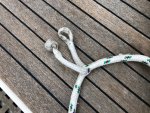
Soft shackles - uses

You can source dyneema hollow tube, or dyneema covers, for any application but in context - for soft shackles from Lancelin, www.lancelin.fr . They imply they have a UK distributor. They seem to call it 'over sheath'. They also sell ready made soft shackles, with and without a sheath (or cover). The soft shackles and the sheath are SK75.

Lancelin have just opened a production unit in Sydney but I don't know if they make sheaths.

A problem with a sheath is how to finish off the cover, and Noelex shows one answer above. For soft shackles Lancelin, in Sydney, made me some to test, and the cover is loose but welded into the turks head (is that what you call it) and woven into the splice. We have used a dyneema abrasion cover, from Nautilus Braids in NZ, on some of our snubbers (bridle) and we whipped and sewed ( sewed with dyneema fishing line).

Jonathan

Could not find a UK distributor.
 
As a warning.
I have written an article for PBO in which I have shown pictures of the outer covering of a dynema rope that had sheared. The inner core did not break but pulled through the covering and off the cleat releasing the load.( a 2.5 tonne sinker). PBO are considering publishing it, along with an article I have written on mooring placement.
Now taking that a step further.
If one places a chafe sleeve over a halyard, as a thickener for a clutch & does not splice the tail into the halyard properly, there could be a potential problem. I have seen instances where people have thought that they can get away with just whipping it to the rope.
The sleeve could slip & form a "bunch" at the clutch, if the halyard slips through the sleeve. This would make it impossible to release the halyard.
It is time consuming splicing the tail of the sleeve, if doing it to an older halyard that has been stretched a bit.
The pictures shown earlier in this thread look fine, but are relatively easy because the tails are spliced into a dynema where the threads could be easily opened up to accept the sleeve splice. It is a different situation on the outer covering of an older dynema covering with tight weaves.
 
As a warning.
I have written an article for PBO in which I have shown pictures of the outer covering of a dynema rope that had sheared. The inner core did not break but pulled through the covering and off the cleat releasing the load.( a 2.5 tonne sinker). PBO are considering publishing it, along with an article I have written on mooring placement.
Now taking that a step further.
If one places a chafe sleeve over a halyard, as a thickener for a clutch & does not splice the tail into the halyard properly, there could be a potential problem. I have seen instances where people have thought that they can get away with just whipping it to the rope.
The sleeve could slip & form a "bunch" at the clutch, if the halyard slips through the sleeve. This would make it impossible to release the halyard.
It is time consuming splicing the tail of the sleeve, if doing it to an older halyard that has been stretched a bit.
The pictures shown earlier in this thread look fine, but are relatively easy because the tails are spliced into a dynema where the threads could be easily opened up to accept the sleeve splice. It is a different situation on the outer covering of an older dynema covering with tight weaves.

I can confirm Dreamer's comments that a dyneema core slipping on the outside sheath of a halyard is a total disaster. I've been involved once, a Code Zero, and the remedy was to cut the halyard (which demands having sufficient crew to tame the sail). You then lose a halyard and replacing a halyard without a mouse line is problematic (not impossible but still difficult) and how many carry spare halyards.

It is (or was?) a common issue, dyneema cores slipping on the outer sheath, and the usual practice is not to rely on a clutch but to keep the halyard tensioned on the winch (I stand to be corrected). This demands the winch is dedicated to one halyard - which is not always possible.


Jonathan.
 
Has anyone found a reasonable
Place to get dark coloured dyneema chafe/covers?

Best I can find is premium ropes in NL. Jimmy green seems pricy and has a 5m min order, with a long order/lead time.

Actually, I have ordered lengths of dyneema from Premium Ropes in NL without difficulty. And with a reasonable delivery time too.
 
I have used this kind of genoa sheet for a couple of years now. The shackle goes simply through the sheet.
Genoa sheet.jpg

I use soft shackles also as jib hanks with dyneema Solent stay.
 
My favourite diamond knot for soft shackles. There is a slightly stronger design with chocked eyes but I find this bit quicker.


dbd2ab19b5f31be252aaa55e8ce18716--rope-knots-paracord-bracelets.jpg
 
My wife sighs and shakes her head whenever she sees a diamond knot used in soft shackle :).

The diamond knot is the most common knot used, but the Brion Toss button stopper knot is better. The soft shackle is about 30% stronger with this knot and without exposed tails the shackle is nicer to use.

The button stopper is harder to tie so start with the diamond knot for your first attemps. Or even better marry someone who will make them for you :).
 
Last edited:
My wife sighs and shakes her head whenever she sees a diamond knot used in soft shackle :).

The diamond knot is the most common knot used, but the Brion Toss button stopper knot is better. The soft shackle is about 30% stronger with this knot and without exposed tails the shackle is nicer to use.

The button stopper is harder to tie so start with the diamond knot for your first attemps. Or even better marry someone who will make them for you :).
The button stopper is indeed stronger, though something else will go bang long before a diamond knot shackle will. I quite like having the short tails. And still need the diagram to check even after many many goes over morning coffee :)
 
Doesn't this effectively halve the effective strength of the sheet as the majority of the load will be taken by the fibres of the sheet that are on the inside of the shackle when it's closed?
I would think so, but sheets are usually sized for comfort in handling, at least in cruising boats, so are several times as strong as they need to be. I have 12mm sheets on my 24 footer, they're more than enough to pick the boat up!

To attach my genny sheet, I've used a single line attached to the genny with a simple larkspur knot for several years. I did it as a quick fix and forgot to do it properly, but to my surprise, it's worked fine, though I suspect Mr Boss would prefer something a bit more solid. My one use for a soft shackle is to attach the whisker pole when sailing goose winged.
 
Last edited:
The button stopper is indeed stronger, though something else will go bang long before a diamond knot shackle will.
True, in most applications soft shackles are much stronger than they need to be, so the extra 30% strength is not often a factor.
 
Doesn't this effectively halve the effective strength of the sheet as the majority of the load will be taken by the fibres of the sheet that are on the inside of the shackle when it's closed?

This would be true if you would pull from both ends at the same time in the same direction, but in this case there is pull from one end at a time. Naturally, the hole weakens the rope a bit because the angle between the fibres and the pull direction is bigger behind the hole than in the straight part, but as mentioned, the sheet is usually much thicker than needed for the load.
 
Top