Shetland - no life raft, no EPIRB/PLBs, no survival suits - would you?

pmagawan could have a point. 1min 50 in:

However, the earlier bits showed how difficult it is to actually make a hole in that area - and even more difficult in many newer boats which have Kevlar in the laminate in the bow sections.

The steel fans would of course say if you fear getting a holed boat then have your boat made of steel - but very few people do!
 
However, the earlier bits showed how difficult it is to actually make a hole in that area - and even more difficult in many newer boats which have Kevlar in the laminate in the bow sections.

The steel fans would of course say if you fear getting a holed boat then have your boat made of steel - but very few people do!

I am not sure you can compare the force of a man with a hammer compared with all the tonnage of a yacht coming to a sudden grinding halt against a rock or suchlike. I would hope it would be nigh on impossible to knock a hole in the hull using the composite layout I am planning.

I dont like rust :)
 
OK, now I am completely confused. I thought you wanted a waterproof compartment at the front in case of a collision seriously damaging the bow - in which case I reckon the ability to withstand a 2m head would be the absolute minimum. And, of course, depends on having a collision hard enough to bust open the bow but not hard enough to damage your bulkhead.

Now I think you're saying that the compartment is more like a buoyancy tank for a dinghy, keeping the boat up if the hull fills. The cruising weight of my 26' boat is four tons, so allowing for a bit of buoyancy in the materials I would need three cubic metres of watertight compartment to keep me afloat. How much are you planning for your world-girdler, and what's yourr projected displacement?

I think we are talking at crossed purposes.

I am planning to have both watertight bulkheads and buoyancy compartments. There will be a bulkhead fore and aft dividing off a lazarette and an anchor locker. There will also be a watertight bulkhead to the forward cabin. I have not got my head around the aft cabin bulkhead yet. As well as this I want the under berth spaces to be sealable so that they provide buoyancy compartments. They will still be used for storage but there will be ample storage elsewhere for things that have a day to day use. This reduces the slight inconvenience of opening a watertight hatch to access these compartments.

As I said the construction method really requires some structural bulkheads as it is essentially frameless (no ribs). Where a bulkhead is already structural, rather than simply a divider of the space, then it takes very little to make it watertight and capable of withstanding significant abuse.
 
Cables do not need to be sealed, you simply run them above the flooded waterline.

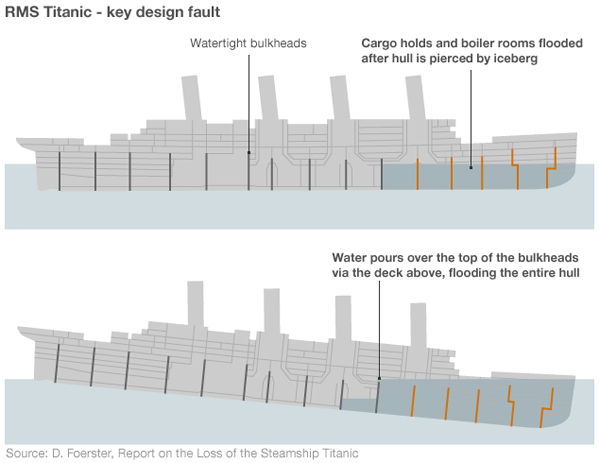
They once a built a ship on that principle they got carried away they put 15 in...

titanic-600.png


Where a bulkhead is already structural, rather than simply a divider of the space, then it takes very little to make it watertight and capable of withstanding significant abuse.
Tell that to a dinghy sailor, how many boats do you see saying "does not take water in tanks" "bouyancy tanks still dry" or what ever... Thats on small boats with compartments DESIGNED to do that... Then there are ventilation (mold etc) issues air expansion/ contraction issues and making it so you can actually live onboard... Not a boat for me....
 
I think we are talking at crossed purposes.

I am planning to have both watertight bulkheads and buoyancy compartments. There will be a bulkhead fore and aft dividing off a lazarette and an anchor locker. There will also be a watertight bulkhead to the forward cabin. I have not got my head around the aft cabin bulkhead yet. As well as this I want the under berth spaces to be sealable so that they provide buoyancy compartments. They will still be used for storage but there will be ample storage elsewhere for things that have a day to day use. This reduces the slight inconvenience of opening a watertight hatch to access these compartments.

As I said the construction method really requires some structural bulkheads as it is essentially frameless (no ribs). Where a bulkhead is already structural, rather than simply a divider of the space, then it takes very little to make it watertight and capable of withstanding significant abuse.

Water-tight bulkheads are standard on Amels:

http://www.forum-voiliers-amel.net/dossiers/doc_plans_Sharki2.pdf See towards the end in the b&w section.
 
why do you think you need it?

are you going to travel further and longer?

D

I bought one. with a limited budget other things had to be cut.
I was going further. Further off shore.
And intend to sail beyond range of SAR.

Noting to do with it. I hope never to need it.
The answer.
Persauding my wife to let me go sailing. No problem.
Persuading my wife to come a little bit harder.

Persauding my wife to let me take our Son. Life raft required.
While it may be a placeabo. it was essential. or the trip would not have happened.

I don't regret it.
My wife has no idea what an EPIRB is. Or A PLB please don't tell her. I cant afford one yet.
 
I bought one. with a limited budget other things had to be cut.
I was going further. Further off shore.
And intend to sail beyond range of SAR.

Noting to do with it. I hope never to need it.
The answer.
Persauding my wife to let me go sailing. No problem.
Persuading my wife to come a little bit harder.

Persauding my wife to let me take our Son. Life raft required.
While it may be a placeabo. it was essential. or the trip would not have happened.

I don't regret it.
My wife has no idea what an EPIRB is. Or A PLB please don't tell her. I cant afford one yet.

love the last line
 
I can see why folks may not kit out boats for a fairly long distance with EPIRB, life raft, flares etc if they don't have the money. But as I have pointed out in the PLB thread skipper has a legal duty of care to the crew and a crew death will be prosecuted. It is unlikely that would happen but it's not worth the risk in my view and I care about crew safety.
 
I can see why folks may not kit out boats for a fairly long distance with EPIRB, life raft, flares etc if they don't have the money. But as I have pointed out in the PLB thread skipper has a legal duty of care to the crew and a crew death will be prosecuted. It is unlikely that would happen but it's not worth the risk in my view and I care about crew safety.

interesting point

and clearly, as sailors, we assess risks every time we go sailing

we are individuals so we assess risks differently

One man's risk too large to take is another man's adventure or everyday experience

Just as the skipper assesses risks so do the others on board

I sail with people who know boats and sailing

They will know the weather forecast, the route, the hidey holes along the way - the chances of getting mowed down by a hovercraft or ferry.

For instance, when people come on my boat it is up to them when they choose to wear a life jacket - generally I would like to see them turn up with their own but I do have spares on board provided people are prepared to gamble on the age of the cylinder.

it is their choice to come sailing in my boat.

we all care about safety - some care more than others

does that mean I am a careless and foolhardy sailor?

serious question requiring some careful introspection.
 
Last edited:
we all care about safety - some care more than others

does that mean I am a careless and foolhardy sailor?

serious question requiring some careful introspection.

To some extent duty of care varies depending on whether visitors/crew have sufficient knowledge to assess the risk and make an informed decision or, whether they/he/she is inexperienced and you have to make the decisions for them. I provide life jackets for everyone on board (except children who I try to avoid), most of the time leaving the decision about wearing them to the individual but, not with inexperienced non-swimmers outside sheltered waters.
 
To some extent duty of care varies depending on whether visitors/crew have sufficient knowledge to assess the risk and make an informed decision or, whether they/he/she is inexperienced and you have to make the decisions for them. I provide life jackets for everyone on board (except children who I try to avoid), most of the time leaving the decision about wearing them to the individual but, not with inexperienced non-swimmers outside sheltered waters.

so the first thing you have to assess is their ability to assess the risk

which in turn relies on their assessment of your perception of risk

I am slowly coming to believe that I have a higher tolerance to risk than some of the sailors I have met over the years

However, when you bring economics into it as well

any fule with the funds would have a boat with all the bells and whistles safety protocols suggest

In an ideal world we would all be sailing boats that are up to charter standard regarding lotation devices, life-rafts, etc

however, I think that we need to widen the demographic a bit

and the best way of doing that is to keep sailing cheap.

I confess that so far there has only been one moment in the whole trip so far when I had even the most fleeting thought that knowing I had a life raft and epirb on-board would be a comfort.


D
 
I confess that so far there has only been one moment in the whole trip so far when I had even the most fleeting thought that knowing I had a life raft and epirb on-board would be a comfort. D

EPIRB is a comfort but the funny thing about the life raft is I sometimes look at the breaking waves and the wind speed and doubt if I would be able to catch the thing before it blows away down wind:sorrow:
 
Dylan challenged us to think carefully about the issues here. One thought struck me that is not meant to be offensive, but is a genuine question.

In the first post Dylan says he was always within vhf range and mobile phone range of emergency services, so why buy a liferaft.

Isn't this passing on the responsibility and cost for your own and crew's safety to someone else? It acknowledges the risks, but assumes someone else will come and deal with it?

A liferaft still requires rescue, but for me it gives me more ways to act my self in a situation rather than rely on others. I am sure the emergency services would prefer to go home after pulling people from a raft rather than bodies from the sea?
 
Last edited:
Dylan challenged us to think carefully about the issues here. One thought struck me that is not meant to be offensive, but is a genuine question.

In the first post Dylan says he was always within vhf range and mobile phone range of emergency services, so why buy a liferaft.

Isn't this passing on the responsibility and cost for your own and crew's safety to someone else? It acknowledges the risks, but assumes someone else will come and deal with it?

A liferaft still requires rescue, but for me it gives me more ways to act my self in a situation rather than rely on others. I am sure the emergency services would prefer to go home after pulling people from a raft rather than bodies from the sea?

what you say is true - in part

but as you say in a life raft you still need rescueing

it is a slim argument that you are a better person because the rescue servivces would prefer to pick up live bodies from a raft than dead ones from the sea

so I am no more reliant on the rescue services than the next man who has spent £800 on a life raft

externalising the risk is true

although over the years I have paid blooming hundreds - probably thousands of pounts into RNLI coffers and never used them

.... yet.

here I am, devlishly dangerous dyl - five decades afloat and still sailing

I do know that if I had to buy a life raft, epirbs, survival suits for five then I would never have set off around the UK

and that is before we get into compulsory survival courses

I can remember the days when you did not have to wear a life-jacket in dinghy races

and blow me.... I did not know anyone who died
 
and blow me.... I did not know anyone who died

Back in the 1980s I remember taking police divers out on the club dory to help with a search ...can't describe the feelings of hope and hopelessness as the sun rose after a night's fruitless effort.

Two little kids had gone kayaking with their dad on Blessington Lake, about twenty miles south of Dublin ...no life jackets were worn and nobody survived ...water was flat calm and warmed to about 20 degrees during an unusually hot Irish summer.
 
Last edited:
The only guy I've ever met whose life was actually saved by a liferaft was the guy who taught me my YM Theory.

He'd been one of a crew of four racing in the Channel in the 1970s. The yacht suddenly started taking on a lot of water - I don't know the precise problem but the ingress was rapid and more than the crew could deal with - and so they took to the LR as the yacht sank. No VHF, no flares (one of the crew hadn't understood their correct firing, declared them all dud and suddenly chucked the lot into the sea!). They were extremely lucky to be washed up - eventually - sick, frightened but otherwise unscathed, on the Dutch shore.

Almost all of the discussion on this thread is of no relevance to me. For coastal and offshore sailing, I carry an in-date liferaft, in-date flares, and grab-bag containing handheld VHF, handheld GPS-plotter and EPIRB. Lifejackets are worn whenever underway.

Responsible safety is (in addition to prerequisites of good seamanship) all about actually having the correct emergency equipment should you ever really need it, and the training to use it correctly.
 
what you say is true - in part

but as you say in a life raft you still need rescueing

it is a slim argument that you are a better person because the rescue servivces would prefer to pick up live bodies from a raft than dead ones from the sea

so I am no more reliant on the rescue services than the next man who has spent £800 on a life raft

externalising the risk is true

although over the years I have paid blooming hundreds - probably thousands of pounts into RNLI coffers and never used them

.... yet.

here I am, devlishly dangerous dyl - five decades afloat and still sailing

I do know that if I had to buy a life raft, epirbs, survival suits for five then I would never have set off around the UK

and that is before we get into compulsory survival courses

I can remember the days when you did not have to wear a life-jacket in dinghy races

and blow me.... I did not know anyone who died

It's a bit like insurance - it's a heck of a cost for nothing....

However, just think that you might find yourself in a sinking boat - and it can happen - and you have no back-up solution.
 
I can see why folks may not kit out boats for a fairly long distance with EPIRB, life raft, flares etc if they don't have the money. But as I have pointed out in the PLB thread skipper has a legal duty of care to the crew and a crew death will be prosecuted. It is unlikely that would happen but it's not worth the risk in my view and I care about crew safety.

Can anyone please point me to a single case where an amateur, hobby sailor has been sued by their crew (or prosecuted for injuring/ killing them). It doesn't even have to be a successful case, just one where an attempt was made to get a "for pleasure" skipper in court for a personal accident. Please don't try to show me stuff where racers or similar have sailed in front of big ships in defiance of sanity.

Thousands of us go to sea every weekend & get into scrapes with our mates & seldom does nayone actually get hurt, but it does happen & occasionally someone will actually die or be badly injured, but has anyone actually ever sued for damages rather than just collected an insurance payout?
 
Lots of safety risk gobaldy gook here...

I am with Dylan on this I have no liferaft, do have PLB now and life jackets for crew.

If you add up the costs for maintaining the emergency equipment seen as essential for some on here its more than the cost of running my boat for the year.

When I am out on the water I meet canoes dinghies etc doing long passages in open waters they have most of it either, should they?

Part of my assessment of sailing is Risk and Damage to Equipment. I do not want to risk my equipment so I cannot afford or be able to go sailing, that's before I consider danger to life. I sail conservatively, I check my forecasts etc. It does not mean I don't go out in windy weather or the boat is not capable to sail in bad weather. I just sail conservatively when I do, I also avoid putting myself in situation where I have to sail in windy weather etc. I do this for fun.

If I spent my weekends commuting across the channel what ever the weather as some on here seem to, I may reconsider this at the moment I see no need.

There is more risk for me walking to my local pub and back than sailing without a life raft... Whilst still being aware that you cannot predict whats going to be hit by lightening, don't ask how I know....
 
Top