Self install of LifePo4 and what requirements for insurance (UK)

A gassing battery, producing enough hydrogen to explode and start a fire is, in my opinion, nonsense.

Hydrogen is 14 times lighter than air and rises at a speed of almost 20 meters per second, what's the chances of it travelling along the length of a boat ?

Sure, it will explode, i've seen a battery explode up close, but no flames and no fire. It goes bang and the gas is gone. We're talking batteries here, not Zeppelins.
 
A gassing battery, producing enough hydrogen to explode and start a fire is, in my opinion, nonsense.

Hydrogen is 14 times lighter than air and rises at a speed of almost 20 meters per second, what's the chances of it travelling along the length of a boat ?

Sure, it will explode, i've seen a battery explode up close, but no flames and no fire. It goes bang and the gas is gone. We're talking batteries here, not Zeppelins.
As @PaulRainbow says, a hydrogen explosion is extremely unlikely. Most battery explosions are steam explosions, resulting from internal short circuits. Hydrogen gas is almost impossible to confine and diffuses extremely rapidly. The chances of an explosive mixture forming are low in the extreme.

Even zeppelins, carrying vast quantities of hydrogen, burnt rather than exploding as can be seen in newsreel footage of the destruction of the Hindenburg.
 
Even if we assume that’s the case (and I highly doubt it) it still isn’t a “lithium battery fire”.

Seems at least as likely to me that the “explosion” was a standard backdraft that any fire produces when air is added and the fire was an electrical or galley fire. Hydrogen is a pretty specific kind of explosion and if that was the start then flames wouldn’t have been present until later if at all.

I feel like a lot of folk are reaching for reasons it was battery related when occam’s razor would suggest numerous more likely events. Even the evidence being put forwards suggests it’s not a battery fire so seems odd so many are determined it was.
You are perhaps in danger of jumping to conclusion. The galley consisted of and induction hob, a kettle and a fridge. The boat was not being used at the time. Perhaps the appliances were left on and malfunctioned but that seems unlikely.

Unwise to speculate - there is simply not enough hard information. Wait for the official report.
 
You are perhaps in danger of jumping to conclusion. The galley consisted of and induction hob, a kettle and a fridge. The boat was not being used at the time. Perhaps the appliances were left on and malfunctioned but that seems unlikely.

Unwise to speculate - there is simply not enough hard information. Wait for the official report.
Not at all. Unlike those determined that this was a battery fire, which appears entirely disproven, i’m simply saying that’s more likely. Induction hobs can cause fires quite easily, they’re electrical appliances and can have faults, same with a fridge or any other electrical system. The location of the fire suggests that too.

I didn’t draw any conclusions as there is zero evidence to draw from. Everything available suggests it’s not a lithium battery fire though, so we can probably put the conspiracies to bed now.
 
Not at all. Unlike those determined that this was a battery fire, which appears entirely disproven, i’m simply saying that’s more likely. Induction hobs can cause fires quite easily, they’re electrical appliances and can have faults, same with a fridge or any other electrical system. The location of the fire suggests that too.

I didn’t draw any conclusions as there is zero evidence to draw from. Everything available suggests it’s not a lithium battery fire though, so we can probably put the conspiracies to bed now.
Don't wriggle. An induction hob will not explode, neither will a kettle or a fridge.. Remember this was an explosion therefore there was a release of some explosive gas and a source of ignition. The batteries were being charged at the time and this MAY have been the source of the gas and a fault in the electrics MAY have been what ignited the gases. Apart from the nutcases don't think anybody here is suggesting it is a "battery fire"

There is much more about this on the other thread (or are you banned from reading as well as contributing?)
 
I am actively considering fitting a LiFePO4 domestic battery as a replacement for my current lead acid domestic battery which means I have to make the decision using whatever information we currently have. While I can clearly see the substantial advantages of fitting a LiFePO4 battery (better effective capacity for weight, longer service life if looked after well), I still have an open mind about the risks. So far:

I am reasonably convinced that LiFePO4 batteries don't undergo thermal runaway leading to explosion and/or fire in the way that other lithium batteries cab and do. Reason: the chemistry isn't right.

A narrow boat on an inland waterway recently suffered an explosion (people heard a bang) and fire (video footage). My tin foil hat detector tells me this really happened ie it is not fake news made up by the Lead Acid Battery Manufacturers Association (motto: Better Lead than Dead). Furthermore, it is alleged, though not proven, that the affected narrow boat (a) had a large LiFePO4 battery bank on board (b) the batteries were on charge at the time of the explosion, (c) no one was onboard at the time (thankfully, but also means it wasn't direct human intervention that cause the explosion) (d) there were no fossil fuels on board at all and (e) the narrow boat had a number of electrical items on board capable of (but not proven to) causing a spark. There is also no reason to suspect arson.

Of the many anecdotal reports of allegedly lithium battery related explosions and fires, this is one of the more useful ones, since it (a) happened on a boat and (b) the batteries appear to have been LiFePO4 batteries, the kind I will fit if I do go ahead and install lithium batteries.

So far, we know there was an explosion and fire, in the absence of any known fossil fuels. The rest of the boat is pretty inert, but at the same time the batteries were being charged. Energy was being fed into that boat and the batteries were active (being charged) at the time the explosion occurred.

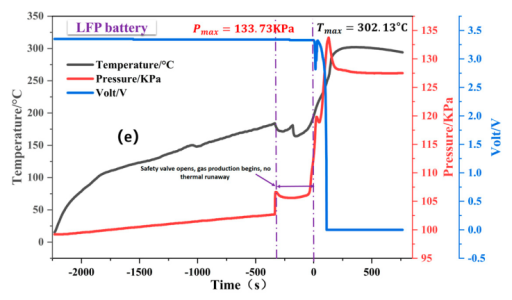
We also know, from the paper that I linked to above, that given sufficient abuse (thermal abuse) in laboratory conditions, LiFePO4 batteries can produce a quantity of hydrogen over a short period of time (note: lead acid batteries may produce more, but over a much longer time frame). Other potentially harmful gases eg carbon monoxide may also be be produced, How hot does a LiFePO4 have to get before it starts misbehaving, and producing gasses? Here is the chart from the paper:

1755503586725.png

Things started happening at around T minus 300 seconds, when the battery temperature sensor recorded around 175°C. At this point, gas production started, and then, at T Zero, the 'main event' happened, gas production increased substantially and the temperature rose, but 'only' to 302°C (which presumably accounts for some but not all of the pressure rise). In all (from other data posted above), it seems that a 100Ah LiFePO4 battery might produce around 25L of hydrogen gas over a short period of time. We don't know how many batteries the affected narrow boat had, or what their capacities were, but we believe there were several - lets say four - and if their capacities were 200Ah (see previously posted screen grab), then we have a battery bank capable, if subject to sufficient thermal abuse, of producing a 200L hydrogen bomb cloud over a short period of time.

At this point it may or may not be worth recalling Conan Doyle: "When you have eliminated the impossible whatever remains, however improbable, must be the truth". We haven't yet fully eliminated the impossible, though we have done some of the way eg we believe there were no fossil fuels on board, and at the moment, what remains is rather improbable, to say the least - but I am not yet sure it is impossible.

One key question for me at the moment is how likely is it that a LiFePO4 battery in a sound real world installation would ever reach case temperatures in excess of 150°C? Sure they might in a fire, but by that point you have got other rather more pressing problems on your hands. If in normal operation, they never get that hot, then the risk of significant short term hydrogen production remains extremely low.

PS vis-avis other posts: can we please stop arguing about whether the was a LiFePO4 battery fire per se? I think it is sufficiently well established that they don't do thermal runaway/spontaneous combustion on their own, the question instead is whether by some other mechanism they can lead to fire and/or explosion.

PPS sneak preview of an insurance approved LiFePO4 battary compartment designed for the marine leisure market due to be unveiled at the Southampton Boat Show next month:

1755506897258.png

Edited to correct inevitable typos...
 
Just to add one point in relation to the exploding narrow boat. Photos of a sister ship show 2*20kWh banks, one for propulsion and the other for domestics (although that sounds improbable). It has a 10kW motor which would typically use 4-5kW for cruising. So not enough in one bank for a day continuous running.
 
Don't wriggle. An induction hob will not explode, neither will a kettle or a fridge.. Remember this was an explosion therefore there was a release of some explosive gas and a source of ignition. The batteries were being charged at the time and this MAY have been the source of the gas and a fault in the electrics MAY have been what ignited the gases. Apart from the nutcases don't think anybody here is suggesting it is a "battery fire"

There is much more about this on the other thread (or are you banned from reading as well as contributing?)
I’m not wriggling at all, I thought what I said was quite straightforward.

LiFePo4 batteries don’t explode either so Im not sure why you mentioned the cooker etc.
i already said it seems more likely a backdraft event which to the untrained eye does look like an explosion.

The batteries may have been being charged yes. The cooker may have been heating something to the point of fire too. You don’t know any more than I do, but seem more willing to fill in the gaps with imagination.

I do agree, the sensible folk aren’t suggesting a battery fire, and if your theory is right then we’re still back to LiFePo4 being safer since lead being overcharged would have been much worse in terms of hydrogen. As I and others have said though, hydrogen is a very particular kind of explosion which witnesses would have described had it happened.
 
there were no fossil fuels on board at all
But there was ample fuel for a fire. Hot wood also offgases and in an enclosed space will build heat and fuel until oxygen is added causing a backdraft event, looking just like an explosion.
note: lead acid batteries may produce more, but over a much longer time frame
Do they? The numbers here and elsewhere would appear to suggest the opposite. Lead starts gassing immediately where too much current is being applied, and for 10A overcurrent will produce 10l in an hour. This will be before a LFP even starts gassing.
 
Photos of a sister ship show 2*20kWh banks

Source (link?) - I know I can be pedantic, but sources do help to verify things.

2*20kWh (energy), 10kW and 4-5kW (both power) - we always need to be careful with units. The paper I have quoted gives battery gas production per Ah. 2*20kWh (2*20,000Wh) is a LOT of energy, on the basis that amp hours = watt hours / volts that is 3333Ah which is a LOT of batteries (and a LOT of gas, around 1666L, with over 800L of hydrogen) based on the rates given in the paper.

But there was ample fuel for a fire.

But there has to be something that catches fire, and from the reports we have the fire started with a bang (explosion). I have yet to see wod spontaneously explode.

Do they? The numbers here and elsewhere would appear to suggest the opposite. Lead starts gassing immediately where too much current is being applied, and for 10A overcurrent will produce 10l in an hour. This will be before a LFP even starts gassing.

I don't know, I am looking into it. Previously I thought LA batteries produced relatively small amounts of hydrogen over long periods (with possibly time for dispersion) whereas the paper I quoted suggests a relatively sudden release of gas over a short period of time when a LiFePO4 battery is overheated (> about 175 degrees C).
 
Typically the BMS will shut everything down at about 60⁰C so if the narrowboat was indeed an explosion/fire that originated in the LiFePO4 cells themselves, it must have been caused either by a faulty BMS and subsequent severe overcharging, or by something that was able to bypass the BMS, such as an internal short.
Just trying to speculate in a way that fits the facts.

That paper with all the pretty graphs is certainly interesting. On careful reading it absolutely reaffirms the position that LiFePO4 is a much safer chemistry than NMC.
 
But there has to be something that catches fire, and from the reports we have the fire started with a bang (explosion). I have yet to see wod spontaneously explode.
Reports say that people noticed the fire after the noise. Entirely consistent with backdrafts and either would be as likely. The fire could well have been smouldering for an hour before it was noticed and if the boat closed up may not have been noticed. Any ingress of air would have caused a bang and flames such as a window giving out or a hatch.
Previously I thought LA batteries produced relatively small amounts of hydrogen over long periods
They produce with electrolysis. Higher current or surface area will increase production drastically. AGM are literally designed to maximise surface area so if it’s gas we’re worried about AGM would likely be the least safe option.
 
Typically the BMS will shut everything down at about 60⁰C so if the narrowboat was indeed an explosion/fire that originated in the LiFePO4 cells themselves, it must have been caused either by a faulty BMS and subsequent severe overcharging, or by something that was able to bypass the BMS, such as an internal short.
Just trying to speculate in a way that fits the facts.

That paper with all the pretty graphs is certainly interesting. On careful reading it absolutely reaffirms the position that LiFePO4 is a much safer chemistry than NMC.
Agree with this. The series of events that would lead to LFP being the cause just don’t seem plausible to me.

The paper describes what happens if you force a runaway event, and seems to ignore how hard that would be as the focus is what happens next. There are papers on what happens when hydrogen fusion is started but we don’t worry about that either as it’s also quite unlikely to suddenly kick off 🤣
 
Much of the misunderstanding here of what happened in the canal boat fire comes about because there are now 2 threads running on what is essentially the same subject, even though this one started from a different question.

Suggest you all read here (I know some have already contributed to both) forums.ybw.com/threads/a-man-who-does-not-mince-his-words.621434/ This has the original video of the fire and the loud mouth commentary, Post#126 has the fireman giving his (distant) view which helpfully includes the photos of the interior of the boat, its batteries and motor and post#143 an explanation of LFP batteries gassing which is largely consistent with the academic papers currently being discussed.

Together they seem to support a sequence of events that started with a possible failure in charging or a short in the battery bank which resulted in overheating and escape of gasses which were then ignited in the galley area (cause unknown). This caused an explosion followed by a fire that was sufficient to burn the batteries.

There are of course still gaps but the sequence is consistent with the video and the known behaviour of overheated LFP batteries in confined spaces.
 
Agree with this. The series of events that would lead to LFP being the cause just don’t seem plausible to me.

I think we need to be clear about the semantics here, in particular the word 'cause'. If for whatever reason (faulty BMS? external heat source?) a LiFePO4 battery goes rogue, and starts to emit hydrogen, and that hydrogen is subsequently ignited either next to the battery or nearby, has that LiFePO4 caused the fire/explosion? It's really down to the semantics of underlying cause: BMS fails/external heat applied > LiFePO4 battery produces hydrogen > hydrogen ignites. Which step is the underlying cause?

An what about 'cheap knock off battery manufacturer > BMS fails > LiFePO4 battery produces hydrogen > hydrogen ignites'? In these examples, the LiFePO4 battery is certainly involved.

Back to determining how much hydrogen a normal wet lead acid battery produces (for comparison to that produced by an over-heated LiFePO4 battery): generally, significant hydrogen (and oxygen) only get produced during gassing in the late stages of charging. There are various formulas available online, and not one I have found is entirely clear and satisfactory. That said, I have adapted this one to get litres rather than cubic feet, and don't think I have made a mistake (but any corrections very welcome if I have) for a single 120Ah battery (note formula uses the lower 6h rate capacity).

Wet lead acid battery:

Number of cells (6 for 12V)
Assumed % overcharge
Litre of H2 per Ah of charge
6h rate capacity
Overcharge time
H2 per hour (litres)
Total H2 (litres)

12.5L per hour, 50L over 4 hours. This compares to around (numbers from the original paper linked to above) 0.55L/Ah x 54%Hydrogen x 120Ah (at 20h rate) = 35L over a few seconds. They seem to me rather different events.
 
I think we need to be clear about the semantics here, in particular the word 'cause'. If for whatever reason (faulty BMS? external heat source?) a LiFePO4 battery goes rogue, and starts to emit hydrogen, and that hydrogen is subsequently ignited either next to the battery or nearby, has that LiFePO4 caused the fire/explosion? It's really down to the semantics of underlying cause: BMS fails/external heat applied > LiFePO4 battery produces hydrogen > hydrogen ignites. Which step is the underlying cause?
I was clear with semantics. A faulty BMS would have to be accompanied by a faulty charger and quite a bit of neglect for many hours. Thats some pretty long odds for being the cause. Im not saying it’s not possible, I’m saying there are a thousand far more plausible explanations if not more.

Quoting a fireman on scene is ridiculous. It’s a gut reaction not an explanation and based on absolute assumptions from a person who has seen and been trained on lithium cars primarily. Ask them now and I imagine they’d say something else. It’s not like the quote was absolute, he said “probably lithium fire” while dealing with a fire and trying to get people away from the scene. I read that as a polite “f&£k off” not a statement.
 
Together they seem to support a sequence of events that started with a possible failure in charging or a short in the battery bank which resulted in overheating and escape of gasses which were then ignited in the galley area (cause unknown). This caused an explosion followed by a fire that was sufficient to burn the batteries.

There are of course still gaps but the sequence is consistent with the video and the known behaviour of overheated LFP batteries in confined spaces.

Agreed, and of course it is still only a tentative conclusion, but plausible, even if very rare, and just as importantly, can be made even rarer by careful mitigation measures.

Getting back on topic for this thread, I have now heard back from my insurers:

"If Your Craft, tender or toys are fitted with Lithium-ion batteries they must be charged within daylight hours , must not be left unattended whilst being charged and they must be used in accordance with the manufacturers’ recommendations/instructions." Presumably that also includes my wife's electric dildo collection.

The above restrictions I already knew about, they have been in the policy wording for a couple of years or so.

They also say "Also, your insurer would require the batteries be fitted by a professional." But they don't say what kind of professional. As member of one of the original true professions (medicine, church and the law), I am indeed a true professional. Perhaps I might even get away with it - and then get hauled up in front of the GMC for bringing the profession into disrepute.

I have replied questioning some of the insurer's assumptions but I am not sure how far I well get. Probably nowhere.
 
They also say "Also, your insurer would require the batteries be fitted by a professional." But they don't say what kind of professional
Does that specific clause specify the type of battery? If that’s a direct quote then it doesn’t exclude lead.
 
Agreed, and of course it is still only a tentative conclusion, but plausible, even if very rare, and just as importantly, can be made even rarer by careful mitigation measures.

Getting back on topic for this thread, I have now heard back from my insurers:

"If Your Craft, tender or toys are fitted with Lithium-ion batteries they must be charged within daylight hours , must not be left unattended whilst being charged and they must be used in accordance with the manufacturers’ recommendations/instructions." Presumably that also includes my wife's electric dildo collection.

The above restrictions I already knew about, they have been in the policy wording for a couple of years or so.

They also say "Also, your insurer would require the batteries be fitted by a professional." But they don't say what kind of professional. As member of one of the original true professions (medicine, church and the law), I am indeed a true professional. Perhaps I might even get away with it - and then get hauled up in front of the GMC for bringing the profession into disrepute.

I have replied questioning some of the insurer's assumptions but I am not sure how far I well get. Probably nowhere.
Move your insurance.
 
Does that specific clause specify the type of battery? If that’s a direct quote then it doesn’t exclude lead.

More semantics! It is a direct quote from the email, and I think, because of the context ie my specific request about LiFePO4 batteries, the batteries here refers to the batteries under discussion, ie LiFePO4 batteries. But I agree it can be seen as ambiguous. It is just another verbal knicker twist example of the insurance version of "what a tangled web we weave when first we practice to relieve [ourselves from any obligation to pay out claims...]"
 
Top