Self install of LifePo4 and what requirements for insurance (UK)

And your point is?
Of course this argument can be used for anything, however my point is that when making a claim the loss adjuster can possibly make it very inconvenient for you to get a satisfactory settlement especially with the added possible third party environmental clean up costs.
People that think they are clever invariably end up with a loss.
Not sure what you thought I was saying. I agree with you, but the same is true of lead batteries. Someone on another thread suggested that’s not the case because negligence is covered, but that being the case then it would also apply to LiFePo4.
 
The above pedantry aside, I'll be happily replacing my lead acid batteries this winter with LiFeP04 ones. With the correct DC to Dc charger and all other electrical safety procedures in place, I'll sleep easy.
But per all these threads, if you do will you still be able to get insurance cover? That is the core issue.
 
I see Renogy is now selling batteries with a flame proof casing
Would it be easier to get insurance with these on board
  • 12V 200Ah Pro Smart Lithium Iron Phosphate Battery

Better Safe than Sorry​

According to UL Solutions' Lithium-Ion Battery Incident Reporting, over 9,000 lithium battery-related incidents have been reported worldwide. The rapid growth of lithium battery use has led to a significant increase in incidents, resulting in injuries and fatalities. It's more important than ever to understand these risks and take active steps to prevent misuse.
2-1912-976-2nd_a3d56517-c6e4-4bb0-a4d5-88edae5b28e6.jpg
 
I see Renogy is now selling batteries with a flame proof casing
Would it be easier to get insurance with these on board
  • 12V 200Ah Pro Smart Lithium Iron Phosphate Battery

Better Safe than Sorry​

According to UL Solutions' Lithium-Ion Battery Incident Reporting, over 9,000 lithium battery-related incidents have been reported worldwide. The rapid growth of lithium battery use has led to a significant increase in incidents, resulting in injuries and fatalities. It's more important than ever to understand these risks and take active steps to prevent misuse.
2-1912-976-2nd_a3d56517-c6e4-4bb0-a4d5-88edae5b28e6.jpg
LOL They appear to have invented Magic!
It's just a gimmick.
 
I see Renogy is now selling batteries with a flame proof casing
Would it be easier to get insurance with these on board
  • 12V 200Ah Pro Smart Lithium Iron Phosphate Battery

Better Safe than Sorry​

According to UL Solutions' Lithium-Ion Battery Incident Reporting, over 9,000 lithium battery-related incidents have been reported worldwide. The rapid growth of lithium battery use has led to a significant increase in incidents, resulting in injuries and fatalities. It's more important than ever to understand these risks and take active steps to prevent misuse.
2-1912-976-2nd_a3d56517-c6e4-4bb0-a4d5-88edae5b28e6.jpg
Suggest you (and everybody else) actually goes to the cited source ul.com/insights/lithium-ion-battery-incident-reporting Not a single mention of boats and the only category that might have included house batteries in boats is energy storage which barely registers.

This is the sort of information that is used by sceptics (and insurers) to underpin their positions.
 
Suggest you (and everybody else) actually goes to the cited source ul.com/insights/lithium-ion-battery-incident-reporting Not a single mention of boats and the only category that might have included house batteries in boats is energy storage which barely registers.

This is the sort of information that is used by sceptics (and insurers) to underpin their positions.
I didn’t mean to add to the fear mongering , I am looking at different battery brands at the moment and when I saw this I thought I’d ask what people thought. It does seem strange that Renogy are saying be careful of lithium and yet only their expensive batteries have all the safety features .
I am intending to self install lithium over the winter and my insurance company is willing to cover it so I am just trying to find the best battery within my budget .
 
I didn’t mean to add to the fear mongering , I am looking at different battery brands at the moment and when I saw this I thought I’d ask what people thought. It does seem strange that Renogy are saying be careful of lithium and yet only their expensive batteries have all the safety features .
I am intending to self install lithium over the winter and my insurance company is willing to cover it so I am just trying to find the best battery within my budget .
Fogstar
 
Agree Fogstar have everything needed, are reasonably priced, based in UK, and are very safe and have remarkably good customer service.
 
I didn’t mean to add to the fear mongering , I am looking at different battery brands at the moment and when I saw this I thought I’d ask what people thought. It does seem strange that Renogy are saying be careful of lithium and yet only their expensive batteries have all the safety features .
I am intending to self install lithium over the winter and my insurance company is willing to cover it so I am just trying to find the best battery within my budget .
Appreciate that which is why I included "everybody else".

Typical straw man strategy - raise something as a perceived problem in order to push your "solution" to differentiate your product from others, who probably either already do the same thing but don't shout about it or don't see it as an issue. Then add a reference to an impressive source of what is actually worthless information knowing almost nobody will actually go to the source.
 
Suggest you (and everybody else) actually goes to the cited source ul.com/insights/lithium-ion-battery-incident-reporting Not a single mention of boats and the only category that might have included house batteries in boats is energy storage which barely registers.

This is the sort of information that is used by sceptics (and insurers) to underpin their positions.

This is one of the few 'data' sources that are available online and it is far from ideal. The methodology is opaque (55% of incidents come from 'The News' but how is that data collected?), If it is spontaneous reporting, it is in effect haphazard. Apparently here in the UK 1% of total incidents involve a fatality, but how many total incidents are there in the UK? Where is the data behind the 'info' presented on the 'infographic', the numbers behind the rates? This sort of 'info' can be worse than nothing at all, because it can be misused and abused at will.

Lithium ion batteries are everywhere, but when did you last see a Duracell lithium bunny spontaneously explode/combust? How many Lifepo battery fires are there annually on UK vessels (inland and seagoing)? What is the rate (number of fires / number of installations)? How do these numbers compare to the same numbers for lead acid batteries? Do we even know how many fires of any cause there are annually on UK vessels? A fairly commonly repeated number is 89 per annum with three fatalities, but I have not been able to determine the source for those numbers, though they are broadly in line with the latest (2024/25) official Fire and Rescue Incident statistics (see FIRE 0303 here), which report 117 accidental boat fires (and 21 'deliberate' boat fires - cripes!) . If they are roughly correct - say 100 per annum - then given say there maybe around 400,000 privately owned vessels in the UK, then that is an annual incidence rate of 0.025%, or one in 4000 vessels. How many of the 100 or so average were caused by LiFePO batteries? We don't appear to know, though we do know there are plenty of other potential causes of fire on board.

The US Coast Guard do however produce an annual Recreational Boating Statistics report which does have some potentially useful attributable cause data. According to the latest report (2024), there were 11,674,073 registered recreational vessels in the US, giving rise to 74 reportable incidents (generally something reasonably serious) involving non-fuel/unknown origin fires/explosions (the US stats do a partial breakdown by cause into fuel and non-fuel related fires), with one death. That's an annual incident rate of 0.0006%, or one in 158,000 registered vessels. These rates are so unbelievably low I had to double check my source and calculations, and they appear to be correct. Either the Americans aren't using lithium batteries on recreational boats, or if they are, either the fire/explosion risk is negligible, or the raw stats are up the spout (which does happen, but I don't think it has happened here).

What I am getting at is that we appear to be in a data vacuum in the UK. OK, the absence of evidence isn't evidence of absence, but we do have the US data, and it suggests negligible risk. The case for insurance requirements, excesses and exclusions seems to me to lack substance.
 
A long thread, but I have not seen a single post of actual insurance policy language. Just a lot of "I think" this will happen.

I have seen US policies that require an installer (they do not use the term electrician) trained in the ABYC standard. Most say nothing about lithium. The ABYC standard has a number of requirements different from LA (mostly charging interlocks) but that is a voluntary standard.

There also seems to be some confusion regarding cell phones and power tools vs. LiFePO4 batteries used in boats. They are as different as LA is from NiCads and don't really belong in the same conversation.
I thought the problem with Lithium battery fires was that water did NOT extinguish them?
LiFePO4 batteries do not catch fire. Other lithium batteries can. They start with "lithium" but are barely related. This is why the ABYC finally accepted LiFePO4 only.

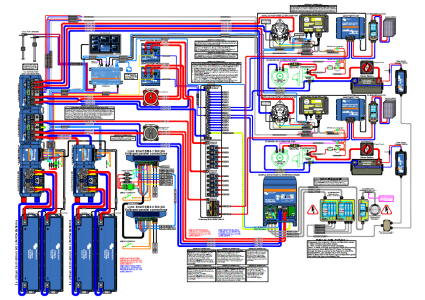
Another concern, not mentioned in this thread (or only obliquely) is the risk of "dark ship." If the BMS trips because you did not get the charge regulation right, or for several other reasons, everything dies and the batteries are not quickly reset. I've heard of a few cases. Also, if the BMS trips while the engine is running, special steps are required to prevent a fried alternator or fried electronics (voltage surge). I'd be more worried about these issues. They are covered in ABCY and you can find information on the net, if you dig. The better makers now offer integrated systems and good instructions (more than most installers know).

1755210840826.png

This may convince you that this is not a DIY job, or even for most installers, unless the system is quite simple (for example, only solar charging and no starting battery simplifies it a lot).
victron schematics
 
You are right about the US but they have the data because it is a legal requirement to report incidents to the coastguard. In an earlier life I carried out a lot of analysis of accident reporting and discovered the same as you. There is some data available from coastguard and RNLI but it is in a form that suits them so does not really help. MAIB is a useful source of the causes behind serious incidents, but as these are rare and random they are mainly useful for identifying specific issues rather than patterns. Drink boating is a prime example. The BPA is having another go at implementing the drink boating law claiming that there are many incidents that involve excessive drinking. However they (and other campaigners) have never found any hard evidence that it is a systemic problem. The incidents are rare and random and the main common factor is that they involve small high powered motor boats or RIBs

My reason for calling this source out is to illustrate that there is no hard data to support the conspiracy theorists - and if there was a serious issue with lots of boats catching fire we would have heard about it. As it is most of the press reports are unreliable because they are mainly interested in sensational headlines rathe than sober facts.
 
I didn’t mean to add to the fear mongering , I am looking at different battery brands at the moment and when I saw this I thought I’d ask what people thought. It does seem strange that Renogy are saying be careful of lithium and yet only their expensive batteries have all the safety features .
I am intending to self install lithium over the winter and my insurance company is willing to cover it so I am just trying to find the best battery within my budget .

A long thread, but I have not seen a single post of actual insurance policy language. Just a lot of "I think" this will happen.

I have seen US policies that require an installer (they do not use the term electrician) trained in the ABYC standard. Most say nothing about lithium. The ABYC standard has a number of requirements different from LA (mostly charging interlocks) but that is a voluntary standard.

There also seems to be some confusion regarding cell phones and power tools vs. LiFePO4 batteries used in boats. They are as different as LA is from NiCads and don't really belong in the same conversation.

LiFePO4 batteries do not catch fire. Other lithium batteries can. They start with "lithium" but are barely related. This is why the ABYC finally accepted LiFePO4 only.

Another concern, not mentioned in this thread (or only obliquely) is the risk of "dark ship." If the BMS trips because you did not get the charge regulation right, or for several other reasons, everything dies and the batteries are not quickly reset. I've heard of a few cases. Also, if the BMS trips while the engine is running, special steps are required to prevent a fried alternator or fried electronics (voltage surge). I'd be more worried about these issues. They are covered in ABCY and you can find information on the net, if you dig. The better makers now offer integrated systems and good instructions (more than most installers know).

View attachment 197797

This may convince you that this is not a DIY job, or even for most installers, unless the system is quite simple (for example, only solar charging and no starting battery simplifies it a lot).
victron schematics
victron system architecture for their lifepo4 batteries that have an external bms is crazy complex. It's designed to sell you all those blue boxes.
When you break it down, there is not a lot needed for most typical small sailing boats.
A couple of good quality lithium batteries with Bluetooth. A couple of NH or class T fuses, a couple of battery isolators. +ve and -ve busbars. A DC/DC charger and a smart shunt. That would be the base system. Only two Victron blue devices!
 
Top