fisherman
Well-Known Member
I would suggest inertia: you have to set the whole column of water in motion.
Why not wash up in a colander, so no bits down the drain?
Why not wash up in a colander, so no bits down the drain?

Could you please give me a technical explanation for your statement above,

pvb has already explained it. The deeper the drain the greater the pressure of the water left in the section of the pipe under water in relation to the head above so the longer it takes to displace the water underneath by overcoming the pressure.
Just make a rig to replicate the run of pipe and the depth of water and prove it for yourself.
pvb has already explained it. The deeper the drain the greater the pressure of the water left in the section of the pipe under water in relation to the head above so the longer it takes to displace the water underneath by overcoming the pressure.
Just make a rig to replicate the run of pipe and the depth of water and prove it for yourself.

Actually, my explanation didn't support your statement that "The deeper the exit under water the slower the drain." Regardless of the position of the seacock, the only thing which affects the flow is the head between the sink and the waterline. You could argue that a seacock deep down would involve a greater length of pipe which would introduce a bit more friction, but it's clutching at straws.
The one think that need to be considered with a seacock outlet above the waterline is the lack of head between the sink and the outlet height. This will be less thet the head when the sea cock outlet is below the waterline.
Most above-waterline outlets are in fact very close to the waterline and there'll be minimal difference - indeed the tiny reduction in head would most probably be outweighed by the shorter pipe with less friction.
Just use the simple rule of thumb as used by generations of oil field workers, 27" height of water equals one psi. So measure the top of the water level in the sink to the waterline and that will give a good idea of the psi pressure.pvb has already explained it. The deeper the drain the greater the pressure of the water left in the section of the pipe under water in relation to the head above so the longer it takes to displace the water underneath by overcoming the pressure.
Just make a rig to replicate the run of pipe and the depth of water and prove it for yourself.
Just use the simple rule of thumb as used by generations of oil field workers, 27" height of water equals one psi. So measure the top of the water level in the sink to the waterline and that will give a good idea of the psi pressure.

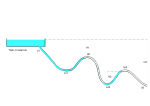
View attachment 68074
As the outlet is submerged an airlock forms until the height of water in the basin is greater than the height of water in the discharge pipework connected to the outlet.
The air is trapped in the pipe from the basin and cannot escape to permit the water from the basin to enter the pipe. It must gurgle as the air slowly escapes. Until H1 is greater than H2 there will be no flow.
An alternative solution would be to connect a second pipe from half way down the discharge pipe from the basin to an overflow on the side of the sink. That pipe could be relatively small as it would only be carrying a small flow of air.


May be so, I can see strange things or I am strange but as they say up north There's nowt as funny as folk .
I thought it was 'nowt so queer as folk' or isn't that allowed now?

It isn't.Why is your username greyed out?