SAE 90-140 oil

I also have a Lofrans Tigres and I use EP90 gear oil.

Don't quite understand 90 - 140 does that indicate a multigrade like engine oil. Now engine oil is subject to head that is very unlikely in a Lofrans Tigres.

The pic of the container of the Valvoline Gear Gard EP 90-140 (GL4) that VicS posted only shows SAE 90 so what does 90 - 140 realy mean.

GearGard%20EP%2090%205L-190x372.png
 
I also have a Lofrans Tigres and I use EP90 gear oil.

Don't quite understand 90 - 140 does that indicate a multigrade like engine oil. Now engine oil is subject to head that is very unlikely in a Lofrans Tigres.

The pic of the container of the Valvoline Gear Gard EP 90-140 (GL4) that VicS posted only shows SAE 90 so what does 90 - 140 realy mean.

GearGard%20EP%2090%205L-190x372.png

Yes ... it is a multigrade (although not to the same numerical scale as engine oil) which might be essential in a gearbox where continuous running does develop heat. As you say, in a windlass it will nearly always be close to the cool 90 end so I'm sure that a 90 grade oil will be absolutely fine.

Richard
 
Thanks Richard, it seems that at least one version of the user manual specifies SAE90.

So is this the same as EP90?

Not quite EP means extreme pressure so IMHO is better than straight SAE 90 which just specified the viscosity of the oil where as EP can stand extreme pressures up can get in some gears
 
Not quite EP means extreme pressure so IMHO is better than straight SAE 90 which just specified the viscosity of the oil where as EP can stand extreme pressures up can get in some gears

I agree.

EP (also called Hypoid) used to be more expensive that straight 90, but it's now the same price so I always use EP even in non-hypoid gearboxes.

Of course, if the manufacturer specifies EP then you probably have hypoid (helical cut) gears so you should definitely use EP.

There has been some discussion about whether using EP in some old design straight-cut gearboxes might cause problems although I'm not sure that these problems have ever been observed in ordinary usage conditions and, in any event, most of the drive trains we are talking about on the forum are probably too modern.

Richard
 
I agree.

EP (also called Hypoid) used to be more expensive that straight 90, but it's now the same price so I always use EP even in non-hypoid gearboxes.

Of course, if the manufacturer specifies EP then you probably have hypoid (helical cut) gears so you should definitely use EP.

There has been some discussion about whether using EP in some old design straight-cut gearboxes might cause problems although I'm not sure that these problems have ever been observed in ordinary usage conditions and, in any event, most of the drive trains we are talking about on the forum are probably too modern.

Richard

I think you will find there is a worm drive. Dont know if that requires an EP oil or not. Of the two Valvoline oils I suggested earlier one is a GL4 oil and one is a GL5. If an EP oil is preferred should the OP choose GL4 or GL5
 
Of course, if the manufacturer specifies EP then you probably have hypoid (helical cut) gears so you should definitely use EP.
Thank you, I've always wondered what hypoid meant.

I think you will find there is a worm drive. Dont know if that requires an EP oil or not. Of the two Valvoline oils I suggested earlier one is a GL4 oil and one is a GL5. If an EP oil is preferred should the OP choose GL4 or GL5

As if I wasn't confused enough! :confused:

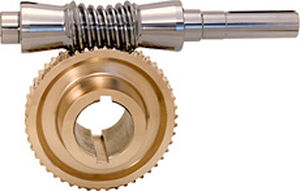
Diagram here confirms worm drive.
 
I think you will find there is a worm drive. Dont know if that requires an EP oil or not. Of the two Valvoline oils I suggested earlier one is a GL4 oil and one is a GL5. If an EP oil is preferred should the OP choose GL4 or GL5

Just because it's a worm drive doesn't mean it's not helical cut. If the manufacturer recommends EP it's either because it's a helical cut worm drive or because he's just erring on the safe side.

I think that GL4 is used in lower stress applications than GL5 but as long as it's EP it shouldn't matter as our application is certainly not high stress. If the manufacturer recommends GL5 specifically then I would use it. If it's just an EP recommendation then use whichever you can get hold of at a sensible price.

Richard
 
A little clarification on the viscosity. Multigrades have the format 15w-40, not 15-40 or 15/40. Are you sure that if your manual says 90-140 it is not giving you options, dependent upon duty/temperature/model?

I made the mistake of believing what I read on the Internet. I looked up Lofrans Tigres Oil and the first few hits I read said SAE90-140. Then I looked in the actual manual (D'OH!) where it says "SAE 90 long life oil"

It seems there is still room for error with EP90/SAE90 and GL4/GL5. I'm waiting on a reply from Lofrans.
 
Last edited:
I've worked with automotive transmissions for 10 years.

The generally accepted definition of a hypoid gear is a spiral bevel (crown wheel and pinion) where the pinion does not sit at the centre axis of the crown wheel.

A helical cut gear refers to its teeth profile. Taking a spur gear for example, straight cut gears are very common. A helical cut version will be able to transmit more power for the same width because there is a larger tooth contact patch. The down side is that it introduces axial / thrust loading.
 
A small update to this thread which might be helpful to others:

A couple of months ago I bought 5L of EP/Hypoid GL-5 gear oil to do a full oil change on both by SD20 saildrives but did not open the container.

This week I have been removing the drive shafts of a 4WD to rebuild the suspension with high lift springs and shocks. The oil in the differentials has the usual Hypoid sulphurous foul smell as expected. As I needed to top up the diffs after reassembly I opened the GL-5 and ....... no hypoid stink at all. A slightly sweet smell which is not unpleasant and nothing like hypoid or engine oil.

I emailed the distributor Westway Lubricants who replied "GL-4 should smell pretty much the same as the GL-5 as they share the same base oils but a slightly different additive package. Our 80w90 gear oils contain a buffered sulphur additive which does not give off a strong odour when compared to many other brands."

This is the first time I have ever used pong-free Hypoid/EP gear oil. It might be useful to remember that if the oil in your saildrive/gearbox/differential does not smell bad, it does not mean that it is not Hypoid/EP. :)

Richard
 
Just heard back from the Lofrans UK Distributor, Peachment:

If you go to a Morris Lubricants dealer (Also known as Golden Film) and ask for product:
LODEXOL XFS GEAR OiI 80W-140L 1LT
We stock the oil but are unable to ship by post or carrier


Spec Sheet from Morris:
Lodexol XFS 80W-140 is a fully synthetic gear oil that has been formulated with high levels of extreme pressure (EP) additives and friction modifiers to protect the critical mechanisms of limited slip differentials. In addition to high load carrying capability, Lodexol XFS 80W-140 will protect against rust and corrosion and has a low foaming tendency. Shock loading occurs when one of the driven wheels looses traction and the differential locks redistributing the drive equally. Standard API GL5 gear oils are unable to cope with this extreme condition and therefore it necessary to use a proper limited slip differential oil to promote long component life.


So, I wondered about this on eBay. What do you guys think?
 
Last edited:
Westway ... same firm as I mentioned in post #17. They seem to be a helpful company.

GL5+ is designed for limited slip differentials but is more expensive than GL-5, presumably because so few vehicles have LSDs that they don't sell much of it. It seems seriously overkill for a windlass where GL-4 or GL-5 would normally be fine. However, it is the viscosity range you were looking for and as it's not the kind of application where you need to change the oil regularly, if ever, and a litre will probably be enough to fill it, then I would say go for it! :)

Richard
 
Top