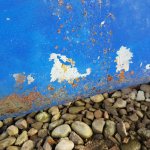
Rust between keel and hull

Crinan12

Well-Known Member
Joined
6 Mar 2019
Messages
606
Visit site
Hi folks just gone to Crinan to antifoul for the 1st time
There is rust between keel and hull
To me it looks quite bad but they I don't really know
I can pick away at the keel and it comes away
Should I be worried? What would the treatment be?
Thanks
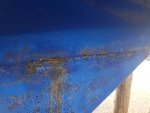

Resizer_15535302522513.jpgResizer_15535302522512.jpg
 
What you have is not at all unusual for boats with iron keels kept in salty water. ( though most of the rust forms when it is ashore) The simple solution short of blasting is to grind or wire brush it out, being careful not to damage the grp. Apply a rust convertor then half a dozen coats of Jotun Vinylester 88 (or Primocon if you can not get it.) They dry fast and you will get three or four coats on in a day. Fill the keel joint cavities with CT1 or a butyl sealant and smooth off then apply another couple of coats of the primer before antifouling. Do not use silicone sealants.
A raking tool like an old saw blade is less likely to leave rust particles than a wire brush, you will not eliminate rust completely but well coated cast iron will resist it.
Once it starts it is hard to stop completely so you may have to apply the coats of primer nearly every year.
 
The proper way is to drop the keels have them grit blasted and treated with a full paint system starting with an epoxy primer. Replace keels with a polysulphide sealant in the joint and you should have many years before you have to do it again.
 
It's hard to tell from the pictures but my first check would be to see if the joint rusting is a result of a grounding or normal use wear and tear. Assuming it's the latter, I agree with Mr Quandry that it's not unusual.

Also assuming that the keel is still firmly attached, another option would be to simply ignore it.

Personally, I'd have a go at trying to make it look a bit smarter. Unless you follow Mr ghostlymoron's advice this will become an annual job. I'd clean away as much rust as possible. If you do this in a yard with any form of power tool keep in mind that there's a real risk of damaging the gel coat of surrounding boats.

Some people like primer, some undercoat and others epoxy. I don't think that there is a great deal to chose between them, the trick is to apply lots of coats. It's guaranteed to stain through by the end of the season however you do it.

Applying sealer to the joint is another nightmare. Done properly, sealant is applied to the (removed) keel; as the hull is lowered onto the keel, sealant will seep out of the joint and a bead can be created. I've never had a great deal of success of re-beading and existing joint. There are some really hi-tec sealants available these days and although I've never used it I believe that Arbomeric MP20, manufactured by Arbo, is good.

It's just another of the many joys of boat ownership.
 
It's hard to tell from the pictures but my first check would be to see if the joint rusting is a result of a grounding or normal use wear and tear. Assuming it's the latter, I agree with Mr Quandry that it's not unusual.

Also assuming that the keel is still firmly attached, another option would be to simply ignore it.

Personally, I'd have a go at trying to make it look a bit smarter. Unless you follow Mr ghostlymoron's advice this will become an annual job. I'd clean away as much rust as possible. If you do this in a yard with any form of power tool keep in mind that there's a real risk of damaging the gel coat of surrounding boats.

Some people like primer, some undercoat and others epoxy. I don't think that there is a great deal to chose between them, the trick is to apply lots of coats. It's guaranteed to stain through by the end of the season however you do it.

Applying sealer to the joint is another nightmare. Done properly, sealant is applied to the (removed) keel; as the hull is lowered onto the keel, sealant will seep out of the joint and a bead can be created. I've never had a great deal of success of re-beading and existing joint. There are some really hi-tec sealants available these days and although I've never used it I believe that Arbomeric MP20, manufactured by Arbo, is good.

It's just another of the many joys of boat ownership.

Thank you everyone. I will do my best with it for this year.
If the keel did have to be dropped/blasted/painted - that's very expensive I take it? Anyone have a rough clue as to what it would cost ?
 
Just tidy it up, it is not too onerous to have to slap on a few coats of suitable primer. Many epoxies are temperature sensitive and an iron keel is slow to warm up so a one pack primer straight from the tin is easiest. Normal night time temperatures of 4-5 degrees C will hold for a big part of each day. It is not an uncommon or risk causing problem on an older boat. If you do decide that it makes sense to take the keel off for blasting you can get a quote from Crinan Boats or Ardfern but I think it is overkill.
 
My previous answer was the ideal but not what I did myself. I power wire brushed, applied multiple coats of primocon followed by anti foul. I attempted to take out the sealant from the joint but, as the joint had 3.5T of boat resting on it, it was under a lot of compression so not very successful. It was deffo better the next year so I just patch treated the few rusty bits. The following year I hit a semi submerged object whilst on overnight passage from Cornwall to Wales this caused a leak which was repaired professionally using previously described method. Both keels were treated and looked superb.
 
As has been said, this is a very common sight on older boats. It does no harm to try as best as you can to tidy it up, adding paint and sealant, although as has been pointed out the gap is being forced closed and will open as soon as the weight of the keel is hanging from the hull. Provided there is no rusty water penetrating the keel bolts into the boat you have little to worry about. Assuming you have stainless steel keel bolts any galvanic corrosion will affect the keel, not the bolts, and that is considerably larger, so loss of metal will be slow.

If you see rusty water, often after a hard beat, it will be time to think about dropping the keel to clean up the horizontal face and re-bed it.
 
Hi folks is there any merit in priming then filling the joint with an epoxy filler? Or is CT1 which quandary mentioned more suitable? Thanks

P.s. is 'epoxy primer' different to normal primer ?
I'm getting confused with all the products. For example primicon is a primer, but hempel (and others) do a 2 part primer. Is one better than the other? Or does it all depend on the application
Thanks
 
Hi folks is there any merit in priming then filling the joint with an epoxy filler? Or is CT1 which quandary mentioned more suitable? Thanks

P.s. is 'epoxy primer' different to normal primer ?
I'm getting confused with all the products. For example primicon is a primer, but hempel (and others) do a 2 part primer. Is one better than the other? Or does it all depend on the application
Thanks

A few problems there. You cannot put epoxy on top of conventional primers, it will not take. Epoxy tends to be brittle, so will crack as the load comes off the joint. You need something as elastic as possible. CT1 might be fairly good for this. Use a conventional primer like Primocon. It just is not worth buying expensive stuff for this job, as nobody will see it and rust will inevitably bring it all off at some stage anyway. Do not be tempted to use anything with silicone in it.
 
Thank you everyone. I will do my best with it for this year.
If the keel did have to be dropped/blasted/painted - that's very expensive I take it? Anyone have a rough clue as to what it would cost ?
Dont worry about it, scrape the rust off, rust converter next, then some hammerite primer or red lead paint if you can still get it, then some hammerite smooth then antifoul. Do it every year if needs be.
 
I think that's what's I'll do skipper
Feel I could spend weeks reading about various treatments
But I'll just need to pick a primer and paint and get on with it
A few folk have suggested dulux metalshield so might give that a go
Cheers
 
You are fairly new to the forum so a bit of advice
Read and pay attention to anything that Vyv Cox posts, he knows stuff but also has all the experience and he makes his knowledge freely available, he writes technical stuff for magazines and has a really useful website where you will find answers to many of your questions. When Vyv offers advice on something it is worth more than any ten of the rest of us. An asset to the forum that we all have benefited and learned from.
 
You are fairly new to the forum so a bit of advice
Read and pay attention to anything that Vyv Cox posts, he knows stuff but also has all the experience and he makes his knowledge freely available, he writes technical stuff for magazines and has a really useful website where you will find answers to many of your questions. When Vyv offers advice on something it is worth more than any ten of the rest of us. An asset to the forum that we all have benefited and learned from.

Wow! Thanks for the unsolicited kind words. I like to help but it is very rewarding to receive such compliments.
 
Top