NotBirdseye
Well-Known Member
Really? I was hoping for another 20 pages? See how long before the admin notices...


What purpose would be served by deleting it? What harm is it causing, other than your personal outrage?From a sensible first few posts, this thread has degenerated to the most peurile level. Can the mods lock it? Or, better still, delete it.
My personal outrage is quite sufficient reason IMO. I've got better things to do instead of reading this thread to see what further depths it's reaching.What purpose would be served by deleting it? What harm is it causing, other than your personal outrage?

Brilliant. Can I use that one day?My personal outrage is quite sufficient reason IMO. I've got better things to do instead of reading this thread to see what further depths it's reaching.


Oscar Wilde, "I wish I had said that."
James McNeill Whistler, " You will, Oscar, you will.
A pedant might argue that Whistler should have said "you shall" to indicate intent, rather than "you will" which indicates proclivity.
I have better things to do than redecorate the bathroom. I resolve this by not redecorating the bathroom. Have you considered not reading this thread?My personal outrage is quite sufficient reason IMO. I've got better things to do instead of reading this thread to see what further depths it's reaching.

Someone already snitched to them, but they won't say who.Really? I was hoping for another 20 pages? See how long before the admin notices...
It definitely wasn't me. It's not my style.Someone already snitched to them, but they won't say who.

The adults have already discussed it and are unanimous in their opinionsCan the adults get back to discussing the finer details of the old Suck Squeeze Bang Blow cycle now?
The adults have already discussed it and are unanimous in their opinions


The definition of compression ratio is the ratio of the total volume enclosed in the cylinder at bottom dead centre to the volume at the end of the compression stroke.So, we got to either,
the compression ratio is determined by an equation and the shape of the piston and combustion chamber has nothing to do with itor
the compression ratio is determined by the combination of the shapes (dimensions) of the piston and combustion chamber (and a few other aforementioned minor physical factors).Which is it?
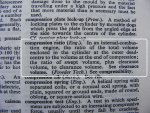
The definition of compression ratio is the ratio of the total volume enclosed in the cylinder at bottom dead centre to the volume at the end of the compression stroke.
This is the definition ... it is not open for discussion or debate ... it is the definition
Indeed so.from the very beginning.


Since when were we discussing dictionary definitions of the term?
The volume at the end of the compression stroke, or clearance volume, is the volume enclosed by the piston and the adjacent end of the cylinder when the crank is at top dead centre.Let's try again ...
OK, so what determines the "volume at the end of the compression stroke"?[Clue: it's not a mathematically equation, a mathematically equation only describes what's going on, not determines it].Thank you. I am sure we'll get there in the end.
(The volume at BDC determines nothing, so I'm ignoring it. It's the proverbial "one hand clapping" in this equation)
from the very beginning.