Rudder rebuild fiil it or leave it empty ?

dunkelly

Well-Known Member
Joined
28 Aug 2018
Messages
286
Visit site
Hi , I've had to remove my rudder to replace the rudder post , it was galvanised steel androttingthrough. I've had anew stainless post made and now come to put it back together . My questions really relates to whether the rudder should be filled or left void . When I took it apart it was full of a reddish brown heavy foam (probably an additive to resin ), anyone any ideas what may be ?
What is the norm ,I'm guessing if its left void water will eventually fill it . Is there any expanding foam type product to fill it with or perhaps something like filite. Anyone any thoughts ? Thanks
 
If it was fine grained with no apparent bubbles it was probably resin microballoons mix. Other fillers were used some were two pack polyurethane foams of varying cell size & can be dug out with a chisel or screwdriver.
None of these expanding foams are waterproof despite what manufacturers claim. Water always gets in.
Microballoons are rather expensive & fillite would be the cheapest filler these days. It may be wise to build up the two halves separately before final joining together to avoid high exotherm & trapped styrene.
 
Thanks , that concurs with my thoughts , but appreciate the confirmation I wasn't doing something stupid . ,ill go ahead with the filite then .again many thanks .
 
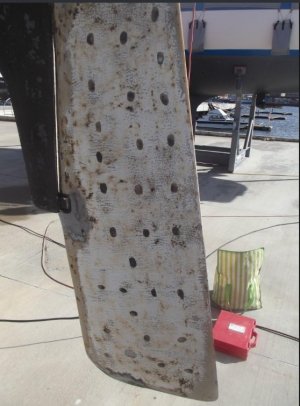
My 38ft rudder has obviously had foam injection at some time before my ownership ....

Rudder.jpg

Photo was lift out 2023 and having had all antifoul stripped from boat ....

She had hard racing with its primers etc all applied .... and checked / recoated lift out 2024.

Lift out 2025 - there was water seeping out of the bottom leading edge corner ...... we are still undecided about action ...
 
At the boatbuilding place I worked at they used foaming epoxy to fill rudder void. A 50mm hole was cut in top face of rudder where epoxy was poured in, from which excess foam could escape as it expanded.

It was not unusual for many builders to do this ... but it always had the element of 'pockets' missed as the foam developed ...

Its reason that rudders that were retro-treated - often had as mine has - multpile holes drilled and injection made at each hole to try prevent any voids.

The questionable factor though - is which foam used !!
 
I recommend that you watch Sailing Hirith's rudder rebuild videos on YouTube. They work through what they are doing reasonably methodically, including the product they used to fill the rudder with foam, and importantly, the teqnique they used. They were keen to avoid future water ingress around the shaft to GRP bond, and developed a method to reduce the probability of that happening.

Sailing Hiraeth

This is the video with the foam and why they selected it. It even includes a video clip of the foam expanding inside the rudder. Good technical video from competent DIYers.

 
I'm half way through and have decided already its definitely going to be too heavy if I completely fill the void with filite resin , so I'm thinking as I've done some filite mainly around the shaft for additional strength that I need to use some sort of expanding foam to reduce any extra weight ,looking at the u tube video it seems that sicomin pb250 is the way to go, are there any alternatives ? ..I'm guessing I won't have a problem with the epoxy foam adhering to the filite which was mixed with polyester resin . Can anyone see a future problem mixing the 2 as I'd rather not have to ground out all the filite I've just put in .
 
I'm half way through and have decided already its definitely going to be too heavy if I completely fill the void with filite resin , so I'm thinking as I've done some filite mainly around the shaft for additional strength that I need to use some sort of expanding foam to reduce any extra weight ,looking at the u tube video it seems that sicomin pb250 is the way to go, are there any alternatives ? ..I'm guessing I won't have a problem with the epoxy foam adhering to the filite which was mixed with polyester resin . Can anyone see a future problem mixing the 2 as I'd rather not have to ground out all the filite I've just put in .
Don't some boat designs have a removable drainage plug in the rudder?
I suspected mine was full of water so drilled a hole in it, water poured out. Was heavy, now it's light. Not sure what to do for the best mind. No metal in mine afaik
 
It was not unusual for many builders to do this ... but it always had the element of 'pockets' missed as the foam developed ...

Its reason that rudders that were retro-treated - often had as mine has - multpile holes drilled and injection made at each hole to try prevent any voids.

The questionable factor though - is which foam used !!
If the video linked to on post #8 you can see how foaming epoxy is added to eliminate the formation of voids. I wonder if what has happened with your rudder is that the foam originally injected has become waterlogged and multiple holes drilled to drain and refoam it, rather than splitting the rudder as in the video, which would seem to be the best course of action for your rudder.
 
Last edited:
If the video linked to on post #8 you can see how foaming epoxy is added to eliminate the formation of voids. I wonder if what has happened with your rudder is that the foam originally injected has become waterlogged and multiple holes drilled to drain and refoam it, rather than splitting the rudder as in the video, which would seem to be the best course of action for your rudder.

Wht previous owner did with yard ... no idea ... the only evidence of work is the multiple filled holes. The method is not uncommon where a rudder originally has no infill ... where its decided not to open up the rudder.

Of course best solution is slice open the rudder into two shells ... fix internal - then decide whether inject expanding foam after rejoining or to lay in multiple thin sheets of closed cell foam - laminating as each sheet added. Broad sand to match the rudder profile - then glass the other rudder half on to seal.
 
Don't some boat designs have a removable drainage plug in the rudder?
I suspected mine was full of water so drilled a hole in it, water poured out. Was heavy, now it's light. Not sure what to do for the best mind. No metal in mine afaik

Its a questionable subject which needs consideration of internal structure of the rudder. Water in the rudder itself in terms of weight is not a concern .. OH why ?? When boat is in the water - the water inside the rudder is nulled ... its only when boat is lifted out of water that thr weight then becomes an issue.
But back to internals ... if the framing / shaft inside rudder and in contact with the water can corrode or degrade - then its a problem ... also the rudder GRP may if internal surface is not resin sealed fully become affected ...

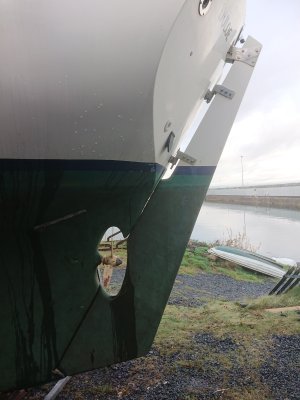
I would be surprised if no metal at all inside your rudder ... unless it has exterior tangs for shaft to transmit turning moment ? How is it hinged ?
 
Its a questionable subject which needs consideration of internal structure of the rudder. Water in the rudder itself in terms of weight is not a concern .. OH why ?? When boat is in the water - the water inside the rudder is nulled ... its only when boat is lifted out of water that thr weight then becomes an issue.
But back to internals ... if the framing / shaft inside rudder and in contact with the water can corrode or degrade - then its a problem ... also the rudder GRP may if internal surface is not resin sealed fully become affected ...

I would be surprised if no metal at all inside your rudder ... unless it has exterior tangs for shaft to transmit turning moment ? How is it hinged ?
 

Attachments

  • DSC_0114.JPG
    DSC_0114.JPG
    1.3 MB · Views: 5
Stainless steel needs oxygen to prevent corrosion, burying stainless steel in fibreglass and foam... Errr...
 
Stainless steel needs oxygen to prevent corrosion, burying stainless steel in fibreglass and foam... Errr...
A widely held misconception. Stainless steel derives its good corrosion resistance from the presence of surface chromium oxide. This normally develops in seconds on freshly cut or rolled steel. Once there it is very difficult to remove, so burying it in fibreglass will have no effect on it at all.

Where a problem can occur is in crevices that fill with water. Oxygen levels at the tip of the crevice are lower than at the surface, creating a corrosion cell that may lead to pitting.
 
In the past I have poured two-pack polyurethane foam buoyancy into canoes. Within a year it was totally waterlogged, despite being sold as 100% closed cell. Epoxy foams are reputedly somewhat better but apparently the cells are quite weak and easily fractured. Even if using it I would try very hard to seal the rudder, preventing water ingress.
 
Thames marine standard practice on Mirages etc was to fill the rudder with microballoons mix, Prouts often just glassed the rudder shaft tangs to one side only.
Marcons who built Sabre 27, Trident 24 & others used a combination of methods including expanding foam.
They also cut corners & often welded Mild steel tangs to the Stainless rudder shaft.
On our Sabre two of the three tangs had failed through corrosion & the last was hanging on by just 3mm of weld left.
It pays to check.
 
Thames marine standard practice on Mirages etc was to fill the rudder with microballoons mix, Prouts often just glassed the rudder shaft tangs to one side only.
Marcons who built Sabre 27, Trident 24 & others used a combination of methods including expanding foam.
They also cut corners & often welded Mild steel tangs to the Stainless rudder shaft.
On our Sabre two of the three tangs had failed through corrosion & the last was hanging on by just 3mm of weld left.
It pays to check.
My Trident 24 has a steel plate rudder, and IIRC from the TOA website, this is general. "Any competent blacksmith or steel fabricator can repair or make a new Trident rudder."

In my case it appears to be stainless, probably an amateur fabrication. I dunno if this is a good thing, but its different.
 
Top