
Replacement AIS Has Technonlgy moved on ?

I am interested to know what software you use to calculate CTS to account for tidal streams.
I am surprised that my fancy B&G Zeus plotter does not have this capability even though the charts contain all the required information.
I wrote my own software to do this on an early Microsoft smartphone but haven't found anything similar that runs on current Android phones.
 
The Vespermarine unit looks a possibility.
Anyone used an alternative? such as digital Yachts.


I am aware that the blurb may overstate what it can achieve and had has similar thoughts about the term "AIS RADAR" but I am cynical enough not to be too misled, well i think I am.
 
well I hope you can see the RADAR returns on your display more clearly than the words on their web page.
View attachment 75187


Ah, I see it now. How odd, they have not used that term in any other context. Can't say I am fussed about it though.


Eastlands:

"I am interested to know what software you use to calculate CTS to account for tidal streams.
I am surprised that my fancy B&G Zeus plotter does not have this capability even though the charts contain all the required information.
I wrote my own software to do this on an early Microsoft smartphone but haven't found anything similar that runs on current Android phones."


This has come up before. It has been reported that one of the Android plotting packages can do these sums but I have never heard of a plotter that can. Seems a shame as it could be very useful, unlike a lot of the "features" you often get.
I used to have a handy program on the Psion 5 that did this very thing.

PS

Found the link, have a look here:

http://www.ybw.com/forums/showthread.php?496866-Tidal-calculation-channel-crossing&highlight=psion
 
Last edited:
I am interested to know what software you use to calculate CTS to account for tidal streams.
I am surprised that my fancy B&G Zeus plotter does not have this capability even though the charts contain all the required information.
I wrote my own software to do this on an early Microsoft smartphone but haven't found anything similar that runs on current Android phones.

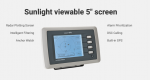
I use Neptune on the pc. Also had it on a pda, with a bluetooth gps which allowed recalculate from current position to waypoint. Quick and easy. It’s why I like the Yeoman I can get a bearing to any point then offset the puck for the tide and get a CTS.


I once sailed with a mathematician/physicsis who could in his head do vectors like 3 miles to the buoy and cross tide of .75 knots boat speed 5 knots and know the angle of the resulting sine (or cosine or whatever) too much for my brain. Piece of paper, a scale and protractor for me.
 
Should I transmit AIS? Do big ships look at class B more than look out of the window?

Yes, sadly, many do.

One night in early September I was in a shipping lane 'twixt Germany and Denmark as it was in line with my passage, the weather was turning awful (it gets very choppy in the Baltic in a strong breeze) and I didn't want to be out all night. I receive but don't transmit AIS (coz I is a cheapskate and contented myself with a second-hand receiver unit when one was available). I called each tanker or container ship following me when it got to 2nm off my transom. Just told them I was eg 2nm off their port bow, my course and speed (about 3 knots up waves and 3.5 knots down them) and asked their intentions.

Some had seen me and said they'd leave me to port/ starboard. Some paused and then gave me a questionably reassuring 'ah, I see you now... I'll leave you to port/stbd'. And then there was that Indian tanker.

As the lane bent to the left, he was approaching in the opposite lane but maintaining his course, so entering the separation zone in my direction. I was stand-on vessel but also obviously required not to turn backwards in a shipping lane. The vessel responded to my call saying I was 1.8nm off his starboard bow (he on my port bow) but said he couldn't see me. I asked him to look again as the gap was closing. Three times we went to a channel off 16 and had basically the same conversation. It became apparent he was only looking at his AIS. I called him back on Ch16 telling him I would be on his radar, that I was exhibiting nav lights and was also now illuminating my sails with a torch. Still he couldn't see me. And now I was flashing at his bridge. Pause. 'Ah, I see you now. I turn to starboard'. Which he did (heading the wrong way up my West-bound traffic lane) and subsequently resumed his course cutting obliquely across my lane behind me to head out of the lanes and North towards Copenhagen.

He hadn't noticed. He hadn't even looked. There was no lookout throughout. When he couldn't find a claimed hazard on his AIS, he just assumed it wasn't there. He didn't even use his radar (there's a decent tri-lens reflector mounted up my mast), which is what the ColRegs require him to use.

He was just driving by Playstation.

Time to upgrade to an AIS transceiver, I fear. Not to make up for my own seamanship, but to compensate for the negligence of a few others.

(I got into Gedser around 0700, after 25 hours.)
 
I once sailed with a mathematician/physicsis who could in his head do vectors like 3 miles to the buoy and cross tide of .75 knots boat speed 5 knots and know the angle of the resulting sine (or cosine or whatever) too much for my brain. Piece of paper, a scale and protractor for me.

cross current, that s an easy one :)
0.75/5 = .15
60 x .15 = 9 deg angle


expl.
as lim (x->0) of sin x / x = 1, for small angles the sin of an angle equals the angle measured in radians, one radian is near 60°, easier to remember.
The transverse current vector component divided by speed vector gives the sin of the angle in radians, multiply by 60 and you get the (approx) angle in degrees. 1 knot transverse current and 5 knot speed: 1/5=0.2; O.2*60 = 12°. Check: Sin 12°=0.2079
Same reason for 1° angle at 60M = one mile, if you steer 1° to one side you will miss the destination at 60miles by 1mile
 
Last edited:
...


I once sailed with a mathematician/physicsis who could in his head do vectors like 3 miles to the buoy and cross tide of .75 knots boat speed 5 knots and know the angle of the resulting sine (or cosine or whatever) too much for my brain. Piece of paper, a scale and protractor for me.
Could have been me?

I have a little laminated card with sin and cos on it.
Cos 10 0.98
Cos 20 0.94
Cos 30 0.87

Everyone knows that Sin 30 is a half?
taking sin 15 as a quarter is not too far out for mental maths (it's 0.2588....)
So it's not actually that hard to be pretty close, head 15 degrees up tide if the tide is 1/4 of boat speed.

The cos's are mostly useful in discussing whether heading up however many degrees to increase our speed with the cruising chute is effective or not. Come up 20 degrees from dead down wind, can you get 7% more speed?

But I very rarely work out a formal course to steer, everywhere I go seems to be up or down wind, and where I steer is a matter of wind and tide strategy.
 
Could have been me?

I have a little laminated card with sin and cos on it.
Cos 10 0.98
Cos 20 0.94
Cos 30 0.87

Everyone knows that Sin 30 is a half?
taking sin 15 as a quarter is not too far out for mental maths (it's 0.2588....)
So it's not actually that hard to be pretty close, head 15 degrees up tide if the tide is 1/4 of boat speed.

The cos's are mostly useful in discussing whether heading up however many degrees to increase our speed with the cruising chute is effective or not. Come up 20 degrees from dead down wind, can you get 7% more speed?

But I very rarely work out a formal course to steer, everywhere I go seems to be up or down wind, and where I steer is a matter of wind and tide strategy.
As a submariner I was taught a whole range of approximations to calculate the CPA of any target. Regrettably as I did not use them for many years I have forgotten them but they probably exist in some old books of handy sums for mariners. With practice one got quite good especially with the CO breathing down your neck. We rarely used radar and even if the CO had permitted its use it was normal to work out the visual answer first then ask the radar office for the plotted answer as a check to personal estimates
 
cross current, that s an easy one :)
0.75/5 = .15
60 x .15 = 9 deg angle


expl.
as lim (x->0) of sin x / x = 1, for small angles the sin of an angle equals the angle measured in radians, one radian is near 60°, easier to remember.
The transverse current vector component divided by speed vector gives the sin of the angle in radians, multiply by 60 and you get the (approx) angle in degrees. 1 knot transverse current and 5 knot speed: 1/5=0.2; O.2*60 = 12°. Check: Sin 12°=0.2079
Same reason for 1° angle at 60M = one mile, if you steer 1° to one side you will miss the destination at 60miles by 1mile

Eh? I love your analysis and need to learn from this, but I couldn't follow it past that statement. If you're plotting your heading and the orthogonal (ie 'transverse') tide, the current vector over the speed vector will be the tangent not the sine. (And your course over the ground will be the hypotenuse.) Granted, for small angles the difference is small but the conversation then diverges to larger angles. Am I looking at this wrongly?
 
Faced with an ageing chartplotter of uncertain connectivity I changed my duff vhf radio to a Standard Horizon 2200 with its own GPS and AIS - about £350 and AIS screen is small - but I can turn off power hungry chart plotter for most journeys, as hardly needed for most of my trundling in Bristol Channel or South Cornish coast. I believe that the Standard Horizon radio could send AIS telegrams to a chart plotter if I had a compatible one, but I don't so I haven't really investigated.
 
Eh? I love your analysis and need to learn from this, but I couldn't follow it past that statement. If you're plotting your heading and the orthogonal (ie 'transverse') tide, the current vector over the speed vector will be the tangent not the sine. (And your course over the ground will be the hypotenuse.) Granted, for small angles the difference is small but the conversation then diverges to larger angles. Am I looking at this wrongly?


yes tangent sorry, anyway both sin and tan have the same "speed" as x when approaching 0, lim (x->0) of tan x / x = 1 too, so the same applies.
Being derived from lim x->0 it is course less and less valid as x travels away from 0, up to tan 90deg -> infinite, an imaginary infinite current which will prevent to go anywhere except following it.

In practice not much difference for small angles (deg)
sin 10 = .174 - tan 10 = .176
sin 20 = .342 - tan 20 = .363
sin 30 = .5 - tan 30 = .577

Transverse currents above one half boat speed probably need something more than mnemonics :)
 
I have a B&G V50 vhf which has an AIS reciever built in.
This is connected to a Vyacht wifi box via NMEA 2000 ( it could also be done by 183)
This transmits all the GPS sentences along with the AIS data to my iPad
I use Imray Navigator on the iPad and overlay the AIS targets.

It works perfectly well and I have never had any problem using an iPad in the cockpit.

Hi Buck,
Out of interest why do you not link it to a chartplotter ? Ive been told the B&G v50 will work with a Vulcan and overlay AIS. does this sound correct?

Steveeasy
 
... Anyone used an alternative? such as digital Yachts...

I have the Digital Yachts AIT 2000 AIS transmitter / Receiver. Does what it says on the tin: interfaces to the Raymarine chartplotter and/or I can connect it to a PC via USB and so use it with a PC based plotting program, in which mode it provides both the AIS and an EGNOS assisted GPS.

Via the PC one can also look at the reports in greater detail as well as a good amount of useful status and diagnostic info such as antenna VSWR. I'm very much satisfied by its performance and ease of use. I don't use an antenna 'splitter' but a second VHF aerial on the comms post, the idea being that (a) it's cheaper than the extra box of electronics in an active splitter, and (b) I thus have an emergency spare VHF aerial should the mast-head one fail (or the mast come down).
 
Last edited:
Hi Buck,
Out of interest why do you not link it to a chartplotter ? Ive been told the B&G v50 will work with a Vulcan and overlay AIS. does this sound correct?

Steveeasy

I'm sure it does but I don't need a chart plotter. I have Paper charts at the table and the iPad for electronic nav anywhere.

Buck.
 
Hi Buck,
Out of interest why do you not link it to a chartplotter ? Ive been told the B&G v50 will work with a Vulcan and overlay AIS. does this sound correct?

Steveeasy

I can confirm that the V50 supplies AIS data onto an NMEA2000 network and that AIS targets can be displayed on any plotter that supports this. I use both a Vulcan 7" and a Zeus 12" on my network. The AIS targets can be configured so you can define what is a "dangerous" vessel and get alerts (if required) or you can simply filter out vessels over a specified distance away. You can also initiate a DCS VHF call to any AIS target direct from the plotter and obviously knowing the vessel names facilitates contact via a regular voice VHF call.
 
Top