AIS permanently on, do you?

For Class B that says "Internal GNSS only, interface to an external GNSS is optional". From that I conclude that everything which has been written in this thread about it being against regs for the AIS receiver's GPS source to be from a separate source which can be switched off (e.g. plotter) is wrong with regards to class B.

I wouldn't trust that document. Firstly it relates to USCG regs, secondly it's been produced by a third party, possibly at USCG who used Microsoft Word and then generated a pdf and didn't bother to title it correctly.

Any official sources?
Digital Yacht have guidance

https://digitalyacht.net/wp-content/uploads/2018/11/Class-B-SOTDMA-AIS-White-Paper-V1_01.pdf

And there is a discussion here about the IEC requirements AIS Class-B Transponder and GPS Receiver - Cruisers & Sailing Forums

The spec is nearly £500 if you really want to read it.
 
AIS on at anchor is helpful to other vessels that are approaching at night.

When on the hard, or in a marina, some vessels leave their AIS transmission on so they can determine if the boat is moved by the boatyard. I don’t think this presents any problems. The position accuracy of AIS is sufficient to determine if a vessel is likely to be at collision risk. Boats stored on the hard stand or in a marina are obvious.
 
Last edited:
Am I the only one who has the audible alarms permanently turned off?
My home waters are very busy with shipping and in the weekends with leisure traffic. There is no point in having an alarm every few minutes.
Even on longer and overnight passages I see no need for an alarm. Whoever is on watch is supposed to be awake and monitor all traffic around us.
When I crossed the Atlantic we did not need an AIS alarm either, the first warning a ship was anywhere around us came from the active radar transponder which alerted us to the presence of a ship at far greater range than the AIS transceiver.
 
Ours are usually off too. A ship closing at 20kts might arrive quite quickly though and if checking the plotter every 20 mins overnight could be missed. On long passages we don’t sit at the helm constantly so an alarm can be useful.
 
When on the hard, or in a marina, some vessels leave their AIS transmission on so they can determine if the boat is moved by the boatyard
And exactly what will they do with that information?
I am bemused by the suggestions that having it transmit while on the pontoon enables the owner to check it is still there.Where else would it be?
 
And exactly what will they do with that information?
I am bemused by the suggestions that having it transmit while on the pontoon enables the owner to check it is still there.Where else would it be?
If my boat was moved I’d make a trip to check on it. Quite often yards do bad things like angling the boat so rainwater floods the cockpit or worse.
There’s zero impact to other people so why should they have to justify what they use it for?
 
Am I the only one who has the audible alarms permanently turned off?
My home waters are very busy with shipping and in the weekends with leisure traffic. There is no point in having an alarm every few minutes.
Even on longer and overnight passages I see no need for an alarm. Whoever is on watch is supposed to be awake and monitor all traffic around us.
When I crossed the Atlantic we did not need an AIS alarm either, the first warning a ship was anywhere around us came from the active radar transponder which alerted us to the presence of a ship at far greater range than the AIS transceiver.
Agreed. We never have the alarm witched on. Just done an Atlantic crossing and we never use it. The on watch crew have a MFD under the hardtop right in front of their nose. We never switched the radar on either.
 
And exactly what will they do with that information?
Boatyards are generally very good and will usually do their best to keep owners happy, but information such as adhering to the boat manufacturer’s recommended support points and procedures is ultimately the owner’s responsibility. Some boats have quite specific requirements for where supports should be located, especially some of the performance catamarans. The boatyard cannot be expected to know these for every boat.

Knowing the boat had been moved, I would certainly ring the boatyard and politely check that the boat had been chocked up correctly and that the boat was in a location where I still had electricity and water (if that is what I requested initially). It would be disappointing to get back to boat-ready to start work and find there was no access to these amenities or, for example, that the boat had been sitting without the number of concrete tie-down points we had requested (and paid for). Sometimes there are specific requirements, such as the need to be in an area of soft ground to dig a hole to remove the rudder or to be in a part of the boatyard where sandblasting, grinding or spray painting is permitted. This information is easily overlooked in a busy boatyard playing Tetris to be able to launch boats at the back of the pack.

Yes, unfortunately, as you tell from the above, I spent more of my life than I would want in boatyards :).
 
Last edited:
Agreed. We never have the alarm witched on. Just done an Atlantic crossing and we never use it. The on watch crew have a MFD under the hardtop right in front of their nose. We never switched the radar on either.
Never switching the radar on cross Atlantic is unusual - often used for spotting rain squalls in the dark, rather than for shipping.

We have the AIS alarm set off by default, but switch on for longer voyages, particularly in generally empty / quiet waters, when watchkeeping can get less proactive, particularly if solo or short handed. A “wake up” alarm can indeed be a useful prompt.

When mid Atlantic we hadn’t seen any vessels in AIS range for over 2 days. Then one night within a few hours we had two CPAs under 1/2 a mile. One a large ship approaching which we called on VHF, partly to ensure they knew we were under sail and partly for a chat, and they confirmed they had seen us and were planning to divert course, which they did.
Shortly after another sailing yacht B-road reaching on port tack approached us on starboard, lights not visible but CPA under 100m. Again tried to call on VHF but no answer. We suspect was single handed and skipper asleep doing circa 8 knots. We eventually altered course to avoid.
 
Must find out how to silence the alarms on Raymarine kit - it would seem to be DSC generated though as opposed to AIS on plotter

When the AIS module is active on the Raymarine Axiom MFD, there is an option on that when that module is opened to silence Alarms. It is also available from the Alarm screen, but I can't remember how to access this as I need to be at the plotter.

My DSC VHF is standalone and not integrated with the Plotter, but shares its antenna with the Emtrak AIS device, which of course is networked to the Plotter. As far as I can tell, all the alarm features are plotter controlled as the AIS unit just sits there with no interaction from me. I assume if you have an AIS DSC VHF, then that will have its own alarm functions. Whether these get over ridden, or t over rides the Plotter's setting, I guess reading the manuals will help.
 
AIS is one of those annoying things I don't miss.
Even so.
AIS if you get it set up can actually be quite useful.
The best thing about AIS if you have a transponder. AIS is quite helpful if you are underway. Particularly when the weather is crap.
In my opinion a Gentleman. Changes her AIS status. When she is not underway.
The rest of us appreciate the consideration.
If you RTFM a little bit off swearing and buggering about with the menu. You can turn of CPA and TCPA alarms for moored vessel's.
So you don't get to many.
Unfortunately most marina's seam to be full of inconsiderate wankers who can't be bothered to change their AIS vessel status from underway to moored or turn it off.
If you have ever heard of "pre departure checks" or "post arrival checks", Add update, AIS status.
Particularly if you happen to have your AIS hooked up to one of those annoying GMDSS radios.
The Red button includes such useful info as No of people on Board. Which might come in handy. If it's up to date. Could be very annoying if its not.
Not sure if class B can or can't display no of people on board.
If you don't know how to change AIS status. RTFM.
Or turn it off.
Unless the AIS is part off an all integrated system. Which will set off all kinds of alarms in the rest of the integrated system. So no, I usually changed the status and left the AIS on. Except for a longer duration when we were going to shut down the entire system.
 
Yes, unfortunately, as you tell from the above, I spent more of my life than I would want in boatyards :).
Thank you.
I guess I am fortunate only to have used yards who know what they are doing, and personally, never been concerned if they move my boat.
I aim to use Ais in the vein of its original purpose, which I believe would be tracking, safety, avoidance etc. I think this thread shows that others also intentionally use it for non "navigation" purposes and suggest that users should change their settings accordingly. I admit ,I thought people in the yard/marina simply just left it on. For some,then,there is a reason, just not related to making passage.
At least that has been clarified!
 
Never switching the radar on cross Atlantic is unusual - often used for spotting rain squalls in the dark, rather than for shipping.

We have the AIS alarm set off by default, but switch on for longer voyages, particularly in generally empty / quiet waters, when watchkeeping can get less proactive, particularly if solo or short handed. A “wake up” alarm can indeed be a useful prompt.

When mid Atlantic we hadn’t seen any vessels in AIS range for over 2 days. Then one night within a few hours we had two CPAs under 1/2 a mile. One a large ship approaching which we called on VHF, partly to ensure they knew we were under sail and partly for a chat, and they confirmed they had seen us and were planning to divert course, which they did.
Shortly after another sailing yacht B-road reaching on port tack approached us on starboard, lights not visible but CPA under 100m. Again tried to call on VHF but no answer. We suspect was single handed and skipper asleep doing circa 8 knots. We eventually altered course to avoid.
Our passage from the Cape Verdes coincided with a very bright moon. A number of time i thought I had left the deck light on😁
We had such strong winds for most of the passage looking out for squalls was pointless. We were sailing in winds over 30kts for a fair chunk of the time.The sail plan could take 40kts and did a couple times.
If we needed to reduce sail, it was just a process of winding in a bit of genoa.
 
Unfortunately most marina's seam to be full of inconsiderate wankers who can't be bothered to change their AIS vessel status from underway to moored or turn it off.

Us mere mortals with Class B can’t change the status can we? That’s a Class A thing only.

(They should all have an off switch though).
 
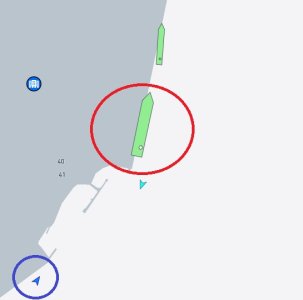
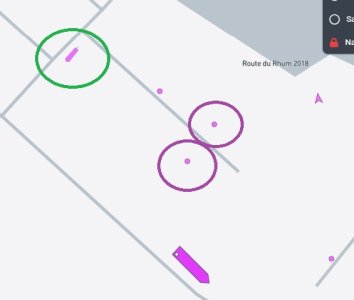
What can be/is useful on the other hand is people adding their vessel size to their AIS configuration, and of course having our plotters configured to show the ais target actual size at an appropriate distance.
Example, the big green icon ship is about 190m long, the circled blue target is a local ferry about 70m long using the standard MT icon
ais1.jpg

The green circle target is an Imoca, about 18m long, the two green purple circles are around two Ultim, about double that size (not to mention beam)
ais2.jpg
 
Last edited:
Top