Relay for 12v fridge switch

MattS

Well-Known Member
Joined
7 Sep 2020
Messages
570
Location
Kent
Visit site
I have installed a new Isotherm kit into my fridge, and want to avoid using the rather delicate-looking thermostat control as the primary method of turning the fridge on and off.

In order to avoid as much voltage drop as possible, I am taking a direct route from the battery isolator switch to the fridge via a fuse. The main wiring behind my DC electrics panel is not up to the job of feeding the fridge directly.

I'd quite like an easy-to-reach on/off switch for the fridge on my electrics panel, so I plan to use a solid-state relay to switch the main fridge supply on and off via a simple push button on the electrics panel.

Can anyone tell me firstly if there's a reason that this is an awful idea?

Secondly, I've found this solid state relay, which has a load current rated at 10A. The fridge shouldn't be drawing more than 5A when it's working hardest, according to the specs. Would this component be appropriate?

https://www.amazon.co.uk/gp/product/B01M075K7L

Are there any alternative 'known good' relays for use in 12V marine environment which would be better for this job?

Thank you!

Matt
 
You might want to consider the adequacy of the device's nominal 10A rating. The fridge you say should not draw more than 5A so it looks like you have a substantial margin but the blurb on the Amazon page says "When the load is inductive or capacitive, like motor, transformer, the load current should be 1/4-1/6 times of max load current ". Assuming 5A is correct then something with a capacity of 20A to 30A would seem more appropriate.
 
@Caladh The manufacturer's instructions don't say anything about separate switching - they provide an in-line fuse to take a feed directly from the battery. I presume their expectation is that the fridge is turned on and off using the thermostat control. But I've read of those controls being prone to failure, and at £125 plus a lot of faff to replace it, I'd rather avoid having to keep activating it on and off. Essentially I can find the right temp setting, and then leave it be.

@Graham376 That would be the ideal setup, but the feed to my electrics panel is just not up to the job currently so until I run some new cabling I think the voltage drop would be too significant. It would also add about 2-3m of additional circuit length vs taking a feed more directly from the battery. I guess I could counter this by using some decently thick cable.

@Baltika_no_9 Thanks - I read that too, and that's what led me to ask for some other opinions - so it looks like my spidey senses were correct!
 
I'd use a conventional automotive relay for this, ideally generic so you can easily replace it. A 40A contact rating won't be expensive.

I would expect the fuse they recommend would be sufficiently rated for the load. Do they say it needs a slow fuse?
 
I have a Cold Box that draws a substantial 7 - 10A depending on ambient temp. Last thing I wanted was to discharge my battery on board.

I took a Heavy Duty relay for a car ..... wired it so when I start boat engine .... once the alternator kicks in - the relay then closes and supplies power to the box. Stop engine - power cuts off to box.
I have option to bypass the relay if I am not going to use engine for a while ... I did intend to install a Battery Saver in the line to prevent over-discharge of battery but never got round to it. Basically being a Motor Sailer - I found I was using engine enough to keep it cool.
 
I'd use a conventional automotive relay for this, ideally generic so you can easily replace it. A 40A contact rating won't be expensive.

I would expect the fuse they recommend would be sufficiently rated for the load. Do they say it needs a slow fuse?

I haven't read anything about needing a slow fuse.

I've always read (and definitely been advised on here before) to use solid state relays to avoid the ignition risk on a boat?
 
I have a Cold Box that draws a substantial 7 - 10A depending on ambient temp. Last thing I wanted was to discharge my battery on board.

I took a Heavy Duty relay for a car ..... wired it so when I start boat engine .... once the alternator kicks in - the relay then closes and supplies power to the box. Stop engine - power cuts off to box.
I have option to bypass the relay if I am not going to use engine for a while ... I did intend to install a Battery Saver in the line to prevent over-discharge of battery but never got round to it. Basically being a Motor Sailer - I found I was using engine enough to keep it cool.

Thanks - that's a nice way of doing it to have it automatically cutting in when the engine's running.

Do you have any recommendations for battery savers? The Victron Battery Protect doesn't seem ridiculous money, but that might just be because I haven't seen an alternative more reasonably priced... ?
 
Thanks - that's a nice way of doing it to have it automatically cutting in when the engine's running.

Do you have any recommendations for battery savers? The Victron Battery Protect doesn't seem ridiculous money, but that might just be because I haven't seen an alternative more reasonably priced... ?

I trawl online sites such as Banggood ..... as they have all sorts of electrical stuff at pocket money prices.

I suggest take time on Banggood as example .... but it will mean a lot of trawling and playing with search terms. Another source is a Caravan / RV dealer as they have such for protecting car from caravan power reqt's ... often cheaper but same product as a Chandlers !!
 
@Caladh The manufacturer's instructions don't say anything about separate switching - they provide an in-line fuse to take a feed directly from the battery. I presume their expectation is that the fridge is turned on and off using the thermostat control. But I've read of those controls being prone to failure, and at £125 plus a lot of faff to replace it, I'd rather avoid having to keep activating it on and off. Essentially I can find the right temp setting, and then leave it be.

@Graham376 That would be the ideal setup, but the feed to my electrics panel is just not up to the job currently so until I run some new cabling I think the voltage drop would be too significant. It would also add about 2-3m of additional circuit length vs taking a feed more directly from the battery. I guess I could counter this by using some decently thick cable.

@Baltika_no_9 Thanks - I read that too, and that's what led me to ask for some other opinions - so it looks like my spidey senses were correct!
Am I being thick in thinking that the thermostat will turn the fridge "On & Off" in normal operation?
 
Car stuff in this manner is cheaper and more reliable than pretty much any alternative for common uses, as well as being Halford's available.
I can't see the reason (TBH) for needing spark protection as a boat's not Zone2 or whatever. It does sound like you've a good idea of what to consider though.
 
I've always read (and definitely been advised on here before) to use solid state relays to avoid the ignition risk on a boat?
I'm trying to think why that may be the case but can't for the moment. I'm happy to have my understanding corrected though. Operation of normal relays in which mechanical contacts are opened and closed does often induce a spark (especially when switching off) which apart from the possible risk that poses in terms of being an ignition source also degrades the contact quality over time. It that spark were present in a potentially combustible environment then that would present risks but hopefully a boat doesn't fall into that category. Relays though are normally enclosed so any spark is not exposed to the environment. Furthermore any decent relay would have a spark suppression mechanism built in.

It is likely/possible in fact that SSRs run hotter than EMRs hence they often require heatsinks.
 
Thanks - that's a nice way of doing it to have it automatically cutting in when the engine's running.

Do you have any recommendations for battery savers? The Victron Battery Protect doesn't seem ridiculous money, but that might just be because I haven't seen an alternative more reasonably priced... ?

Before installing lithium I've used one of these successfully for avoiding the fridge draining the lead acid bank.

Kemo M148A Battery Guard Module
 
I'm trying to think why that may be the case but can't for the moment. I'm happy to have my understanding corrected though. Operation of normal relays in which mechanical contacts are opened and closed does often induce a spark (especially when switching off) which apart from the possible risk that poses in terms of being an ignition source also degrades the contact quality over time. It that spark were present in a potentially combustible environment then that would present risks but hopefully a boat doesn't fall into that category. Relays though are normally enclosed so any spark is not exposed to the environment. Furthermore any decent relay would have a spark suppression mechanism built in.

It is likely/possible in fact that SSRs run hotter than EMRs hence they often require heatsinks.

I think the two potential combustion risks on a boat are gas leak (i.e. from stove connection) or lead acid batteries gassing off, which could potentially gather in the same area that you might have things like relays etc.
 
Am I being thick in thinking that the thermostat will turn the fridge "On & Off" in normal operation?

Yes - thermostat will control the on/off cycling of the compressor to maintain the temperature in the fridge.

But here I'm talking about isolation of the fridge completely i.e. cutting the power so that it cannot operate regardless of thermostat operation.

The main reason for doing something separate is that the thermostat controls that are provided with the fridges are expensive to replace, and reported to be prone to failure if switched regularly. I can believe this, having played with the control a bit - I don't have tonnes of confidence in its longevity...
 
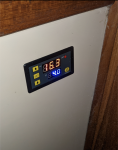
I'm a bit confused about what you're trying to achieve but this is what I did. I have a conventional rocker switch fed from the domestic isolator feeding the controller. I have replaced the mechanical thermostat with an electronic one which gives much more control and allows me set upper and lower temperature ranges and turn the refrigerator on and off if necessary.
 

Attachments

  • Screenshot_20221215-005003.png
    Screenshot_20221215-005003.png
    1,022.5 KB · Views: 6
I'm a bit confused about what you're trying to achieve but this is what I did. I have a conventional rocker switch fed from the domestic isolator feeding the controller. I have replaced the mechanical thermostat with an electronic one which gives much more control and allows me set upper and lower temperature ranges and turn the refrigerator on and off if necessary.

Thanks - I'm just trying to achieve the same outcome as you have with your setup, but without having to significantly extend the main 12V supply cabling to route it via a switch (which would increase the voltage drop).

To locate a switch on my electrics panel, wired directly in line with the supply, I'd have to add a good 3m to my 12v supply circuit..

So my idea to use a relay was to have a switch located somewhere convenient, but without a significant interruption to the supply circuit :)
 
I think the two potential combustion risks on a boat are gas leak (i.e. from stove connection) or lead acid batteries gassing off, which could potentially gather in the same area that you might have things like relays etc.
Well that's right of course, those are very real dangers and a boat which doesn't have an alarm to detect things like that is very much at risk. However the, presumably securely enclosed, relay that you're considering still leaves all the other options - alternator, starter solenoid, dodgy battery connectors, contact breakers, gas stove etc.

I am though in agreement that if you can remove just one potential source then it is not a bad thing.
 
Top