Radar reflector for small vessel ?

Maybe ... but the BW is 3cm and 10cm

Its why 10 elongates headlands etc on display.

3cm requires waveguide
10cm uses cable.

Maybe, but others were talking about X and S band, and you were talking about 3 and 10, so meaningless comparison to those of use unfamiliar with radar.

Having had to Google to make sense of your post, I was merely trying help others make sense of the information that you and others had provided, and had forgotten that further down in your post you'd mentioned 3cm and 10cm, not 3Ghz and 10Ghz.
 
Maybe, but others were talking about X and S band, and you were talking about 3 and 10, so meaningless comparison to those of use unfamiliar with radar.

Having had to Google to make sense of your post, I was merely trying help others make sense of the information that you and others had provided, and had forgotten that further down in your post you'd mentioned 3cm and 10cm, not 3Ghz and 10Ghz.

Fine ... but maybe use the standard terms instead of introducing terms that only a lab tech would consider.

3cm and 10cm are the Industry terms.

Just for interest ... the use of X and S band terms come from the dear old Americans .... according to info when I was at College as a Cadet.
 
My point is the 3/10 cm/GHz was coincidentally interchangeable and directly related.

I agree radio speak is in wavelength in some disciplines. I hold a few radio licences (SRC, Amateur Radio & Aviation). In ham radio, it's talk about 40 metre band, 2 metres or 70 cms etc. Aviation, it's frequency for VHF comms and weather radar (C/X band) discussed in GHz.

So, depending on your sphere of operation, it could be either. You mention "BW is" .. do you mean beam width? This is proportional to wavelength but beam width is also a function of antenna design and larger beam widths have the effect of stretching objects displayed as the first part is struck by the leading edge of the beam and the trailing edge by the back edge of the beam.
 
Last edited:
My point is the 3/10 cm/GHz was coincidentally interchangeable and directly related.

I agree normal radio speak is in wavelength. I hold a few radio licences (SRC, Amateur Radio & Aviation). In ham radio, it's talk about 40 metre band, 2 metres or 70 cms etc.

Its also a bit confusing to others as the 3 and 10 are transposed if you talk Ghz vs cm ... but this is nothing to do with OP's post.
 
Fine ... but maybe use the standard terms instead of introducing terms that only a lab tech would consider.

3cm and 10cm are the Industry terms.

Just for interest ... the use of X and S band terms come from the dear old Americans .... according to info when I was at College as a Cadet.

I was using the terms served up by Google.

Hilarious that you should be berating me for not using the industry terms. I don't know the industry terms - I had to Google only because you were using terms that were meaningless to the lay leisure boater and inconsistent with those used in the preceding discussion !
 
Maybe ... but the BW is 3cm and 10cm

Its why 10 elongates headlands etc on display.

3cm requires waveguide
10cm uses cable.
Not always.
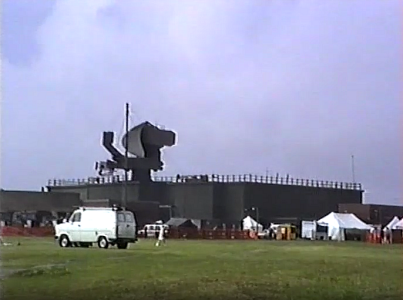
This little S band beastie, used waveguide, some of it water cooled.
1717952669491.png

Mind you it normally transmitted 10 MW, but could transmit 60MW.. on a damp day between the waveguide and the dish the air would glow blue purple, we were putting so much energy in the sky...
 
Fine ... but maybe use the standard terms instead of introducing terms that only a lab tech would consider.

3cm and 10cm are the Industry terms.

Just for interest ... the use of X and S band terms come from the dear old Americans .... according to info when I was at College as a Cadet.
And they've changed the band letter meanings over the years.. as a radar Technician we used frequencies..
 
I was using the terms served up by Google.

Hilarious that you should be berating me for not using the industry terms. I don't know the industry terms - I had to Google only because you were using terms that were meaningless to the lay leisure boater and inconsistent with those used in the preceding discussion !

I cannot help that you are one of the peeps who do not know ....

Not berating - just answering yours ...

Judging by most of the thread others are a lot less concerned than you seem to be.
 
Not always.
This little S band beastie, used waveguide, some of it water cooled.
View attachment 178247

Mind you it normally transmitted 10 MW, but could transmit 60MW.. on a damp day between the waveguide and the dish the air would glow blue purple, we were putting so much energy in the sky...

Of course and appreciated at such powers ... but for such as Merchant Shipping ... waveguide / cable statement stands.
 
All well and good ... but next time out on the oggin .... take a look at the buoys you pass used in shipping channels. Notice the reflector used ? Rain catchers.
As an ex OOW on Bridge - those buoys show up on radar .. even though they are low - often smaller than a MoBo ...

I do not say - reflector is always seen / good ... but if that MoBo should mount a rain catcher on top of its small mast as some do - he will be replicating what most buoys do.
You make a good point here. It always stuck in my mind that the ‘rain catcher’ type of reflector is the most effective but perhaps because it is not particularly sleek or attractive it is rarely seen on a mobo. But then perhaps many mobo designs are more about form than function! 😉
.
 
You make a good point here. It always stuck in my mind that the ‘rain catcher’ type of reflector is the most effective but perhaps because it is not particularly sleek or attractive it is rarely seen on a mobo. But then perhaps many mobo designs are more about form than function! 😉
.
For transmitting CCTV video at around the 3.5GHz mark we used an antenna that looked like one section of the "rain catcher" reflectors with a dipole at the resonant focus at that frequency, they are/were quite common and seen along a good number of motorways in the UK, being very cost effective and easy to make for the performance given.
 
The model depicted in post #7 operates only on one of the two radar bands that ships might be using. Two band types are even more expensive. I've never been clear how much of a disadvantage the lack of the other band is. (Neither do I know how consistent (or not) the re-broadcast signal is around the 360 degrees horizon, or at different vertical angles fro the horizon.)
I have the double X-S frequency RTE, it lights a green led when it is painted by a X-band radar, an amber led if by an S-band radar.
By experience, amber led on usually means a *very* big ship (or coastal radar station), it usually flickers together with the green led though at slower frequency say once every 2-3seconds; sometimes it's amber alone and indeed if the ship comes into view one only sees the bigger radar antenna rotating, they probably forgot to activate the smaller X-band.
The green led alone usually means smaller vessels like fishing, smaller ships etc.
FWIW, I also have an AIS transponder and after a number of communications with ships I feel a lot more reassured by the RTE than by the AIS txr.
 
One of the surprising facts about shipping and AIS ....

Apart from the integrated AIS into radar ... many ships still have text AIS displays ... unbelievable I know - but true.

To get info - OOW has to scroll through reading the short data - then select one to show full data ...

Even on integrated - the operator has to choose which target he wants info on.
 
I had a GS249 for a short time. Cant think where you would mount anything. The reflector needs to be as high as possible.
 
I had a GS249 for a short time. Cant think where you would mount anything. The reflector needs to be as high as possible.
I found tight under the spreader secured against the shroud worked on a smallish boat. That was for the original Firdel reflector before they brought out the significantly smaller "Blipper" that now graces the forward face of many a mast. The original instruction was to mount it as far from the mast as possible to reduce the shadow thrown by the mast.
 
If it's not an active RTE, then you can't count on being visible. I have the above on my boat, and as far as a radar signature is concerned it turns it from a 24' wooden (stealth) blip to a 100m steel "..don't bugger about with me!" signal.
It makes me laugh seeing £50k boats with £50 'reflectors'!
People should save money and wear a tin foil hat instead.
What a cool idea. Make the tin foil hat big enough and you have a radar reflector for free:LOL: (joking of course)
 
Top