Racing Rules of Sailing

It’s a long time since I used mine but I have a memory of trying to sort out the sail’s sheet and guy at the same time as a continuous line on the snuffer that always seemed to get in the way and had to be made fast somewhere. It may be that newer designs are better, but in any case, that bundle of stuff at the top of the sail just looks silly. I have an idea that snuffers may be more useful to cruisers with poleless sails though I have no experience of them.
Our sail isn’t quite poleless, as it flies from a bowsprit. But in practice it’s similar to a cruising chute, with an outhaul instead of a guy, and 2 sheets on a permanent clew.
 
It’s a long time since I used mine but I have a memory of trying to sort out the sail’s sheet and guy at the same time as a continuous line on the snuffer that always seemed to get in the way and had to be made fast somewhere. It may be that newer designs are better, but in any case, that bundle of stuff at the top of the sail just looks silly. I have an idea that snuffers may be more useful to cruisers with poleless sails though I have no experience of them.
Work of the devil in my view :mad:
 
I have a dim recollection - might have read it in one of Capt John Illingworth's missives - of a crew member being directed to sit in front of the mast and, if the spinnaker misbehaves and the skipper so commands, to fire a Very Pistol flare into it pdq....!

Them were the days!

:LOL:
 
I have a dim recollection - might have read it in one of Capt John Illingworth's missives - of a crew member being directed to sit in front of the mast and, if the spinnaker misbehaves and the skipper so commands, to fire a Very Pistol flare into it pdq....!

Them were the days!

:LOL:
The days when people had money to burn?
 
I love setting the spinnaker on my Fulmar. That is without any crew. I used to race a lot and was the foredeck crew, chief winchman and spinnaker trimmer in my teens and onward. In the distant past I have have a few bad spinnaker problems - but the crew discussed what went wrong and what should happen to prevent it happening again. Learning from mistakes is the solution to prevent most spinnaker accidents.

Just to show how the photo in my avatar was taken, watch this video of me sailing under spinnaker going from Cowes to Eastbourne. The filming was done to the east of the Looe Channel at Selsey Bill to off Brighton. Most of the time I was doing 6½ to 7 knots.


Most people have problems dropping a spinnaker and I can say that in the past decade I have never got the spinnaker wet. The trick is to attach a snatch block on the sheet clipped down at the aft end of the coachroof just before dropping. Then tighten the sheet slightly before tripping the guy. The luff will now be held tight behind the mainsail. Gather the foot in, which is easy as it is behind the main. Then drop the spinnaker into the cockpit. I leave one turn round the halyard winch for friction to stop it just dropping immediately. I have used this method on every angle from dead running to on the beam (with 15 knot wind speed).

I just am not scared of what could go wrong with a spinnaker, as I am acutely aware of the warning signs and take remedial action before anything happens. Having a good autopilot you trust is essential to do this singlehanded.
 
We use our Code 0 more in the Solent. It’s not as efficient when trying to run deep, but we can deal with it more easily, furl it when the wind gets up more or less on the instant. You use up a lot of water space going downwind at speed to get the kite down. The consequences of getting it as comprehensively wrong as that picture could be pretty serious. We’re perfectly accustomed to using the spinnaker in confined places on our litle mono, it’s just a different kettle of fish on a fairly quick multi.
 
With the snuffer that I made, I've only ever had a 'learning curve' with the deployment of the sail. As mentioned before, when solo it's essential to have a perfect autopilot, nad a snuffer is also something of a faff to set up, in part through not being an everyday event, and it's certainly not a racing item!
With mine, it's the raising of the snuffer to set the sail that's been the irritation, in that I've had to remain on the foredeck to raise the snuffer 'funnel', whilst keeping downwards tension on the sail, which will otherwise bunch up and jam. Once the sail is 1/2 way deployed, then the funnel does readily slide up on its own.
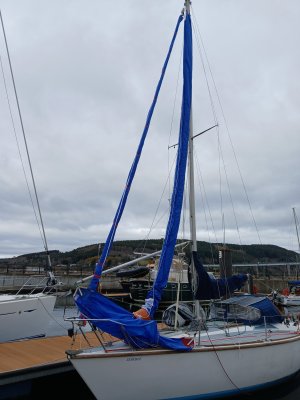
20250313_125044.jpg
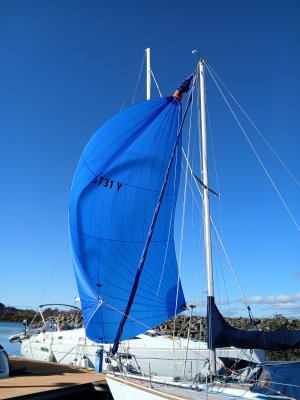
20250317_112116.jpg
Using a spinnaker bag would indeed be easier for launching the sail, but the snuffer is a better option when dowsing the sail instantly, with fewer potential snag points I'd say, but each to their own, as whichever manner one uses, and becomes familiar with, is the probably best for that boat.
 
I love setting the spinnaker on my Fulmar. That is without any crew. I used to race a lot and was the foredeck crew, chief winchman and spinnaker trimmer in my teens and onward. In the distant past I have have a few bad spinnaker problems - but the crew discussed what went wrong and what should happen to prevent it happening again. Learning from mistakes is the solution to prevent most spinnaker accidents.

Just to show how the photo in my avatar was taken, watch this video of me sailing under spinnaker going from Cowes to Eastbourne. The filming was done to the east of the Looe Channel at Selsey Bill to off Brighton. Most of the time I was doing 6½ to 7 knots.


Most people have problems dropping a spinnaker and I can say that in the past decade I have never got the spinnaker wet. The trick is to attach a snatch block on the sheet clipped down at the aft end of the coachroof just before dropping. Then tighten the sheet slightly before tripping the guy. The luff will now be held tight behind the mainsail. Gather the foot in, which is easy as it is behind the main. Then drop the spinnaker into the cockpit. I leave one turn round the halyard winch for friction to stop it just dropping immediately. I have used this method on every angle from dead running to on the beam (with 15 knot wind speed).

I just am not scared of what could go wrong with a spinnaker, as I am acutely aware of the warning signs and take remedial action before anything happens. Having a good autopilot you trust is essential to do this singlehanded.
Very impressive video. No spinnaker problems whatsoever as you were making swift progress.

Looking at it on my phone screen I didn’t notice if the starboard display was speed through the water or over the ground. I would guess it must have been the latter with a waterline length of ~9m.

I’d guess Concerto had a fairly clean bottom at the time?
 
The most interesting spinnaker moment I can think of recently was on the doublehanded RTI a couple of years ago. We were approaching St Kats, had the A-sail up, and decided to peel to the S. Got everything set up, pole up, hoisted the S outside of the A, bit of pole back, it filled nicely, and we broached. With the autopilot on and as many spinnakers in the air as there were people on the boat.
 
I recall being with a wealthy builder on his boat & I had been looking after fordeck all week with no problem. On one particular day he invited some flashy types & he suggested that I stood back behind the wheel with him & his wife whilst they got on with hoisting the kite. Eventually got it up but realised it was the light weather one & he wanted a heavy weather one. No problem. Do a spinny peel.
Did I say no problem? The boat went all over the place as 2 spinnakers entwined & filled
(He & I had been discussing building council houses which we had both been building & the floor areas of 3 bed houses being 900 ft2)
The boat rolled everywhere & his wife screamed
I leaned over his shoulder & said " John you have got 4500 ft2 of sail up. That is enough to fully carpet 5 council houses"
He shouted back "There is enough F..ing money up there to BUY 5 f..ing council houses- Go & get it down & get those twats out the f..ing way"
 
Last edited:
We use our Code 0 more in the Solent. It’s not as efficient when trying to run deep, but we can deal with it more easily, furl it when the wind gets up more or less on the instant. You use up a lot of water space going downwind at speed to get the kite down. The consequences of getting it as comprehensively wrong as that picture could be pretty serious. We’re perfectly accustomed to using the spinnaker in confined places on our litle mono, it’s just a different kettle of fish on a fairly quick multi.
I suspect that one reason for the different choices is that a fast cat can make up time on a broad reach while a non-planing monohull generally won't.
 
Very impressive video. No spinnaker problems whatsoever as you were making swift progress.

Looking at it on my phone screen I didn’t notice if the starboard display was speed through the water or over the ground. I would guess it must have been the latter with a waterline length of ~9m.

I’d guess Concerto had a fairly clean bottom at the time?
The starboard display is speed through the water. Waterline length 7.92m. At the time the antifouling was fairly clean as I had sailed from Chatham to the Isles of Scilly and was returning to Chatham, all in 3 weeks.
 
I suspect that one reason for the different choices is that a fast cat can make up time on a broad reach while a non-planing monohull generally won't.
For sure, a code 0 makes little sense on a fully displacement keelboat. But we do suffer of our course is dead downwind, the asymmetric kite makes up for that but you do need space if you’re short handed. You can leave the drop much later with a 3rd crew member.
 
The starboard display is speed through the water. Waterline length 7.92m. At the time the antifouling was fairly clean as I had sailed from Chatham to the Isles of Scilly and was returning to Chatham, all in 3 weeks.
Amazing speed. Would have thought you’d be <7 knots through the water.
 
Top