Putting floats on anchor chain

Worth bearing in mind that rope rodes and very light chain ones work perfectly well with the better anchors. As do heavy chains in stronger winds. In each of these cases there is no chain, or very little, on the seabed. New generation anchors cope perfectly well with rode off the bottom, with no compromise to holding. Fortress even advise (or did) that no chain is necessary.
 
Anchoring in coral can or will break off pieces of living coral. Anchoring in coral can also result in the chain and anchor becoming jammed in the coral resulting in further damage when you try to retrieve the rode, and retrieval might actually not be possible. Having your chain wrapped round a coral bommie would not be any fun for you or the coral. Coral will also wear the galvanising it is very abrasive.

Many coral location ban anchoring and sometimes offer courtesy moorings. Safe anchorages, for both the coral and the coral, in coral locations are very well documented. You would be a fool not to use them.

Jonathan
 
Scope is a very outmoded concept valid for older designs of anchors and to a lesser extent anchors that are too large for the engine capacity of the yacht to set deeply. The tension angle of the rode is diced by the angle of the shackle to the anchor shank and this bears little or no relationship to scope. The tension angle is a function of the shear strength of the seabed and the resistance of the shackle and chain to burial - these latter 2 constant (for each seabed) are independent of scope.

As your modern anchor sets the rode attached to the anchor, those first few feet attached to the anchors, is subject to increased resistance to burial and the shackle angle increases. As mentioned the shackle angle is independent of scope.

As Vyv has mentioned modern anchors are very tolerant of high tension angles (in comparison to older design of anchor).

Scope had considerable importance with the older designs but is much less relevant for anchors introduced since, say the Spade design was released (there are some modern exceptions).

Its an anchor thread - there is bound to be some controversy :)

Jonathan
 
Could the reasoning be to protect the coral from the chain ?

Perhaps more practically to keep the chain from snagging on coral heads when the wind shifts. Even if you anchor in clear sand, there can be a few scattered heads. This can also make sense in some rocky areas.

And what Neeves said.

The floats used are light and will be pulled down when the wind comes up. They should be JUST enough to lift the chain and no more.

Normally you don't float the whole chain, only the bit near the edge of the clear area. Just a few floats, and not right next to the anchor.
 
Here is an interesting video by a young girl who is sailing around the world on a 26' Grinde - in this episodes she talks about freeing her anchor chain from the coral heads, and using floats on it.
She stresses that the coral where she is anchored is dead, so no corals were killed in the filming.

 
As some are concerned about me damaging coral, let me elaborate - the idea is to drop the anchor in sand and then float the chain over the coral that surrounds the sand, allowing us enough scope without damaging the coral.

The concept is to allow the floats to lift the chain off any living coral that might be impinged during a win d shift. If the floats are too effective then the rode may lift the chain altering the tension angle and allowing the anchor to drag. I challenge owners to know what wind speed will allow them to deploy chain with floats that allow the chain to clear live coral under any conditions. Of course safety of the crew and yacht should be the focus......

........ which is why it is not recommended at all to anchor in coral.

The danger of providing videos of deploying anchors in dead coral is - you don't know if the coral is dead, unless you are an expert and dive on it prior. Coral is bleached but then forms the basis for a coral bloom to secure a new location to replace the old.

Any encouragement for anchoring in coral should be discouraged, not encouraged.

I do encourage people to dive on coral - to be amazed. What you see is what you potentially will destroy if you and hundreds of others will damage if you anchor in coral - each yacht slowly chipping away.

We went to the Barrier Reef and have declined further visits - not because of the damage to the Reef but the sheer numbers attracted - the Whitsundays have been damaged by their simply ease of access (and brilliant marketing)..

If you want to see the Reef - take a commercial tour.

Maybe someone else can comment on other reefs - or contradict my comments.

Jonathan
 
... The danger of providing videos of deploying anchors in dead coral is - you don't know if the coral is dead, unless you are an expert and dive on it prior. Coral is bleached but then forms the basis for a coral bloom to secure a new location to replace the old.

Any encouragement for anchoring in coral should be discouraged, not encouraged....

Jonathan

^^This.
 
I have been advised to do this over coral.
It may also be a very good idea on rocky bottoms in tidal areas, after a few cycles the chain can wrap around obstructions, shorten and shorten, the tripping line becomes useless and one is in a rather uncomfortable situation, guess how I know.
IIRC you are cruising to new places, sometimes it will be impossible to "choose your spot, not anchor there, go elsewhere... and similar, so it can be a useful technique.
Anchoring problems are not only caused by hurricanes, far from that :)
 
Scope had considerable importance with the older designs but is much less relevant for anchors introduced since, say the Spade design was released (there are some modern exceptions).
I am interested by this. A bit of searching has only turned up arguments that are generally against shorter scope, are you able to point to information that makes a good case for doing it? FAOD, I am not challenging your statement, I'd just like to learn more.
 
I am interested by this. A bit of searching has only turned up arguments that are generally against shorter scope, are you able to point to information that makes a good case for doing it? FAOD, I am not challenging your statement, I'd just like to learn more.
I can put in a bit of practical experience. I was forced to anchor on my kedge due to a windlass problem. It's a Fortress FX16 with 5 metres of 8 mm chain and 16 mm Anchorplait. Thanks to a misunderstanding on length marking I anchored in 5 metres on a 3:1 scope for a couple of days in a full gale. The anchor never moved and proved very difficult to retrieve from the dinghy. Very thoroughly set.
 
It may also be a very good idea on rocky bottoms in tidal areas, after a few cycles the chain can wrap around obstructions, shorten and shorten, the tripping line becomes useless and one is in a rather uncomfortable situation, guess how I know.
IIRC you are cruising to new places, sometimes it will be impossible to "choose your spot, not anchor there, go elsewhere... and similar, so it can be a useful technique.
Anchoring problems are not only caused by hurricanes, far from that :)
If don't know the place, I use a fish finder very successfully, to check out the area where I'm intending to anchor.
 
I am interested by this. A bit of searching has only turned up arguments that are generally against shorter scope, are you able to point to information that makes a good case for doing it? FAOD, I am not challenging your statement, I'd just like to learn more.

I'm more than happy if you challenge my statements - go for it! :)

The context of my comments were the suggestion that a high scope, 5:1 vs 3:1 allowed the anchor to be tensioned at at an angle closer to the horizontal. I was being slightly economical with reality as a high scope, the 5:1 also allows friction of the rode on the seabed (which I was ignoring) and also ignores the impact of catenary. Without going into detail, yet, or not at all - friction of the rode on the seabed has a decreasing role as the rode straightens and you can replace the benefit of catenary with elasticity (a snubber).

So stick to the angle developed by scope.

As a modern anchor sets the toe of the fluke and the shackle point bury, roughly, together. As the toe and increasingly the fluke bury the shackle end of the shank bury along with some shank and some chain. The shackle's ability to be buried is resisted by the seabed and the shackle - pivots on its clevis pin such that the shackles has an increasing angle to the seabed. The resistance of the chain to burial accentuates this phenomena. Its the angle of the shackle that determines the tension angle and as the anchor sets more deeply the tension angle increases (yet the scope angle remains the same, also not quite true. As the chain buries the catenary of unburried chain gets shorter (by the amount buried).)

The resistance to penetration of the shackle and chain is a function of the shear strength of the seabed and the size of the shackle and chain, bigger shackle and chain - more resistance.

You cannot change the seabed but you can alter the shackle and chain. Smaller shackle, smaller chain (commensurate with maintaining adequate strength).

This concept is not new the US Navy has known this for decades as has the oil ring industry. It really only became a factor for us with the introduction of modern anchors, say starting with Spade as the previous generation of anchors did not set in the same way, they did not bury the shackle and chain so easily.


Fortress conducted some tests a few years ago in Chesapeak Bay and employed the services of Bob Taylor whose career was with the US Navy in their research faciiities in California. Bob analysed the performance of the Fortress anchor and I quote from his reuslts

Quote:

'Each anchor test started out with an 8:1 scope and ended after 100 feet of drag at a 5:1 scope. There was concern that the scope change could dramatically influence anchor behavior. I evaluated both a high load and a low load case at various scopes using Navy analysis tools (1,2) described in 4.2. The code CSAP allows calculation of line configuration from the surface to an embedded anchor and can accommodate multiple line types, weights, buoys and up to 17 soil layers. This unique program was validated with full-scale data and has been used by the Navy for many years to design fleet moorings. The anchor shank depth and load are inputs to the code.
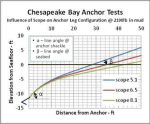
At a 2100lb load the maximum depth of embedment for the shank shackle on the FX-37 anchor in a normal mud is about 11 1/2ft with this mooring line. This places the center of the anchor at about the 13ft depth and the fluke oriented such that it can no longer penetrate the seabed. Essentially the anchor and mooring line are in an equilibrium position. Note that two angles are illustrated on the chart, the angle α at the anchor shank and angle β at the seafloor surface. Water depth at the site was only 30 feet so catenary is influenced significantly by the fact that the end of the chain is 11 1/2ft in the seabed.
Figure 8 and Table 1 show that line angle at the anchor is hardly affected by the change in scope from 8.1 to 5.1. Angle α changes 1.2 deg while angle β 6.5 deg. The change at the anchor might have a very minor effect on the anchor’s maximum embedment but it won’t be noticed in the scatter of the data. I also checked behavior at the 500lb load, which is more typical of most of the fixed fluke anchors. At this load the anchor body is located at about 5 feet into the seabed with the shank at 3 feet. A 3 degree change at the seabed causes only a 0.5 deg change at the anchor. This will not influence anchor behavior at all.
Although it is desirable to maintain a constant scope during a test, it seems that the test process employed at Chesapeake where scope was changed during the test had minimal affect on the test.
12
page13image46068528

end quote

At 500lb tension Taylor calculates shackle angle at 35 degrees whether a scope of 5.1: :1 or 6.5:1 and at 2,100lb tension shackle angle is calculated at a fairly consistent 48 degrees (at which point the anchor is dragging). So actual tension angle bears little relationship with scope angle and is not anywhere near horizontal of 0 degrees. Additionally as tension is increased from 500lb to 2,100lbs and the angle at the shackle increases from 35 degrees to 48 degrees - the anchor sets more deeply.

500lb of tension is roughly a 20hp engine with a decent prop at near maximum cruising revs. So roughly a decent power set. The FX 37 is a bit big for a yacht with a 20HP engine - so a smaller anchor would dive more deeply and the shackle angle would thus be higher.

Now - this is an extreme example. I don't have access to Bob Taylor's programme to determine shackle angle but I can set anchors, dig them out (carefully) and check the angle of the rode buried in the seabed and compare with the scope angle. Unexpectedly what Bob Taylor says is correct - the scope angle is only influenced in a minor way by the tension angle imposed by the shackle - for an anchor that is buried. The angle at the shackle is much higher than the scope angle - in Bob's case the tension angle is 35 degrees with a well buried Fortress under 500lb of tension - soft, soupy mud. Rather a long way from that romantic idea of near horizontal.

Vyv in his post above underlines that the scope angle and (if we could measure it) the tension angle are not the critical numbers we have been led to believe as being important - tension angles can be quite high, not horizontal, and modern anchors will perforce more than satisfactorily. Vyv is not alone in his observations - others have said the same on this forum.

But

Don't forget that though modern anchors will set and develop hold at 'poor' scope ratios there is a loss of 'catenary effect' which you would need to replace with some other characteristic - snubbers and elasticity being the common alternative (to catenary).

The lesson is - don't get hung up about scope and the idea your rode should be horizontal and on the seabed. If a modern anchor, Spade, Fortress, Excel. Rocna, Viking is able to engage - it will set. Short scope does mean that any movement of the yacht, chop, swell or yawing will have an immediate and negative effect but that is different, even if related) to angle of tension. If you have a decent snubber it will allow safe use of 'short' rode. If your anchor is too big or badly designed, Mantus, it will not set deeply - again - that's another issue.

If you still use a CQR, Bruce, Delta and more so if you use a nefarious copy - stick to long rodes, high scope ratios.

We set our anchors at a 3:1 scope - as if the anchors do not engage and develop hold there is something wrong (and we retrieve and try again). We very seldom use more than a 5:1 scope - but we do use decent snubbers. Deploying at 10:1 demands you have plenty of room - which might not be available - its worth playing around with scope and snubbers - you will be pleasantly surprised. The proviso is - you need a decent modern anchor.

Jonathan
 
I am familiar with the testing re. pivoting fluke anchors. They bury much more deeply than general purpose anchors, and thus as far as that difference goes, obey different rules.

For example, during Panope's tests, the shackle is seldom more than a few inches below the sand. During Taylor's tests, the anchor was generarll more than 5 feet under ground, and ins some cases much more. Just look at the graph.

I do not believe Taylor's tests should be extrapolated to general purpose anchors.

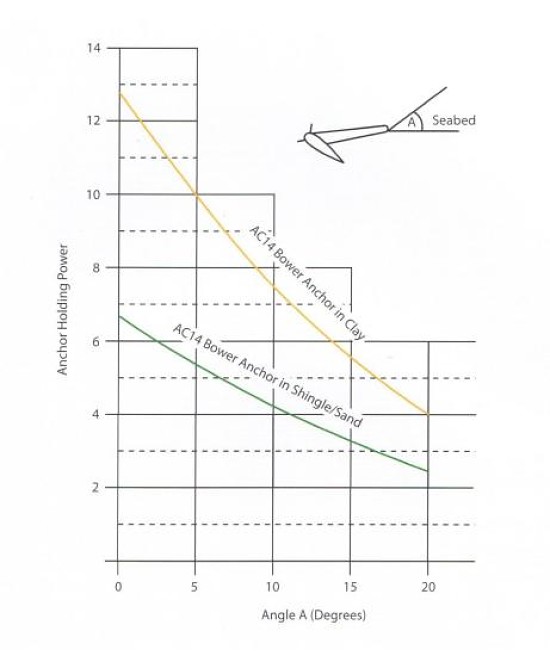
Does anyone have holding capacity vs. scope data on general purpose anchors, such as Mantus, Spade, or Rocna? Until we see that data, I'm not sure what we are talking about. Anecdotal tales are interesting, but the rode tension was probably no more than 20% of the proven holding capacity of the anchor, so we don't know what was lost, only that there was still enough remaining. I've published some test results, with rope instead of chain to eliminate the effect of catenary, and the results were not perfect. They were "good," maybe even impressive, but holding was reduced. The other thing I noticed, is the effect is greater in flowing sand or soft mud, with the holding below 3:1 scope (about 20degrees) to unpredictable to plot, which is why the graps stop there.

I plotted my data against this data (below), and the curves were very close, depending on the design. HOWEVER, the Fortress had very different (better) short scope characteristics, sufficient that I don't not consider them directly comparable. It was a clear outlier in the plot. It also burried a lot deeper.

So let's look at data for the anchors we actually use. Rocna. Spade. Mantus. Excel.

[BTW, I once asked SPADE this question. They said it maintained 100% hold at 7:1 scope. They then explained that is because they rate holding capacity at 7:1 scope. Hysterical.]


Anchor-holding-power-relation-with-scope.jpg

image-asset.png
 
As some are concerned about me damaging coral, let me elaborate - the idea is to drop the anchor in sand and then float the chain over the coral that surrounds the sand, allowing us enough scope without damaging the coral.

Don't use any kind of float or tripping line, cos some clown will think it's a mooring buoy and trip your anchor, I've watched this happen several times. Very few designated anchorages are over coral beds, some are in areas with coral heads, so try and enter at low tide with the sun high, preferably behind to see where they are.

If you really do have a sand patch, set up a 180 degree double anchor with both led to the bow. If you do not have a chain rode, polypropylene is cheap and it floats so tends not to get wrapped around coral heads.
 
Top
