
You are using an out of date browser. It may not display this or other websites correctly.
You should upgrade or use an alternative browser.
You should upgrade or use an alternative browser.
Porn
- Thread starter jezjez
- Start date

johnalison
Well-Known Member
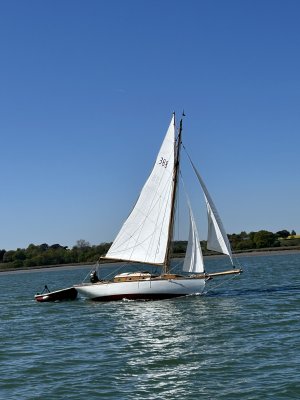
Gunter porn at that.

DanTribe
Well-Known Member
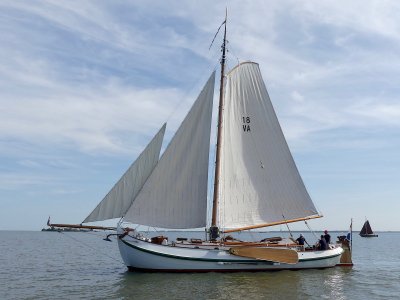
Are you sure? Appears to have a peak and throat halliard, so I think gaff.Gunter porn at that.
Not that I'm pedantic!
Puffin10032
Well-Known Member
Definitely gaff rigged. In its narrowest (most pedantic?) definition a gunter rig would have a tensioned wire strop up the back of the mast to which the gaff is attached. This allows the gaff to slide up and down for reefing without falling away from the mast. Whether the simplified rig seen on small dinghies such as Herons and Mirrors can truly be called a gunter is an argument I'll leave to the pedants.Are you sure? Appears to have a peak and throat halliard, so I think gaff.
Not that I'm pedantic!
Anyway, whatever the nomenclature of the rig, that's a very nice boat.
johnalison
Well-Known Member
Maybe. The only gunter boat I have sailed was the Yare and Bute ODs on the Broads which we called gunter because the gaff was high and close to the mast, as in this boat, so for me a gunter rig is just a very high gaff, rather than having any particular equipment.Definitely gaff rigged. In its narrowest (most pedantic?) definition a gunter rig would have a tensioned wire strop up the back of the mast to which the gaff is attached. This allows the gaff to slide up and down for reefing without falling away from the mast. Whether the simplified rig seen on small dinghies such as Herons and Mirrors can truly be called a gunter is an argument I'll leave to the pedants.
Anyway, whatever the nomenclature of the rig, that's a very nice boat.
Jan Harber
Well-Known Member
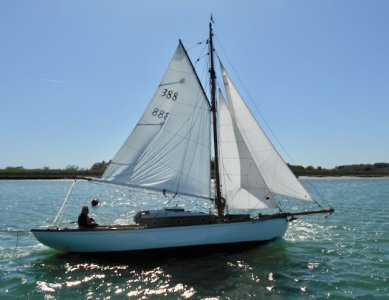
I too photographed this gaff cutter yesterday as she sailed past us on a moorings at Ramsholt and I have since found out more about her. She is Capriccio, formerly Wendy, designed by Morgan Giles and built at Fishbourne, IoW in 1912. When she came to the East Coast in the 1980s she was re-named. She has been owned since 2019 by an OGA member and is kept at Ramsholt on the Deben.

14K478
Well-Known Member
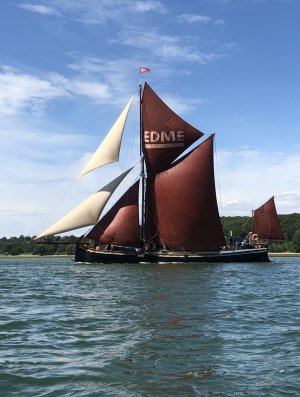
I would not normally presume to post on the same page as Jan Harber but this is my only pretty picture, snapped with an iphone from the cockpit of my son’s Squib, and it shows the Harman family yacht EDME, still engineless, going like a train for the finish line of the Pin Mill barge match on the 24th September 2022. This was a case of “There is no second” because the rest of the fleet were still in Harwich Harbour.
Puffin10032
Well-Known Member
Maybe. The only gunter boat I have sailed was the Yare and Bute ODs on the Broads which we called gunter because the gaff was high and close to the mast, as in this boat, so for me a gunter rig is just a very high gaff, rather than having any particular equipment.
The closeness of the gaff to the mast is a bit of an optical illusion as Jan Harber's image shows. Y&BODs have both a throat and a peak halyard according to their class rules so are definitely gaff rigged regardless of how high the gaff is held. You can see a similarly high gaff on the OGAs excellent Gaffling dinghy.
johnalison
Well-Known Member
Yes, I can see that now from the second picture.The closeness of the gaff to the mast is a bit of an optical illusion as Jan Harber's image shows. Y&BODs have both a throat and a peak halyard according to their class rules so are definitely gaff rigged regardless of how high the gaff is held. You can see a similarly high gaff on the OGAs excellent Gaffling dinghy.
johnalison
Well-Known Member
I’ve just remembered another gunter-rigged boat that I sailed, when I spent a week at Salcombe with the ICC. They had some 13’ dinghies we used for instruction. The gaff was held up by a single line attached with a rolling hitch. Until you learned to tie a rolling hitch you didn’t get a chance to go sailing, though I was already familiar with knots by then.
14K478
Well-Known Member
I think the gunter rig was developed in small racing boats such as the predecessors of the International Fouteen which were often carried aboard warships and often sent by train - in both cases a rig that stowed in the boat but which gave good performance was wanted. I think the smallest sizes of racing keelboats, up to the “two and a half raters”, also favoured it because it kept the mast short and the rigging simple.
I think it can have one halyard, or two, or a sliding arrangement with one halyard.
I think it can have one halyard, or two, or a sliding arrangement with one halyard.
DanTribe
Well-Known Member
In my youth arguments such as this were settled by reference to a book called Sailing by Peter Heaton.
BTW. Edme is sprit rigged, not gunter or gaff. Oh no! It's starting again!
BTW. Edme is sprit rigged, not gunter or gaff. Oh no! It's starting again!
14K478
Well-Known Member
I had a copy! But I started with this one:In my youth arguments such as this were settled by reference to a book called Sailing by Peter Heaton.
BTW. Edme is sprit rigged, not gunter or gaff. Oh no! It's starting again!
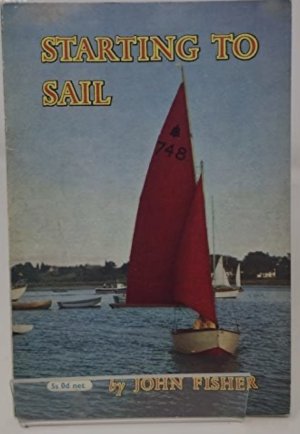
Of course EDME is sprit rigged
 I just thought it was a “porn level” picture!
Puffin10032
Well-Known Member
I think the gunter rig was developed in small racing boats such as the predecessors of the International Fouteen which were often carried aboard warships and often sent by train - in both cases a rig that stowed in the boat but which gave good performance was wanted. I think the smallest sizes of racing keelboats, up to the “two and a half raters”, also favoured it because it kept the mast short and the rigging simple.
I think it can have one halyard, or two, or a sliding arrangement with one halyard.
I think it pre-dates the I14. I've found this very interesting article. It's mostly about the old Aussie skiffs but does explain the origin of the sliding gunter rig
Gaff or Gunter?
I feel that the defining feature of a true gunter rig is that there is some method of holding the gaff up against the mast so that it can slide up and down to facilitate reefing. The earliest method seems to have been two iron straps. I've read of, but never seen, a tensioned wire strop up the back of the mast being used. Some sort of track would probably also work.
The problem of arguing that gunter is merely a synonym for high-peaked gaff is that at what gaff angle does a sail magically transform from gaff to gunter?

Frayed Knot
Well-Known Member
Oh well, in for a penny…
Here’s some Dutch porn - ex-queen’s yacht to which we’d had to tie alongside (no pressure) the previous day.
I try not to be a pedant but I’m fairly confident that’s not gunter rigged.
Here’s some Dutch porn - ex-queen’s yacht to which we’d had to tie alongside (no pressure) the previous day.
I try not to be a pedant but I’m fairly confident that’s not gunter rigged.
14K478
Well-Known Member
A very good article. Thank you.I think it pre-dates the I14. I've found this very interesting article. It's mostly about the old Aussie skiffs but does explain the origin of the sliding gunter rig
Gaff or Gunter?
I feel that the defining feature of a true gunter rig is that there is some method of holding the gaff up against the mast so that it can slide up and down to facilitate reefing. The earliest method seems to have been two iron straps. I've read of, but never seen, a tensioned wire strop up the back of the mast being used. Some sort of track would probably also work.
The problem of arguing that gunter is merely a synonym for high-peaked gaff is that at what gaff angle does a sail magically transform from gaff to gunter?
I suggest that if the gaff is as long as the boom, and sometimes gets called a yard, then the boat is perhaps gunter rigged.
Claud Worth gives the ideal length of a gaff as between 2/3 and 3/4 of the length of the boom with the ideal angle of the gaff as at a right angle to the clew.
Dee Bee
Well-Known Member
Wikipedia says a gunter rig has a yard that goes vertical to the mast unlike a gaff rig. I remember learning on a dreadful gunter rigged boat - the Copyu.

LittleSister
Well-Known Member
I remember learning on a dreadful gunter rigged boat - the Copyu.
No, that was just a Coypu that had rigged wrongly!


