Oxalic acid concentration for hull cleaning

Simon 420

Well-Known Member
Joined
13 Jan 2020
Messages
103
Location
Bedford
Visit site
I now have attire of oxalic acid for purposes of cleaning our boat prior to cutting and polishing. Any recommendation as to concentration please? Two areas to think about: –

1. Normal hull sides which will have residue of salt and polish from last time plus general dirt
2. Waterline area where we have the usual build-up of scaly gunge
 
I now have attire of oxalic acid for purposes of cleaning our boat prior to cutting and polishing. Any recommendation as to concentration please? Two areas to think about: –

1. Normal hull sides which will have residue of salt and polish from last time plus general dirt
2. Waterline area where we have the usual build-up of scaly gunge
A nearly saturated solution is usually recommended,
It does not work in cold conditions.

Wear gloves and eye protection. Wash off any splashes promptly.
 
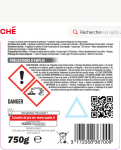
According to the instruction label on the oxalic acid I buy in France, it is 100g to 1 litre of warm water.

I can measure 1 litre but I guesstimate 100g as I have no means of weighing it.

It works best in warm weather.

1672998564363.png
 
I have seen recc'd of 200g per 1 litre ..... at this concentration - it only removed light marks on my hull and a pals I did for him. It was no better in fact than using a Toilet Cleaner ..... my fav used to be Cilit Bang Lime and Rust until some twit bureaucrat forced its re-formulation.
Now I use 400g as a minimum per 1 litre hot water .... plus Wallpaper paste to thicken it to a paste to let it cling to the surface instead of just running off ....

How I do the job ....

1. High Pressure Wash all hull removing salts and crud .....
2. Then with water hose or pressure washer - I make sure surface is wet ... often it has dried by time all hull is done in 1. and apply the paste with a long handled roller and a brush where needed to get into joints / awkward areas. Working water / paste in sections ....
3. Leave it for some minutes ... if its light staining - then its basically by time I've completed hull - I can go to start and begin washing off using the high pressure washer - taking care to make sure it blasts away from other boats / people / animals / myself.
4. I repeat if necessary.

Once done - then its a light cutting agent such as Silver Polish or T-Cut ..... removal must be complete though as it can yellow the GRP.
Finally I use a car wash detergent with wax included ..... contrary to some advice I have seen. Some say that the silicon based car wax is not good for GRP ..... after many years - I have seen no evidence for this.
 
With Hull cleaning mix in wall paper paste to so that it’s a gel which sticks in place. Wash off often 15 mins. I’ve always used 100g of oxalic acid per litre in warm water with good success.
 
We make up a saturated solution, add until further additions of dry oxalic acid no longer dissolve. Any undissolved solids you can use for your next batch, the same day, (spot cleaning on areas that need a bit more work). We tend only to use it in warm weather, I'm not sure if the weather makes any difference, but you will increase the concentration with warm water - but don't go overboard and use boiling water. Pressure wash the hull, or have that done for you, this will remove much or most of the dirt, then before the hull dries treat with acid.

Boatyards we have seen use squeegee type 'things' on poles (and the acid gets everywhere). We prefer to use a small hand held spray bottle which allows focus on bad areas (38' cat hull). The spray bottle is handy for odd rust marks on deck, spot cleaning. Work from the deck level down

Oxalic works well on tannin stains at the water line.

We don't polish our hull - cannot comment.

You are working with a chemical reaction - if the hull, or part of, is clean - you are wasting your time - focus on the areas with staining.

As Vic says, wear gloves and eye protection (goggles), keep children and pets away. If it gets in eyes, or on a cut - copious volumes of water.

Jonathan
 
Saturated solution. If you go down the wallpaper paste route be careful. If you don't leave it on long enough it doesn't have time to get rid of stubborn stains. Make it too thick, leave it on too long and it can be a pain to get off. I put a triple dose of boat shampoo in the mix, and sponge it on liberally using rubber gauntlets. This stops it running down inside your cuffs. Wet sleeves holding the solution against your skin for a while will become very uncomfortable.
You will need to do the whole of the hull once you start. It will soon become obvious why, areas of the hull you thought were clean that are adjacent to areas you have treated will stand out.
 
Last edited:
Oxalic acid will bleach. Do tests before using on anything but white gelcoat.

On anything but white gelcoat there is no real need to use it. I now have a blue hull and remove any oxidization with a fine polish like 3M finesse it. then a coat of wax.
 
I part powder and 9 parts hot water works well. But as you’ll know, wash down any surrounding things you don’t want eroded. Like a trailer for example. Then wash down after too.
Oxalic acid has more of use for getting rid of fresh water staining I’d imagine. It breaks down the iron content in anything it’s applied to. Why it’s so effective on fresh water staining.
If it’s just to clean any salt deposits off…I might be using something else perhaps.
 
I use a floor mop with a telescopic handle and microfibre head to apply the acid from ground level.

Then hose off and finally follow with a liquid wash-and-wax cleaner/polisher.
 
Oxalic acid doesn't clean, It bleaches the dirt white.
I get your thoughts there…but to be fair…when using it to rid fresh water staining, it does have a very effective result. It naturally breaks down the iron that is the content/make up of the stain itself. As far as I know, most or all of the top hull cleaner products, have it or a very similar variant of it, in the ingredients.
it’s extremely effective for the above use at least.
 
I use a floor mop with a telescopic handle and microfibre head to apply the acid from ground level.

Then hose off and finally follow with a liquid wash-and-wax cleaner/polisher.

I use a paint roller on a telescopic arm ...... an old trick to stop it running down and onto your hands / arms ..... empty drink bottle ... cut of top section so you have a 'funnel'. Pass handle through the screw top hole with the funnel facing the roller ...... tape the bottle in place so nothing gets past the joint to handle. Anything that runs down now will collect in the 'bottle'.
 
I now have attire of oxalic acid for purposes of cleaning our boat prior to cutting and polishing. Any recommendation as to concentration please? Two areas to think about: –

1. Normal hull sides which will have residue of salt and polish from last time plus general dirt
2. Waterline area where we have the usual build-up of scaly gunge
If you are going to cut and polish , then you dont need to use the acid as the cutting will remove the surface staining.
 
Works wonders on "rust " stains, ie bases of stantions and around cleats and fairleads etc.
For those of us with any aversion to hard work, its a delight, simply paint it on and sit back and allow it work its magic while you congratulate yourself on the result.
A second application normally removes the worst staining.
Rumours its iron in the water thats the problem locally.

The downside is doing small test area and then the dazzling whiteness makes you painfully aware of just how scuzzy the rest of the boat has become.
Buy on ebay at around £15.00 per Kilo or buy Y10 at about the same price for 340g pot, suspect that only a small proportion of that is actually Oxalic acid.
One well known on line chandlery is bit sniffy about buying the acid in power from and proclaims that its difficult to use because it will not stay on long enough to work especially on vertical surfaces.
Budget washing up liquid solves that problem.
 
@marinereflections who used to post here was the expert and was very generous with his advice.
Once of the processes to consider prior to the cutting stage is to remove limescale - spray up the waterline area with Viacal and wash off so that you are dealing with the gelcoat.
 
Works wonders on "rust " stains, ie bases of stantions and around cleats and fairleads etc.
>
The downside is doing small test area and then the dazzling whiteness makes you painfully aware of just how scuzzy the rest of the boat has become.
Buy on ebay at around £15.00 per Kilo or buy Y10 at about the same price for 340g pot, suspect that only a small proportion of that is actually Oxalic acid.
One well known on line chandlery is bit sniffy about buying the acid in power from and proclaims that its difficult to use because it will not stay on long enough to work especially on vertical surfaces.
Budget washing up liquid solves that problem.
6% according to the safety data.

.
 
I found oxalic acid quickly removed yellow stains from my decks, but the stains reappeared a week or two later. What am I doing wrong?
 
Top