
One for solar geeks

geem

Well-Known Member
Joined
27 Apr 2006
Messages
8,999
Location
European side of the pond
Visit site
We are in Antigua with our boat. We have new 250W bifacial solar panels mounted on our guardrails. 2x250W on port and starboard sides giving us a total 1000W of bifacial panels. The panels can tilt from vertical through to horizontal. It's the shorted day of the year so I thought I would report on solar production down here at 17°N
Our panels are configured in series pairs as we are a 24v boat and these are nominal 20v panels. The sun angle at 12:00 is almost 50° so a lot better than the UK ut even so it's winter here.
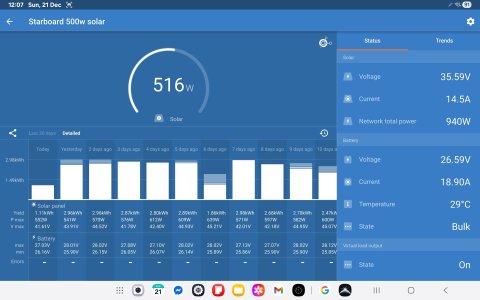
I just measured the angle of my starboard panels. They are adjusted simply by means of a notched support. The lowest notch gives me 45° and the next notch up gives me 55° they are currently set on 55° and output of the solar is exceeding the rating of the panels. It has done this on the last 13 consecutive days. Some of the performance may be down to their bifacial gain but either way, it's pretty impressive. 500W of solar has been harvesting just under 3kWh per day on average. We don't get perfect sun here. We have had lots of rain showers and squalls and plenty of cloud. Screenshot_20251221_120725.jpg
 
Just seen your other thread and I guess 280Ah LiFePO4 cells so no need to float. Looks like a great set-up.
btw I was i Glasson Dock in my solar powerd motor boat in August, just missed you. It would have been good to ser your boat.
 
Just seen your other thread and I guess 280Ah LiFePO4 cells so no need to float. Looks like a great set-up.
btw I was i Glasson Dock in my solar powerd motor boat in August, just missed you. It would have been good to ser your boat.
Just out of interest

You presumably have separate power banks for your house and motor(s) - are they the same chemistries LEP or do you use a different chemistry for the motor(s). I only ask as vehicles, I understand, vehicles tend to use chemistries different to LEP. I have a friend building an all electric blue water sail cat - and he might be interested in your experiences.

Jonathan
 
The solar insolation is excellent in the Caribbean.

Importantly, there is only a small difference between winter and summer.

In any cruising area, the minimum solar insolation is critical to ensuring there is enough power. The consistency of the Caribbean makes electrical power planning easy. The length of the solar days in the Caribbean is not long, but nevertheless, the total output is excellent.

The difficulty comes when cruisers depart these areas of excellent solar insolation. It is hard to believe how much the solar output can deplete when cruising into more marginal areas.
 
Just out of interest

You presumably have separate power banks for your house and motor(s) - are they the same chemistries LEP or do you use a different chemistry for the motor(s). I only ask as vehicles, I understand, vehicles tend to use chemistries different to LEP. I have a friend building an all electric blue water sail cat - and he might be interested in your experiences.

Jonathan
It's a small lnland/coastal cruiser which I converted. 48V 300Ah custom LifePO4 for propulsion. I kept the lead 12V domestic with its own solar just for llow power stuff like ights, instruments phone charging and added a 48V inverter for cooking. It works well but starting from scratch I would eliminate the 12V and use a small dc-dc converter if required.
 
Just seen your other thread and I guess 280Ah LiFePO4 cells so no need to float. Looks like a great set-up.
btw I was i Glasson Dock in my solar powerd motor boat in August, just missed you. It would have been good to ser your boat.
24v boat so we have two 280Ah batteries at 24v. Equivalent to 1120Ah at 12v. Plenty of capacity. We float every few days but with a high output
watermaker, immersion heater and electric cooking, we can draw plenty of power. The big battery capacity will see us through a few days of heavy cloud
 
The solar insolation is excellent in the Caribbean.

Importantly, there is only a small difference between winter and summer.

In any cruising area, the minimum solar insolation is critical to ensuring there is enough power. The consistency of the Caribbean makes electrical power planning easy. The length of the solar days in the Caribbean is not long, but nevertheless, the total output is excellent.

The difficulty comes when cruisers depart these areas of excellent solar insolation. It is hard to believe how much the solar output can deplete when cruising into more marginal areas.
I assume you mean in winter. Back in the UK, we harvest similar amounts of power as the Caribbean winter because the UK summer days are so long.
The UK winter is impossible with solar.
 
As a general rule, if relying on solar output, the batteries should be achieving a float voltage most days.
That's true for lead acid (ideally every day) but not needed for lifepo4. You canj ust use it like a fuel tank, just top up as required.
 
You want LFP to reach full, or very nearly, in order to allow the cells to balance. But it doesn't have to happen very often. A couple of times a month should generally be sufficient.
 
The input still needs to exceed the output no matter the battery chemistry.
As I said with lifepo4 you can use it like a fuel tank albeit one with a very slow leak. Also no need to fully charge as often as twice a month. My 48V system has no automatic balancing but I manually top balance once a year. Doesnt take more than a couple of Ah i to the lowest cells.
 
Top