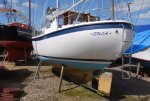
Old Man's Boat or Family Cruiser

Conor O'Brien, who wrote many books about the practical aspects of cruising based on his long experience of ocean voyaging and sailing in Irish waters, came to the conclusion that the ideal cruiser would have a powerful engine and a square rig that could be operated entirely from the deck.

This conclusion assumes that ocean voyaging is done using prevailing winds and when one needs to get in and out of harbour one uses the engine.

The same could also apply to many of today's cruising yachtsmen who don't seem to be very fond of going to windward yet carry a rig designed for that purpose rather than one more suited to sailing off the wind.

Of course there would be practical considerations that did not apply in O'Brien's time. Nowadays yards would have to be cock-billed in marinas or when rafted up!

If nothing else, it would add an interesting new dimension to a yachting scene almost entirely dominated by dreary uniformity
Certainly refreshing when you see a different rig amongst all the bermudians
 
Refreshing to see, but I wouldn't want to own one.
Nor I doubt would anyone who ever plans to sail to windward, or doesn't have a big crew including top men to go aloft and clew up the sail in an impending gale. Plus all that weight aloft.

Yeah, nice to look at, but I leave the ownership those with deeper pockets & lazier schedules.
 
I'll admit to being nearer 50 than 40 (73) but if I had to choose a sturdy old motor sailor I'd try a Banjer … there was one advertised recently. Proper little ship. Go to weather like the proverbial brick whatnot but a thumping big engine would take care of that!
edit: Just checked ... still on Apollo Duck, much updated and lovely!
Banjers are one of the traditional MS that went through considerable development over their years in production and they, to use a proper nautical term, look right.
They essentially started out as a seagoing MoBo with steadying sail - its last evolution was the Oceanique class with up to a 100sqm.

They have a great website, giving the history etc., but also provide valuable and useful tech numbers which are essential to assess a design or make qualified modifications.
 
Refreshing to see, but I wouldn't want to own one.
Nor I doubt would anyone who ever plans to sail to windward, or doesn't have a big crew including top men to go aloft and clew up the sail in an impending gale. Plus all that weight aloft.

Yeah, nice to look at, but I leave the ownership those with deeper pockets & lazier schedules.
There are rigging solutions for square sails that do not require going aloft and according to wind tunnel evaluations they are more efficient down hill than Bermudan. Not sure I would need to own one, though. I could see the appeal if I were crossing an ocean.
I could, however, be persuaded to own a gaffer for cruising. We have a 14' day sailer with it and its great fun.
Gaff rig is also surprisingly efficient. A friend of ours got well clobbered by a gaffer in his 44' Boreal - going to windward. The lee-board Lemster out-pointed and out-footed his modern, Bermudan rigged and centre board aluminium yacht.
 
Last edited:
When you are working, invariably your sailing is time constrained and so much upwind sailing ends up getting a little help from the engine. Once retirement takes over then that constraint is taken away - to a degree. All boats will sail - some much better than others- with the wind on the beam we can set both sails and plod nicely along at 5kts - if we bear away a bit the main tends to blanket the Genoa so we tend to drop the main and if the conditions seem ok - out comes the spinnaker.
We have sailed some decent passages in Claymore over the past 20 years - the wheelhouse has protected us from the excesses of Scottish weather where we can have the odd damp day - and then being in the North - up towards the top of the planet - we are nearer the sun - so it gets hotter and browns us faster, another good reason for the wheelie hoos
Had there been one on the market when we started looking, we would have considered a Claymore. They are no doubt a better sailing boat than the Watson we bought (- it can be fixed). This is my second boat with covered steering and I would never own anything else.
 
I have to admit I haven't sailed either. But I suspect the trade off between light to modest wind performance with a Pogo 8m compared to an HR 34 might be a pleasant surprise? We toyed with the idea of a heavier displacement boat 2 years ago on change of boat (thinking Najads/ Rassys). Maybe not? We went from 35 to 42, still Jeanneau....., still under 9 tons. She will do well in 5 to 8Kts of wind and really romp along in 12-14. We rarely try beating into F5-6 - why? No time constraints as we are retired? If we meet 25-30Kts we reef enough and keep going.
We're neither of us young , technically. So why wait for F4 to do 5Kts for much longer when you can get 60% of apparent wind from F2/3/ 4 onwards and do 7-8Kts in a decent wind?

There are many different reasons for choosing a boat?
Sailing well in light to modest air is more fun.
F6+ is a good reason for more books and cups of tea!
To our own and great surprise, we out-sailed a Pogo 30 in our modified Watson 32 - broadreach, both under genoa only and 13kts of wind. My wife insisted I take a picture, 'cos no one would believe us.
 
Each to their own. I have no problem with a heavier boat used to have an old 9t Hilliard, 30' x 8'6" and 5' draught in a straight line she sailed well in anything over 10 knots. Did a biscay circuit in her and once had to sail her in to Brighton marina as the engine wouldn't start. Had a taller aluminium mast and a huge light weight genoa did once spend an hour beating out of st helier harbour. Now on another heavy weight: westerly Conway, which I love. As a comparison I crew on a quarter tonner and would not cruise that on my own as in anything over twenty knots needs 3 or 4 crew on the rail to stop it falling over. My family don't do sailing though.
 
To our own and great surprise, we out-sailed a Pogo 30 in our modified Watson 32 - broadreach, both under genoa only and 13kts of wind. My wife insisted I take a picture, 'cos no one would believe us.

Define “out-sailed”. I would guess that if your CW beat a Pogo 30 on a broad reach either they were not trying that hard, they didn’t know what they were doing, or there was something wrong with their boat.
 
Banjers are one of the traditional MS that went through considerable development over their years in production and they, to use a proper nautical term, look right.
They essentially started out as a seagoing MoBo with steadying sail - its last evolution was the Oceanique class with up to a 100sqm.

They have a great website, giving the history etc., but also provide valuable and useful tech numbers which are essential to assess a design or make qualified modifications.
How, does a Banjer 37, compare with a Fisher 37?
I understand the Banjer had an optional 'bigger' rig.
 
Define “out-sailed”. I would guess that if your CW beat a Pogo 30 on a broad reach either they were not trying that hard, they didn’t know what they were doing, or there was something wrong with their boat.
We left the Paimpol lock, as the last boat, with a flotilla from the Glenans Sailing school. The drying channel does not leave enough room to point up into the wind to raise the mains, so all the boats set the gennies and set out for sea and we did the same. We were some 200m behind; by the time we reached open water, we had passed them and were catching up with the next. Unfortunately, we then continued on to Brehat, whereas the fleet went to St. Malo

I'm not sure how you can 'try harder' on a broad reach, under genny only?

Being a Glenans, there has to be at least one person on board who does know what they are doing.

As far as I can tell, the Glenans maintain their boats in top form.

We have also passed a Bav 32 in light going on the Isselmeer.
Our Watson is not standard, it has a streamlined rudder and deadwood and at 72sqm carries more than twice the SA than the regular offering (See Avatar). She is not a racer, but these instances do nicely demonstrate the hydrodynamic quality of the Watson hull, given a few simple upgrades. Off the wind I do not pay the penalty for that big, comfortable box on top. We were doing about 4.5kts at the time.
 
Last edited:
How, does a Banjer 37, compare with a Fisher 37?
I understand the Banjer had an optional 'bigger' rig.
Fisher 37: LWL 9.91m; Beam 3.66m; Draft 1.60m; Displ. 14226kg; Ballast 4990kg; Sail area 73.4 sqm;
SA/D 12.73; Ballast/Displ. 35%; Displ/Length 407; Hull speed 7.65kts

Banjer 37: LWL 10.21; Beam 3.48m; Draft 1.40m; Displ. 12000kg; Ballast 4000kg; Sail area 28, 42, 75, 97sqm;
SA/D 5.25(28), 7.88(42), 14.08(75), 16.73(97); Ballast/Displ 33%,
Displ/Lenth 409; Hull speed 7.76kts

Both Banjer and Fisher are reported to roll a lot. The Banjers with the larger sail areas and bigger rigs are said to roll less than their shorter rigged sisters. Having dramatically increased the SA on our Watson, I can corroborate that.
 
My fathers freeward rolled terribly it’s not enough to take the design of a fishing boat which are designed to roll and create a yacht the bilges need to be much tighter with a definite turn of the bilge to dampen rolling
 
My fathers freeward rolled terribly it’s not enough to take the design of a fishing boat which are designed to roll and create a yacht the bilges need to be much tighter with a definite turn of the bilge to dampen rolling
Agreed, though I doubt that fishing vessels are designed with rolling in mind. Slack bilges, as you correctly pointed out, are IMHO the result of the need for load-carrying ability - in this case fish. A burdensome hull has a lot of buoyancy low down - that has a detrimental effect on stability as well. On the up-side, taking a traditional and likely timber-designed MFV hull of considerable volume and building it in GRP, requires a lot of ballast to bring the thing down onto its lines. No matter how heavy the machinery or fit-out, you easily end up with ballast ratios of around 40% or more. As a result most of these boats could easily stand more sail and their motion would greatly benefit from having a rig with more inertia.

The Watsons have a much sharper turn to their bilge than either the Banjer or Fishers. Their hull is a direct GRP interpretation of a vessel of wooden construction, with separate stem and keel, clearly defined rabbet line and even the typical hump where the garboard plank would turn into the deadwood. I cannot shake the impression that when Colvic asked G.L. Watson Ltd. to come up with a design to compete with the Fisher, the boss told his draftsman: "Why don't you just take the fish boat we did for Bob, scale it to size, change her to GRP and stick a couple of masts on her." And that's what they did.
I'm certain I'll get into trouble for saying that, 'cos every one knows: the hand that drew the lines of the Watson was guided by divinity; except for the steering end of it, that part was done by the mail boy when the divinity was on a coffee break.
 
I read somewhere that getting the net on board was helped by the rolling of the fishing boat hull and the other factor was as the fishing boat was to be at sea it needed to survive and a hull that gave to the waves although more rolly was likely recover .
 
I read somewhere that getting the net on board was helped by the rolling of the fishing boat hull and the other factor was as the fishing boat was to be at sea it needed to survive and a hull that gave to the waves although more rolly was likely recover .
Interesting comment on rolling to help bring in the nets. I'm not sure how much that would have been a factor once the fishing fleets became motorized. Otherwise, a rolling ship is harder to work on. Many fishing craft use steadying sail, paravanes and various types of bilge keel, active or passive, to stabilize. What was desirable though, was a boat with a slow roll and preferably one that had a roll period that did not coincide with the common local wave patterns.
Fishing boats seem to have become more burdensome with the introduction of engines and the older motors were crazily heavy. Our 58hp diesel weighs with transmission about 260 kg, which is quite heavy by current standards. A Danish Hundested of the same output weighed 2600kg. Fishers and Watsons, I think, are more likely GRP interpretations of motor vessels, rather than a sailing type. In the design company's listing, the CW 32 is noted down as a MFV.
 
You should race, no doubt about it.


.
A race being defined as two boats on the same body of water and in sight of one another. I guess we do.
I did read about an "upgraded" Fisher 30(?) that supposedly won the San Diego to Ensenada on corrected time. They must have had quite the handicap.
 
Last edited:
It would be interesting to know why fishing boats of Scottish origin have rounded sterns perhaps some Viking lineage ?
Danish ones do too, at least the traditional ones, as do many Mediterranean models. Still the strongest and easiest way to form the stern of a ship and a natural way to get rid of all that displaced water.
 
Top