New VHF aerial on mast not working well

I've seen suggestions before to contact a radio club and get someone with an swr meter on the boat. If this kit is cheap and our needs are simple (i.e. we're looking for fairly gross faults rather than fine tuning) can we buy a box for about the same as we'd have to pay to compensate a radio enthusiast for their time and travel and skip the hassle of interaction with men with beards and poor fashion sense? Any recommendations for A Thing to purchase and an idiot's guide to VHF antenna fault finding?
We know the basic fault, it is not in doubt. Something about aerial to cable interface or the cable to mast interaction is attenuating or partly short out the signal. The question i ask is what might it be and how do I get it remedied
 
We know the basic fault, it is not in doubt. Something about aerial to cable interface or the cable to mast interaction is attenuating or partly short out the signal. The question i ask is what might it be and how do I get it remedied
No splitter. Its all between the plug in cabin and the metal of the aerial unless one thinks gomex cant make a metal pole insulated from its fixing screw
 
I have a similar issue with the vhf antenna that I reused last year whilstbi put in new coax. (It was a mistake, and I have no idea if it is the cable broken or pinched or something wrong with the antenna )

I am going to fit a new Metz antenna wired with Messi and Pauloni coax. I hope to be able to use the existing coax to draw the new cable through with the mast in place.

If needs be, I'll stick the cable to the outside of the mast behind some tape (sillage repair tape has lasted 10 years on my previous radar dome...)

(I have a spare vhf antenna on a pole at the Stern and a stugbby Ais antenna on top of the mast, so I won't be solely relying on a fudge eitherway)
 
We know the basic fault, it is not in doubt.

Apologies. I was drifting your thread to ask a question relevant to my own VHF debugging, although with a question I thought might be generally useful to others. Thanks to skylark and andsarkit for the pointers. Presumably with these nanoVNAs I'd need an adapter for the connector.

None taken ?

Working in the technology industry I should be sensitive to such negative stereotypes (although I've always regarded myself as more Jobs than Wozniak)
 
Last edited:
I was hoping someone could suggest what had gone wrong instead

The upper end was glomex clamp, with core inserted into base of aerial and outer ring clamping coax and sheet and pushing it all together.

Did you just stick the coax core into the base. This sounds a bit dodgy as it might not be a tight fit. Some antenna companies provide a ferrule which is soldered on to the coax core and it is the ferrule which is inserted into the antenna base.
 
Last edited:
Did you just stick the coax core into the base. This sounds a bit dodgy as it might not be a tight fit. Some antenna companies provide a ferrule which is soldered on to the coax core and it is the ferrule which is inserted into the antenna base.
No ferule in kit so just stuck core of cable that glomex supplied. Seemed to work on the glomex backup aerial so not alarmed then. Now however .....

Boatyard sucked teeth and said could be well over £300 what with multiple cherry pick lifts and attempts to get it sorted. And thats without another £45 for aerial.

So the answer to how to fix it is change sequentially everything but the hull. Just as well I am still gainfully employed 4 days a week
 
Firstly, if it looks like your antenna is faulty don't put too much power from the radio in to it - if it reflects back then you can fry the output of the radio.

Secondly, are the 2 antennas you're trying the same? Could one be a high gain which gives better performance over a narrower range of angles?

I would also check the cable.

In a co-axial cable the power is transmitted as an electric field between the core and the sheath, it doesn't act as a cable in the traditional sense. For this to work the distance between the core and the sheath has to remain fairly constant, so you can't put sharp bends in to it (the cable type will have a minimum bend radius) and you can't squash it.

If the cable's fine, then you either have a dodgy connection, a broken antenna or a failed transceiver. All you can really do without test equipment is to try swapping out one at a time.
 
My bet would be either on the connection at base of antenna or the PL-259 plug at radio end. Just one stray wire or insufficient contact is enough to cause a problem.

Easy enough to start with re-fitting the connector for radio.

No ferule in kit so just stuck core of cable that glomex supplied. Seemed to work on the glomex backup aerial so not alarmed then. Now however .....
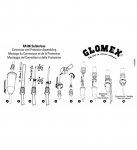
See attached diagram for usual Glomex antenna cable attachment. It all needs to be fairly precise, and note folding over of braid and core.

With the costs involved from the yard, would it not be easier/cheaper to send someone up the mast once boat is afloat?
 

Attachments

  • Glomes_RA106_Cable_Connection.jpg
    Glomes_RA106_Cable_Connection.jpg
    35.4 KB · Views: 15
Firstly, if it looks like your antenna is faulty don't put too much power from the radio in to it - if it reflects back then you can fry the output of the radio.

Secondly, are the 2 antennas you're trying the same? Could one be a high gain which gives better performance over a narrower range of angles?

I would also check the cable.

In a co-axial cable the power is transmitted as an electric field between the core and the sheath, it doesn't act as a cable in the traditional sense. For this to work the distance between the core and the sheath has to remain fairly constant, so you can't put sharp bends in to it (the cable type will have a minimum bend radius) and you can't squash it.

If the cable's fine, then you either have a dodgy connection, a broken antenna or a failed transceiver. All you can really do without test equipment is to try swapping out one at a time.
Tranceiver fine as works excellently with backup aerial just aerial not high enough to give good range. Havent tried transmitting as no one to hear me in yard, but thanks for reminding me to keep my fingers off the TX.

Both backup and new mast head have same gain. Both Glomex, but one is sern mount with thick cable and premade connector and other one needs thin cable clamped in cable.

Cable bends dictated by geometry of mast. Wretched cable exit is at base of mast so turn is tight so thats possibly the issue.

Or it could be cable at top of mast.

As yard has just charged me £387 for replacing and re-routing a manual bilge pump 1 1/4 in pipe and completely ignored my written suggestion to ease the task , I fear the worse in getting their assistance on aerial.

OHOTH a.k.a. Very Peed Off Design Engineer
 
Last edited:
I've seen suggestions before to contact a radio club and get someone with an swr meter on the boat. If this kit is cheap and our needs are simple (i.e. we're looking for fairly gross faults rather than fine tuning) can we buy a box for about the same as we'd have to pay to compensate a radio enthusiast for their time and travel and skip the hassle of interaction with men with beards and poor fashion sense? Any recommendations for A Thing to purchase and an idiot's guide to VHF antenna fault finding?

I hope you are not suggesting that radio hams are men with beards and poor fashion sense? Most radio hams would be only too pleased to help you out with tracing your antenna problem and give advice free.
 
I hope you are not suggesting that radio hams are men with beards and poor fashion sense? Most radio hams would be only too pleased to help you out with tracing your antenna problem and give advice free.
The only radio hams I know were pirate radio folk and even pirate TV. Some had fair fashion sense though that didnt impress the magistrate who gave some 2 year suspended sentences.

Mind you their processes could be hurried due to futiveness/secrecy. I remember helping carry a large capacitor bank for stabilish transmitter drive voltage, and my freind dropped an electrical screw driver from his top pocket for us to see it evaporate as it hit the terminals. We didnt drop capacitor but we did keep hands clear in an exaggerated manner
 
I hope you are not suggesting that radio hams are men with beards and poor fashion sense?

I'm sure radio hams are the very epitome of diversity and my misapprehension is based only on the particular subset of radio hams who make youtube videos or who I've met in person

In fairness, not all of them had beards. Plus the "radio look" would probably have been high fashion in hackney in 2015.
 
no beard or bad dress here I think, wife would shoot me, most ham guys will have quite sophisticated antenna analysers and can test swr and tune quite easily as most of us make our own antenna. However faulty antennas from new are rare and most issues are connections, the centre core is relatively easy to do but the screens are often the problem, that’s why most crimp them. Unfortunately you may have to go up and have a look as you the connection at radio is easy to check so issue must be up top.
 
no beard or bad dress here I think, wife would shoot me, most ham guys will have quite sophisticated antenna analysers and can test swr and tune quite easily as most of us make our own antenna. However faulty antennas from new are rare and most issues are connections, the centre core is relatively easy to do but the screens are often the problem, that’s why most crimp them. Unfortunately you may have to go up and have a look as you the connection at radio is easy to check so issue must be up top.
I am starting to think I must buy a track secured mast climbing ladder. Paying the yard £80 per pop is too much for maybe up and down the mast via cherry picker and I sending up a man perhaps less skilled than myself. Of course if its the cable pinched at mast base I am stuffed
 
Have you any photos of the installation in particular the connection. It sounds like that may be the weakness.

If the coax is pinched at the base, surely you should be able to see it.

If your mast is safe to climb in the yard you could do it with climbing gear, many options covered in other threads.

If I was in your shoes I'd bring a new antenna and sufficient coax to go from masthead to radio and some spare and go up in the cherry picker once and when there make a decision on what to do, u

Btw if feeding a cable into or pulling one out of the mast, PTFE or silicone makes things much easier.
 
Top