Nelson project.

The Cummins QSB mechanical project with Latestarter is still in progress. The Yanmars came along at the right time and allowed the Nelson project to advance. It would be great to see the mechanical QSBs through to fruition. Watch this space!
 
The Cummins QSB mechanical project with Latestarter is still in progress.

Latestarter has not posted on here for more than 2 years - I was getting worried that something had happened to him, but good news to hear that he is still active.

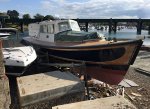
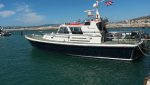
I came across (by accident) this 50' Nelson today, for sale in Gibraltar for GBP 20,000 - any other Nelson fans on here who might be interested in her?
Nelson 50 for sale Gibraltar, Nelson boats for sale, Nelson used boat sales, Nelson Commercial Vessels For Sale Ultimate Warrior - Apollo Duck

Nelson 50.jpg
 
Latestarter has not posted on here for more than 2 years - I was getting worried that something had happened to him, but good news to hear that he is still active.

I came across (by accident) this 50' Nelson today, for sale in Gibraltar for GBP 20,000 - any other Nelson fans on here who might be interested in her?
Nelson 50 for sale Gibraltar, Nelson boats for sale, Nelson used boat sales, Nelson Commercial Vessels For Sale Ultimate Warrior - Apollo Duck

View attachment 118050
He's alive and kicking.

Yes, that boat in Gib is a lot of boat.
 
In response to the earlier request for more detail:
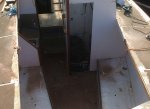
This was the moment we committed to a larger fore cabin. Not a good state to head out to sea in!
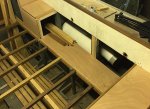
The overall plan was to take about a year, as you can tell though it’s actually taken 3 years. There was a lot of rot in the deck which had to all be cut out and replaced. The deck is now sheathed and spray painted so hopefully good for a few years.


539F3F82-9974-420B-BCD0-C5AB66757C9F.jpeg
 
A couple more images from the papers I luckily found through the Trinity House archivist previously mentioned.
The weight is listed at 8.85 tonnes. This is the reason that they were able to get 21 knots from a pair of Perkins HT6.354. My last 40 was considered to be a light boat at about 10.5 tonnes(she had an aluminium top). Vigilant is actually currently about 8.5 tonnes as the new machinery is lighter than the original. We have just touched 30 knots on trial. The designer tells me that his calculations suggest a top speed of 30.4 knots so we are just about there. My original hopes of maybe 32-34 knots were based on previously reported speeds by other Nelson 40s but I recently went out on the ex-Debonair which reportedly did 30 knots and she managed 26 knots. Horatia, the other high speed boat, is currently out of commission but apparently ‘just touched 30 knots downhill’ on trials when new(eye witness report). The good news is there are another few horsepowers in the Yanmars and I hope, once run in, we can tweak props and achieve 31-32 knots. The whole USP of this boat was to be the fastest Nelson 40.


2AF4B748-01C0-4CEE-A583-648EB9C9860B.jpeg16908D09-73E1-4A0B-A81D-E957A82F28DB.jpeg0E2FDD5F-8571-4861-823E-E9C387F1E03F.jpeg
 
Intermediate stages. As you can see we built a ‘shack’ over the cockpit for a workspace but even with this it was difficult. We moved in to the shed soon after.

6418933E-3D2A-42D2-80E4-26AB7ED10F8C.jpeg

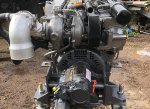
The business end. Twin Disc MG 5601A(down angle)were a lucky find. They needed a full rebuild by MIT over on the Isle of Sheppey, excellent service. They are 1.75:1 to keep the revs at the prop high as we are on 1.5” shafts and need to keep the torque lower.

0CC9DB30-2DCF-4548-8724-5AA75AED2AA9.jpeg

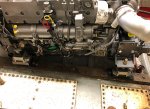
The engine beds are parallel to the shafts. We fitted 9 degree wedges under each foot and the installation is now almost horizontal.

7AAEEFF6-9007-4D3F-9247-CBA75118B0E9.jpeg

A deal was made with Halyard Marine made palatable by a very decent discount as the project was ‘interesting’. We had full exhaust system with silencers like dustbins, heaviest duty soundproofing and she is now a pretty quiet boat. The exhaust hose is 6” as far as the silencers and 8” to the transom.
Vigilant has no clamshell intakes on the side of the wheel house. This is for several reasons. She has very wide decks due to her previous role. To have the air intakes on the wheelhouse sides you need to lose another 8” each side of the interior for a soundproofed intake duct, this would have made the wheelhouse too narrow. Also the intakes there allow spray to enter the engine room if you venture out in proper Nelson weather. Corrosion ensues and I wanted to avoid this.
The air intakes on Vigilant are in the forward end of the cockpit. The entry in to the engine room is in the centre of the aft engine room bulkhead(about 3 feet square). However we have built a soundproofed tunnel under the cockpit floor so the air enters at the front of the cockpit, travels rearwards along the outer edges of the underfloor space, then travels forward through the centre tunnel and in to the engine room. This has given good noise attenuation and a dry engine area. It was a little experimental but seems to work well.
D871C07D-2FB0-4C72-B01E-DB7C222115A6.jpeg
 
Last edited:
Would trim tabs give the edge? Seen them on the shorter versions.
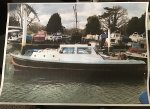
Apparently Vigilant’s trim is ‘perfect’. Literally. Just by luck rather than judgement I assure you! When our trim figures were assessed against all the papers from the original design we are ‘the datum boat’, a very happy co-incidence.
 
This is a small idea for the future. The rear of the wheelhouse is perhaps a little ‘stark’ with it’s vertical cut off so a little work on the coamings may help.
Thanks for all the interest. I am one very happy bunny. She’s come out exactly as I hoped. Looking forward to the next 20 years of extensive cruising now.


D883610E-4411-4EDE-9178-2A07FEEE4723.jpeg
 
Wow! What a great project and what a fantastic result. It would make a great article for MBY.
Im guessing cruising speed is 20-25kts? What’s your range at those speeds? And any more pics would be great.
Thanks for posting.
 
I have two fuel figures at different speeds.
At 20 knots she’s burning about 10 gallons per hour each engine giving 1 mpg
At WOT the official fuel figures are 94 litres per hour or 20 gallons each side. As this equates to 30 knots we have 0.75mpg
About a year ago I bought two fuel flow meters from this forum and fitted them to the port engine. They are supposed to be good to flow up to 200 litres per hour, plenty I thought. It turns out that the engines actually feed over 300 litre per hour and return 200 of that. Because of this flow being outside limits I’m not sure how accurate the readings are. I have just done the first fuel top up and the total fuel burnt is not far off what we put in. I’m hopeful the flow meters will turn out to be accurate.
 
Top