Need some advice on tidal mooring lines before I rip my cleats out!

jackleggett

New Member
Joined
19 Apr 2025
Messages
8
Visit site
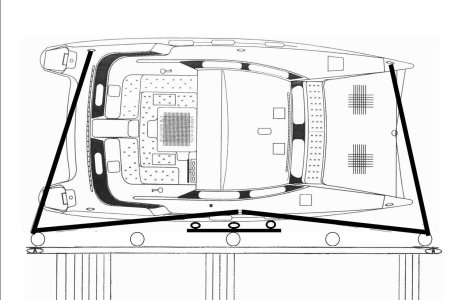
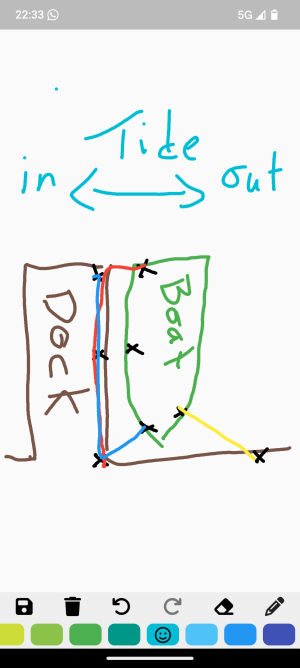
We've recently been put in a new spot in our marina and I'm really struggling to find a line setup that doesn't feel like it's going to rip my cleats out. So the mooring is tidal, and when the tide goes out my boat sits about 2 foot higher to the dock compared to floating, the issue however is that as the tide goes out it pulls me away from the dock, then when it dries out and the dock sinks that much lower it's putting a hell of a pressure on my lines. Current setup in my rudimentary drawing but I've run the lines through the cleat on the dock (free running) and all the way back along the dock so I can have them as long as possible to give them as much stretch as I can but you can still play a bloody tune on them at low tide. Has anyone got any ideas?? The more slack I give it, the more it takes and I just end up further from the dock but just as tight. At this point I'm considering bungees or even throwing down an anchor in the marina to keep my boat closer to the dock as it dries out.6151.png
 
Sounds like you need some proper advice on this! Is this the norm in your marina coz it doesn't sound great. I'd ask to move, its probably why that berth was vacant. Otherwise copy the neighbours. Some ropes are stretchier than others......don't use old halyards for example. Octoplait is good for stretch. But your diagram doesn't show springs .... they should be there. Running through cleats doesn't seem right. Would have thought that encourages your boat to lift the pontoon, which you want to minimise. Maybe after a while the boat will have dug it's own hole and the situation will improve, meantime go as slack as you can .... live with the gap when the boat is afloat . Just some thoughts, apologies if they are a bit random! Sounds like a nightmare for fendering too. Good luck
 
That works for a floating dock, but with tide you really need spring lines and fender boards. Also, you tie to the far stern cleat, not the near one, and angle it behind the boat. Chris-cross lines and keep them long. Do NOT use the near-side cleats, use the far side cleats.

This is my bulkhead tie-up for tides. Notice the fender board with big fenders behind it. If there is more than 3 feet of tide, the springs are spread farther. Multiple fender boards may be needed.

It is common for boats to tie-up to tidal bulkheads here. This is how it is done.

1758407300240.jpeg
 
The issue with using the port lines is the dock isn't long enough to tie them further back so they'd end up rubbing up and down the stern of the boat, so I only have the option of using the starboard side cleats!
 
There might be solution but it depends on a few factors. like the weight of your boat and the length of mooring rope between the cleats on the boat and the cleats ashore, ie: the distance between or scope in other words. You could try an 'Angel' a heavy weight suspended midway between the cleat on the boat and the dock cleat, on bow and stern lines.

You would need to be in attendance for the turn of at least one tide to get the adjustment right. Any heavy weight will do. Years ago Thames Lighters not able to moor on buoys, those that lay alongside wharves and needed a long scope on their moorings but not be prone to being dragged out into the stream by the run of the tide, could often be seen with a similar rig. Obviously the Marina Management will get excited if you use old scrap iron as they did but something like a filled 10 litre plastic jerry can shouldn't upset them..too much.

Tie a trip line to the weight which will allow you to haul it along the mooring rope to a position where it is most effective. Once you have found that position you can mark the mooring rope so that you know where to hang the weight on your return should you leave the berth.

It's trial an error to start with. Adjust your ropes to suit you when the boat is high above the dock, then adjust the weight and it's position so that the weight takes up the slack as the tide ebbs and tries to pull the boat off the Dock.

The above suggestion may not work in your case, but it may be worth a try, and a suitable weight hanging about midway 'tween boat and shore should haul you alongside as the mooring rope goes slack. (y)
 
Last edited:
Op needs to make the mooring lines longer. This gives more stretch room. Perhaps this could be acheived by taking the mooring line to the other side of the dock. Either above deck Not good as a tripping hazard or perhaps under neath the dock. On the far side or indeed even on the boat side as said a heavy weight on the end of a line from the boat that runs through a sheave on the end of the line to the dock.
Our club marina with fixed jetties and perhaps 1 m of max tide use a sytem of a chain from the jetty down to a heavy weight. Onto this chain is shackled a line to the boat. Hence on a high tide the mooring line lifts the weight so averting too much strain on the mooring line and cleat. Perhaps might be an idea there. ol'will
 
The issue with using the port lines is the dock isn't long enough to tie them further back so they'd end up rubbing up and down the stern of the boat, so I only have the option of using the starboard side cleats!
Back the boat in. That is what I did in my last slip. Easy enough with some practice. Then the stern is a good candidate for cris-cross lines.

Think outside the box. Try to get clever. But the solution is NOT stretch alone or not fundamentally, it is lines that tolerate tide by can angling up and down. This is a problem I used to deal with daily. The solutions was always some variation on post #3.
 
Practically in every marina we were in, we had floating pontoons and tying was not an issue. Perhaps you could leave very long lines to something father away, tide would not affect you too much?
 
I have had this myself. The boat touches bottom first then the pontoon dries out way below the boat and the mooring lines become bar tight threatening the cleats. You need a normal set of semi loose lines but in addition heavy duty shock cord to hold the boat near the pontoon. It will stretch as required.
 
You could also try hanging some weights on the normal mooring lines enough weight to counter the tidal flow. That way as the ropes start to tighten the weights will start to lift without putting to much strain on the cleats.
 
Last edited:
Pythagoras is your fiend here!

The stretch (as a %age) on spring lines would be far less than the stretch on the breast lines (which is essentially what you have drawn).
 
Look at the other side of the problem:

Ask the marina to weld some two foot "legs" to the floating pontoon, so that it dries out sooner, rather than laying on the floats.

Of course only possible if your pontoon is not linked to a whole set of others.....
 
Pythagoras is your fiend here!

The stretch (as a %age) on spring lines would be far less than the stretch on the breast lines (which is essentially what you have drawn).
Is that still the case if the lines are running the full stretch of the pontoon as they're currently setup? Not arguing, just not sure!
 
That works for a floating dock, but with tide you really need spring lines and fender boards. Also, you tie to the far stern cleat, not the near one, and angle it behind the boat. Chris-cross lines and keep them long. Do NOT use the near-side cleats, use the far side cleats.

This is my bulkhead tie-up for tides. Notice the fender board with big fenders behind it. If there is more than 3 feet of tide, the springs are spread farther. Multiple fender boards may be needed.

It is common for boats to tie-up to tidal bulkheads here. This is how it is done.

View attachment 199746
Appreciate the diagram, unfortunately that setup isn't quite an option due to the length of the dock, but I'll see how close I can copy it.
 
Is that still the case if the lines are running the full stretch of the pontoon as they're currently setup? Not arguing, just not sure!
Yes - but not how you have them set up! Thinwaters diagram shows the sort of thing you want - but you probably want an even more extreme version. If you are bows in as per your sketch - you want a line running diagonally from the bow of your boat to as far aft on the pontoon finger as possible. And another line. Crossing this running from as far astern on your boat to as far forward on the pontoon as possible. These are known as spring lines - they stop the boat moving forward and backwards. They aren’t particularly good at keeping the boat snug against the pontoon. If they are 20’ long and set when the boat and pontoon are level and the boat then move “up” 2’ then the hypotenuse becomes less than 1.5” longer - 0.5% stretch of it was actually tight to start with.

The lines running perpendicular to the dock/pontoon hold the boat “in”, but are much less tolerant to height changes. Say these lines are only 2’ long (perhaps an exaggeration but it makes the point and isn’t impossible) and the height changes by 2’ then you now are trying to stretch them by nearly 40% - almost 10”. You can leave them a little slack (maybe with a weighted angel to take the slack out) or use bungees or perhaps some rubber snubbers that will stretch to some extent. Thinwater is suggesting you make those breast lines longer by tying to the opposite side of the boat - that will help with stretch but as the line is probably not straight the Pythagorean benefit is limited, although you probably share the load between cleat and gunwhale.

Whatever you do make sure you use a “knot” that can be released under load eg. An OXO or round turn two half hitches not a cleat hitch.
 
With a fixed hight dock, the lines you show in your diagram are totally wrong.
The lines running along the dock and around the cleat are going to wear out in fairly short time.
First, you have no springs rigged, they are the controlling lines to stop surge and the inherent elasticity means that they can be rigged tight, this also helps hold the boat tight in.
Your bow and stern lines should have som slack in them to allow for the boats rise and fall. Some people rap those lines around a rubber snubber to control the slack.
 
Top