Need some advice on tidal mooring lines before I rip my cleats out!

You could also try hanging some weights on the normal mooring lines enough weight to counter the tidal flow. That way as the ropes start to tighten the weights will start to lift without putting to much strain on the cleats.
The problem with that is that if the tide or wind have any strength at all the weight just lifts. If a 10 kg weight will hold the line, we could tie up the boat with clothes line. Good on a nice day.

It is important to visit your boat during a full gale or violent thunderstorm in order to understand what happens when you are not there. Hurricanes. What happens when there is an 2-3 meter storm surge (happened at my marina once, no harm to my boat).
 
Look at the other side of the problem:

Ask the marina to weld some two foot "legs" to the floating pontoon, so that it dries out sooner, rather than laying on the floats.

Of course only possible if your pontoon is not linked to a whole set of others.....
Not an option I'm afraid, good shout though.
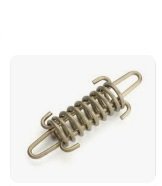
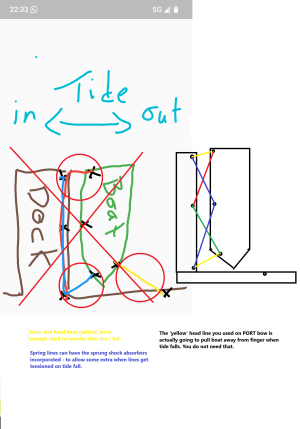
Yes - but not how you have them set up! Thinwaters diagram shows the sort of thing you want - but you probably want an even more extreme version. If you are bows in as per your sketch - you want a line running diagonally from the bow of your boat to as far aft on the pontoon finger as possible. And another line. Crossing this running from as far astern on your boat to as far forward on the pontoon as possible. These are known as spring lines - they stop the boat moving forward and backwards. They aren’t particularly good at keeping the boat snug against the pontoon. If they are 20’ long and set when the boat and pontoon are level and the boat then move “up” 2’ then the hypotenuse becomes less than 1.5” longer - 0.5% stretch of it was actually tight to start with.

The lines running perpendicular to the dock/pontoon hold the boat “in”, but are much less tolerant to height changes. Say these lines are only 2’ long (perhaps an exaggeration but it makes the point and isn’t impossible) and the height changes by 2’ then you now are trying to stretch them by nearly 40% - almost 10”. You can leave them a little slack (maybe with a weighted angel to take the slack out) or use bungees or perhaps some rubber snubbers that will stretch to some extent. Thinwater is suggesting you make those breast lines longer by tying to the opposite side of the boat - that will help with stretch but as the line is probably not straight the Pythagorean benefit is limited, although you probably share the load between cleat and gunwhale.

Whatever you do make sure you use a “knot” that can be released under load eg. An OXO or round turn two half hitches not a cleat hitch.
You talk a lot of sense, thank you. I've re rigged as close as I can to that and I'll see how the tide (coming in at the moment) handles things.
 
It sounds like the berth is of doubtful suitability for your boat. It's the combination of (a) taking the ground at a different state of the tide from when the pontoon takes the ground (if it does) and (b) the pontoon not being long enough for you to use traditionally placed bow and stern lines rather than short breast lines (and finger pontoons are hardly ever going to be long enough, although a main walkway pontoon might suffice) and (c) the fact that the water isn't always as flat as a millpond (which really it isn't anywhere except in some small basins like on a canal) so you can't allow slack to appear in your lines.

The standard way of dealing with mooring alongside where the boat rises and falls with the tide and the thing moored to doesn't is what we do when moored to a harbour wall or jetty. Long bow and stern lines led well forward and aft - and if there's much tide that means not just long but l-o-n-g - so that as the boat rises and falls the lines move in an arc at the boat end but don't have to adapt to anything other than a small change in distance between the attachment on the boat and on the shore. Plus two springs to stop ranging, again long for the same reason. Then temporary breast ropes when the boat has crew on board who can adjust them frequently with the tide but no breast ropes if there is no one around to tend them.

I don't see a solution to your problem if you can't run lines from bow and stern long enough to mean that the distance from the pontoon cleat to the ones on the boat stay almost constant as the boat rises and falls with the tide. Obviously a little slack appearing and disappearing wouldn't be a problem, but it would have to be very little. You could attempt a kludge where you maximise the distance by running a line from the bow as far aft on the pontoon as you can, and a stern line as far forward as you can, but I'm not sure that will work or be very safe.

The problem you have - boat moving up and down with the tide relative to 'the shore' - is why floating pontoon marina berths where the boat stays afloat have become so popular - they remove the problem.

I think you might need to move either to a finger berth where you'll be afloat at all states of the tide, or to a walkway where you can run out long bow and stern lines. Otherwise to a mooring buoy.
 
Somebody probably has had this problem & can suggest a simple solution. If not then :-
A possibilty-- Go to a scrap yard & see if you can get hold of a pair of half hundred weight scale weights. Then hang them on the centre of the blue & red lines that you have shown in the sketch. This might give you adjustable tension enough to pull the boat in. Problem is that you do not want them to jam between boat and pontoon & mark the boat Also when you untie the boat the red & blue lines will disappear into the deep blue sea pulled under by the weights, where you cannot get them
There is a solution to this but it needs experimentation

Put them not straight on the lines but on length of line hanging down such that they hang below the pontoon & swing clear of your boat because at that point the hull curves away
Now at HW you need to cast off so you need the line attached to the weights & the red & blue lines to be long enough so you pull the weights up & put them on the pontoon whilst you are sailing. That way you can tie up with no load on the ropes. Then before you go home, drop the weights in & off you go.

It really depends if, first the weights acting on the middle of the springs give you the movement you need & if you can be arsed to lift them in & out of the water to

The problem with that is that if the tide or wind have any strength at all the weight just lifts. If a 10 kg weight will hold the line, we could tie up the boat with clothes line. Good on a nice day.

It is important to visit your boat during a full gale or violent thunderstorm in order to understand what happens when you are not there. Hurricanes. What happens when there is an 2-3 meter storm surge (happened at my marina once, no harm to my boat).
It is better for the boat to pick up 2x50kl weights than try to pick up a poonton. 2x50kl weights are going to need one hell of a wind or tide to lift them. If that's the case then not much can be done. It happened to me and my only option was to cut the rope with a sharpe serated knife. The rope was bar tight with no give in it left. It basicly parted with a bang.
 
It is better for the boat to pick up 2x50kl weights than try to pick up a poonton. 2x50kl weights are going to need one hell of a wind or tide to lift them. If that's the case then not much can be done. It happened to me and my only option was to cut the rope with a sharpe serated knife. The rope was bar tight with no give in it left. It basicly parted with a bang.
This is not a binary choice. Neither are acceptable.

I've put load cells on breast lines before for an article. the tension on moderate size boats is often 100-250 kg in even a modest storm, and pushing 400 kg in a real blow. A 50 kg weight would pop right up and the boat would move several feet. Whether that space is available I don't know. I do know that in a real storm the weight won't do much. And if the weight is heavy enough to do much (lifting 50 kg to untie my boat sounds like a real drag) it will be unmanageable. Weights are used around small lakes, with runabouts, in protected coves, but I'm not sure that would work in the saltwater cruising boat world.

Either a different slip or a way to use long lines that can angle to adjust for the change in elevation.

Floating docks are not that common here, and we tie up to either pilings or bulkheads. Multihulls are commonly on bulkheads because they are too wide for slips between pilings. Fender boards and long lines.

Just my opinion and expereince.
 
Last edited:
Sounds like you need some proper advice on this! Is this the norm in your marina coz it doesn't sound great. I'd ask to move, its probably why that berth was vacant. Otherwise copy the neighbours. Some ropes are stretchier than others......don't use old halyards for example. Octoplait is good for stretch. But your diagram doesn't show springs .... they should be there. Running through cleats doesn't seem right. Would have thought that encourages your boat to lift the pontoon, which you want to minimise. Maybe after a while the boat will have dug it's own hole and the situation will improve, meantime go as slack as you can .... live with the gap when the boat is afloat . Just some thoughts, apologies if they are a bit random! Sounds like a nightmare for fendering too. Good luck
I agree with setting long springs and slack fore and aft lines would help and reduce snatch and potentially stop you hanging off the pontoon so much. My marina berth has a strong tide and rocks and rolls in a SW swell so like you, I worry about how much tension my cleats are under due to snatch. I have copied my neighbours and used small car tyres to reduce snatch as they create a rigid stretch when under pressure. The tyres are secured to the pontoon cleat with chain and the warp secured to the tyre. It's a game changer.
 
I agree with setting long springs and slack fore and aft lines would help and reduce snatch and potentially stop you hanging off the pontoon so much. My marina berth has a strong tide and rocks and rolls in a SW swell so like you, I worry about how much tension my cleats are under due to snatch. I have copied my neighbours and used small car tyres to reduce snatch as they create a rigid stretch when under pressure. The tyres are secured to the pontoon cleat with chain and the warp secured to the tyre. It's a game changer.

A good idea which would be enhanced with some pictures. Pictures are still worth 1,000 words. :)
 
This is not a binary choice. Neither are acceptable.

I've put load cells on breast lines before for an article. the tension on moderate size boats is often 100-250 kg in even a modest storm, and pushing 400 kg in a real blow. A 50 kg weight would pop right up and the boat would move several feet. Whether that space is available I don't know. I do know that in a real storm the weight won't do much. And if the weight is heavy enough to do much (lifting 50 kg to untie my boat sounds like a real drag) it will be unmanageable. Weights are used around small lakes, with runabouts, in protected coves, but I'm not sure that would work in the saltwater cruising boat world.

Either a different slip or a way to use long lines that can angle to adjust for the change in elevation.

Floating docks are not that common here, and we tie up to either pilings or bulkheads. Multihulls are commonly on bulkheads because they are too wide for slips between pilings. Fender boards and long lines.

Just my opinion and expereince.
Long lines are the only real answer. Close into the pontoon there is no room for allowing the pontoon to drop an extra foot when a ground. If the boat is a bilge keel needing over a meter of water that's where the problem begins. These berths are only good for flat bottom lifting keels.
 
I would ask WHY you have just been moved to this (unsuitable) berth? Your choice or the harbour master? If not your choice why are you not telling the harbour master that the berth is not suitable?

Our boat resides in a drying harbour, though the actual berth only dries on a spring tide, but there is little change in boat / pontoon height as the boat (and probably previous boats that occupied the berth before us) have dug their own hole and at an extreme low tide when it dries we sit isolated in our own little puddle.
 
Trick is to stick around until low tide and adjust till everything is just snug. Aft and f'ward springs, plus stern and bow lines, with fenders added to the off side for matey next door then it doesn't matter if the boat ends up a few feet away flopping about at high tide, A boat "hanging" on its lines at low water is a sorry sight indeed.
 
Trick is to stick around until low tide and adjust till everything is just snug. Aft and f'ward springs, plus stern and bow lines, with fenders added to the off side for matey next door then it doesn't matter if the boat ends up a few feet away flopping about at high tide, A boat "hanging" on its lines at low water is a sorry sight indeed.
You have got this the wrong way round. They are not talking about a boat hanging off its lines, they are talking about a pontoon hanging off a boat.
Boat higher when agrond than pontoon agrond so pontoon hangs off boat.
 
You have got this the wrong way round. They are not talking about a boat hanging off its lines, they are talking about a pontoon hanging off a boat.
Boat higher when agrond than pontoon agrond so pontoon hangs off boat.
Rgr, tho prob because Ive never come across this before. Odd tho seeing as all the boats using that pontoon would have formed a trench over the years.
 
First .... STOP leading your fore and aft lines perpendicular to dock ... that effectively makes them short.

SPRINGS and MORE springs are the answer ... the longer the better ...

Look at how some pontoons are moored in high tidal ranges ... the X rope format.

mooring.png

This is how I would start .. and then play the lines to arrive at best solution. You may find that you have to accept that tide out lines are the best and then when you want to use the boat - pull her in ..

I would talk to the Marina guys though and explain your problem - I'm sure they already realise .. but you may be able to work out something with them.

Its well to remember that stern and headlines do not allow for large rise and fall range ... but springs do much better in this. The trick is to have length as you correctly decided - BUT your mistake was to lead them 90 deg to the boat round the shore cleats .. THAT effectively created short lines.
 
Refueler's post above is good.

I have a similar situation but would put rubber snubbers on the yellow lines.
The type where you wrap the line around. This is what I use but have to accept that sometimes I have a larger step across than desirable!
 
First .... STOP leading your fore and aft lines perpendicular to dock ... that effectively makes them short.

SPRINGS and MORE springs are the answer ... the longer the better ...

Look at how some pontoons are moored in high tidal ranges ... the X rope format.

View attachment 199886

This is how I would start .. and then play the lines to arrive at best solution. You may find that you have to accept that tide out lines are the best and then when you want to use the boat - pull her in ..

I would talk to the Marina guys though and explain your problem - I'm sure they already realise .. but you may be able to work out something with them.

Its well to remember that stern and headlines do not allow for large rise and fall range ... but springs do much better in this. The trick is to have length as you correctly decided - BUT your mistake was to lead them 90 deg to the boat round the shore cleats .. THAT effectively created short lines.
The 2 yellow lines could be made fast to a cleat further back and then go through low friction rings (LFR) which would allow the rope to stretch a lot more.
Quite a discussion here 4x4 LFR for snatch recovery of vehicle - marine application of the LFR, no mention of anchors :)
 
The main trouble is the boat touches ground before the pontoon, so if the boat is blown or carried by the tide to its maximum distance away from the pontoon, that the lines allow the boat is stuck and cannot then move so as the tide recedes the pontoon needs an extra meter of line to touch bottom, therefore putting massive strain on the cleats. the cleats were never designed for these loads . Simple, its not a suitable berth.
 
Top