

Sheppy
Well-Known Member
I suppose all this started some time ago now with a previous boat. I found the concept of storing a boat out of the water on a lift quite intriguing and was surprised how few people had experience with them, so in my usual fashion, the researched the concept to near death. I think I've now turned into a self proclaimed expert in boat lifts 
My current boat doesn't take much of a slim build up, let alone growth, to effect her performance and so I started to revisit some of the options I had looked at before. One clever system simply creates a barrier around your boat, in essence a kind of drive-in pool, some even pump out the water too. But an actual boat lift, well that seemed to me the best option. There are quite a few different types with quite a few different prices too. Some are just ridiculously expensive, albeit very well designed. The Sunstream V Lift probably being the best, but equally with one of the highest price tags.
But does one really need a boat lift, hard to say, it's not everyone's cup of tea, and if I had a trailer and a 4x4 I probably wouldn't have bothered. But after working out antifoul costs with lifts and storage, a couple of mid year lifts for cleaning and other maintenance, anodes, etc etc, I figured it a worthy investment and I should break even in three to four seasons.
I know from existing comments and conversations that many of you think this is a great idea, and I also know many of you don't. I'm not really interested in whether you think I'm a crazy so and so, I'm just trying to prevent the problems that come from keeping a boat in the water. And I'm little lazy too, I just hate antifouling
I also believe that the biocides in antifoul paint are slowly being removed due to pressure from the EPA and the EU and so this kind of paint is becoming less and less effective. There's also evidence that suggests marine growth is becoming immune to the biocides, so a double whammy effect. I'm also moored in a heavy fouling location, all the other boats in my location suffer from lack of performance and economy after just three months from a fresh antifoul.
I settled on the concept of the Air Dock over other systems, partly due to cost and partly due of the low impact both visually and via installation along with a few other reasons too. I had my concerns, and to some extent still do, but Ken, the owner of Air Dock, was extremely helpful and patient, and answered a barrage of questions over what became a year long research project. And so, after much deliberation, I wrote the cheque and ordered one.
It was a bit of an unknown quantity ordering something like this from the States, but the shipping company who initially were just dropping my consignment off at the airport offered, well for a small fee of course, to clear customs and then deliver to my door. Actually, they were very reasonable and very helpful. SEKO Logistics if anyone's interested.
The design of this system does require four mounting points. These can be four points on a dock, side dock with two posts etc, but as I have a semi-free floating dock which changes position slightly with wind, currents etc, I had to build and install a simple PVC-u frame system. Yes, this is the strange object recently spotted traveling down the Dart being steered by two tenders.
MDL in Galmpton were very helpful and allowed me to construct the frame in their yard and then launch from their slip when completed. They even pulled out all the stops to get my boat lifted a day early as she was rather integral to the assembly of the lift. So a big thank you guys.


The idea of the frame is that once shored up to one side to the dock, the other side gives you your two other fixing points. The frame is flexible but strong enough to withstand most situations. Although I followed their design specification for the frame, I have over engineered it a little, and will continue to add improvements as necessary. I also should have adapted the frame to my boat draft which I initially wanted to do but decided to keep to their specs in case I was missing something. The frame is constructed from 110mm drainage pipe, all glue/welded together, screwed for added strength, with U-bolts installed on the top of the T pieces for anchor points. It's a simple but effective design offering strength with good flexibility.
With the frame roughly in situ, the actual lift was assembled. My boat uses a system of three bags, two stern and one bow. I won't go into any real technical specs here, you can get all that from their website. The bags have small inner chambers that are constantly filled with air, these not only keep the lift afloat when the main chambers are deflated but also creates a natural docking guide - you just point your boat into the lift and the air chambers keep you centralised - a bonus for me
The assembly is straight forward enough, if a little fiddly in places. It would be ideal to assemble the lift on dry land and tow, but we opted to do this in situ, not really an error, but it did make things more interesting! Anyway, once the lift was ready and loosely tied off, we got Blue Marlin into position and pulled her on. This is where adjustment of the inner chambers was necessary and I had to let air out before I could pull her on easily. Ideally you just drive on and off when deflated. After checking all the ropes and tie offs, we raised her about half way, and she went up really quite quickly. She uses a 110v air blower, so I had to purchase a suitable inverter and run off one of the batteries. I had the engine running to save the battery, but she'll happily lift her without. With the leg trimmed down, the exhaust and leg mostly comes out of the water, but the water pickup stays under almost for the entire lift. After checking all the ropes and tie offs again, we lifted her all the way and let her settle while we had a celebratory beer!
The lift is a simple process. You start the pump then open the three separate valves to inflate. You manually control the vales accordingly to manage the air in the main chambers. Having a pressure gauge would be useful but it's easy to stop the pump and check height and levels. She's very stable on the lift too, she moves far less in waves/wake. The bags inflate to about 5 to 8 psi, so there's no great pressure to deal with.
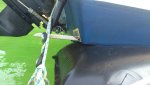
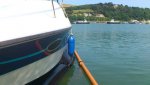
We left her half lifted the first night, just seemed the right thing to do, and after a sleepless night, she was still there in the morning. She was listing ever so slightly to starboard, but after some discussions, we decided this was due to the sun beating down on the port side bag, and not a leak - but hey, it's early days.
There are a few problems, or challenges as I like to call them. As the lift dries out, which will only happen on the occasional very low tide, the lift ropes won't have had enough slack to reach the top of frame and would have crushed it. Remember I said about making the frame risers too high? Well, I decided to re-attach all the ropes to the riser poles instead of the top U-bolts, some are placed in hosepipe to ease movement. The theory being that as the frame touches the bed, the lift will continue to drop about another 60cm or so, and now the ropes will drop too down the risers too. I've also added a small piece of cored to the top of the frame through the rope loops so the ropes can't go below a certain height and get caught under the frame. I need to keep the risers free from growth, but that's quite and easy task. There are a few other adjustments and tweaks to make but I'm getting there.
The construction and assembly was all very easy and straightforward, but this recent spell of wonderful hot weather did make it seem like incredibly hard work. We were often working with no protection from the sun and this slowed progress. And as with all projects, everything took much longer than we thought. A friend came down to help with the project and I have to admit his truck proved instrumental to some of the fetching and carrying of the various items. It's certainly a two man build, so thanks Anthony. We even had to ask Robin to come down to MDL to help walk the frame from the yard to the waters edge.
Although the bags are very strong and suitable for drying moorings, I'm not happy to just leave her to the mercy of the riverbed, so am going to create a sacrificial layer of foam or thick rubber to sit under the lift, thus adding some additional protection.
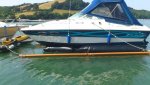
Continued below in next posting........
My current boat doesn't take much of a slim build up, let alone growth, to effect her performance and so I started to revisit some of the options I had looked at before. One clever system simply creates a barrier around your boat, in essence a kind of drive-in pool, some even pump out the water too. But an actual boat lift, well that seemed to me the best option. There are quite a few different types with quite a few different prices too. Some are just ridiculously expensive, albeit very well designed. The Sunstream V Lift probably being the best, but equally with one of the highest price tags.
But does one really need a boat lift, hard to say, it's not everyone's cup of tea, and if I had a trailer and a 4x4 I probably wouldn't have bothered. But after working out antifoul costs with lifts and storage, a couple of mid year lifts for cleaning and other maintenance, anodes, etc etc, I figured it a worthy investment and I should break even in three to four seasons.
I know from existing comments and conversations that many of you think this is a great idea, and I also know many of you don't. I'm not really interested in whether you think I'm a crazy so and so, I'm just trying to prevent the problems that come from keeping a boat in the water. And I'm little lazy too, I just hate antifouling
I also believe that the biocides in antifoul paint are slowly being removed due to pressure from the EPA and the EU and so this kind of paint is becoming less and less effective. There's also evidence that suggests marine growth is becoming immune to the biocides, so a double whammy effect. I'm also moored in a heavy fouling location, all the other boats in my location suffer from lack of performance and economy after just three months from a fresh antifoul.
I settled on the concept of the Air Dock over other systems, partly due to cost and partly due of the low impact both visually and via installation along with a few other reasons too. I had my concerns, and to some extent still do, but Ken, the owner of Air Dock, was extremely helpful and patient, and answered a barrage of questions over what became a year long research project. And so, after much deliberation, I wrote the cheque and ordered one.
It was a bit of an unknown quantity ordering something like this from the States, but the shipping company who initially were just dropping my consignment off at the airport offered, well for a small fee of course, to clear customs and then deliver to my door. Actually, they were very reasonable and very helpful. SEKO Logistics if anyone's interested.
The design of this system does require four mounting points. These can be four points on a dock, side dock with two posts etc, but as I have a semi-free floating dock which changes position slightly with wind, currents etc, I had to build and install a simple PVC-u frame system. Yes, this is the strange object recently spotted traveling down the Dart being steered by two tenders.
MDL in Galmpton were very helpful and allowed me to construct the frame in their yard and then launch from their slip when completed. They even pulled out all the stops to get my boat lifted a day early as she was rather integral to the assembly of the lift. So a big thank you guys.
The idea of the frame is that once shored up to one side to the dock, the other side gives you your two other fixing points. The frame is flexible but strong enough to withstand most situations. Although I followed their design specification for the frame, I have over engineered it a little, and will continue to add improvements as necessary. I also should have adapted the frame to my boat draft which I initially wanted to do but decided to keep to their specs in case I was missing something. The frame is constructed from 110mm drainage pipe, all glue/welded together, screwed for added strength, with U-bolts installed on the top of the T pieces for anchor points. It's a simple but effective design offering strength with good flexibility.
With the frame roughly in situ, the actual lift was assembled. My boat uses a system of three bags, two stern and one bow. I won't go into any real technical specs here, you can get all that from their website. The bags have small inner chambers that are constantly filled with air, these not only keep the lift afloat when the main chambers are deflated but also creates a natural docking guide - you just point your boat into the lift and the air chambers keep you centralised - a bonus for me
The assembly is straight forward enough, if a little fiddly in places. It would be ideal to assemble the lift on dry land and tow, but we opted to do this in situ, not really an error, but it did make things more interesting! Anyway, once the lift was ready and loosely tied off, we got Blue Marlin into position and pulled her on. This is where adjustment of the inner chambers was necessary and I had to let air out before I could pull her on easily. Ideally you just drive on and off when deflated. After checking all the ropes and tie offs, we raised her about half way, and she went up really quite quickly. She uses a 110v air blower, so I had to purchase a suitable inverter and run off one of the batteries. I had the engine running to save the battery, but she'll happily lift her without. With the leg trimmed down, the exhaust and leg mostly comes out of the water, but the water pickup stays under almost for the entire lift. After checking all the ropes and tie offs again, we lifted her all the way and let her settle while we had a celebratory beer!
The lift is a simple process. You start the pump then open the three separate valves to inflate. You manually control the vales accordingly to manage the air in the main chambers. Having a pressure gauge would be useful but it's easy to stop the pump and check height and levels. She's very stable on the lift too, she moves far less in waves/wake. The bags inflate to about 5 to 8 psi, so there's no great pressure to deal with.
We left her half lifted the first night, just seemed the right thing to do, and after a sleepless night, she was still there in the morning. She was listing ever so slightly to starboard, but after some discussions, we decided this was due to the sun beating down on the port side bag, and not a leak - but hey, it's early days.
There are a few problems, or challenges as I like to call them. As the lift dries out, which will only happen on the occasional very low tide, the lift ropes won't have had enough slack to reach the top of frame and would have crushed it. Remember I said about making the frame risers too high? Well, I decided to re-attach all the ropes to the riser poles instead of the top U-bolts, some are placed in hosepipe to ease movement. The theory being that as the frame touches the bed, the lift will continue to drop about another 60cm or so, and now the ropes will drop too down the risers too. I've also added a small piece of cored to the top of the frame through the rope loops so the ropes can't go below a certain height and get caught under the frame. I need to keep the risers free from growth, but that's quite and easy task. There are a few other adjustments and tweaks to make but I'm getting there.
The construction and assembly was all very easy and straightforward, but this recent spell of wonderful hot weather did make it seem like incredibly hard work. We were often working with no protection from the sun and this slowed progress. And as with all projects, everything took much longer than we thought. A friend came down to help with the project and I have to admit his truck proved instrumental to some of the fetching and carrying of the various items. It's certainly a two man build, so thanks Anthony. We even had to ask Robin to come down to MDL to help walk the frame from the yard to the waters edge.
Although the bags are very strong and suitable for drying moorings, I'm not happy to just leave her to the mercy of the riverbed, so am going to create a sacrificial layer of foam or thick rubber to sit under the lift, thus adding some additional protection.
Continued below in next posting........
Last edited:


