MAIB harness report.

If you are concerned about adverse loading then via ferrata karabiners might be a good alternative to standard marine tether clips. NB I have no idea whether the locking mechanisms used in these would work well in a sailing environment.

I've got a lot of old climbing and caving equipment some of which I've used on the boat (boom brake for example) but it is vulnerable to extra corrosion than is found in cave or crag so needs more fresh water rinsing and a bit of lubrication. I've ordered a couple of Kong Tangos, used for via ferrata, to replace my Gibb clips but these are also not ideal for marine use for the same reason., but will be OK if regularly maintained.

I expect there will be plenty of new hardware options in the next year.
 
Last edited:
Most times one is going to go over the top of the guard rail so the line will snag on the top of the stanchions as each one bends & the casualty jerks each one in turn. Although the slack in the Guard rail might mean the casualty stops at that point. if the casualty falls over the top of the rail the safety line will lift the jackstay up & it will clear the cleat.
As for short lines they are far too restrictive as one cannot stand up, get onto the cabin top to reach the mast etc without un-clipping & re clipping. Lines with 3 clips are useless as for the most point one is moving about like Marley's ghost with lumps of spare metal & the free line snagging around rigging , feet etc
It is OK talking about jackstays inboard & they would, in theory, be a good idea. But try going onto the fore deck & clipping & unclipping all the way. It is made worse with boat owners who insist in sailing with a tent up over the hatch as the crew has to navigate that first. There would also be areas where one could not actually install jackstays.
With a jackstay along the side deck one can clip on whilst in the cockpit, Step onto the side deck ( quite a risky procedure if you think about it) then go forward in one go. Better if doing so up to windward then if falling to leeward the line should catch the casualty on the opposite side deck.
 
I used a carabiner on a U bolt, it would regularly lay flat, turn and trip itself open on the other side of the 'U'. Fortunately it was only to hold open a hatch, but it did drop the, 3ft square steel, hatch on my head once.
 
I used a carabiner on a U bolt, it would regularly lay flat, turn and trip itself open on the other side of the 'U'. Fortunately it was only to hold open a hatch, but it did drop the, 3ft square steel, hatch on my head once.

Yes, non-screw gate carabiners are not safe in that way, screw gates are safe but not easy to open with a gloved or cold hand, for example, and are particularly prone to corrosion. Via ferrata stuff is better but with some corrosion issues in a marine environment as previously mentioned.
 
The Kong Tangos have been in increasing use in the US for about 10 years. The largest chandlery (West Marine) uses them on their top-of-the-line tether. If they are rinsed occationally and generally stored in a dry locker, they work very well. There have been a few corrosion issues, but that is a matter of reasonable gear maintanance. I have used them for ~ 8 years.

We have also been remiss in not mentioning the Wichard Proline (Prosnap) hook. It is very similar to a via ferrata carabiner in both appearance and strength (I've tested them in all directions--full results in PS). It does have some fine mechanisms and corrosion may or may not be an issue, though I suspect they've looked closely at that. If you get your hands on them, I think you'll find a lot to like. Not cheap, though. As if it matters that much if it works properly. Perhaps they will set the new standard. I 'll be switching one of my tether sets.
 
We have also been remiss in not mentioning the Wichard Proline (Prosnap) hook. It is very similar to a via ferrata carabiner in both appearance and strength (I've tested them in all directions--full results in PS). It does have some fine mechanisms and corrosion may or may not be an issue, though I suspect they've looked closely at that. If you get your hands on them, I think you'll find a lot to like. Not cheap, though. As if it matters that much if it works properly. Perhaps they will set the new standard. I 'll be switching one of my tether sets.

Not quite the same, but a you mention Wichard----I have had the Wichard snap hooks for some years now but would not recommend them. They are really stiff to operate especially with cold hands. No sign of corrosion though
 
I've got a lot of old climbing and caving equipment some of which I've used on the boat (boom brake for example) but it is vulnerable to extra corrosion than is found in cave or crag so needs more fresh water rinsing and a bit of lubrication. I've ordered a couple of Kong Tangos, used for via ferrata, to replace my Gibb clips but these are also not ideal for marine use for the same reason., but will be OK if regularly maintained.

I expect there will be plenty of new hardware options in the next year.

I've been using standard steel caribiners onboard for many years with no problems, a rinse in fresh water often and dab of oil now and again they're holding up well, Ali ones not so robust. Works well with a grigri though they can take a bit of getting used to as well, sometimes need a bit of a tug to set them.

IMHO part of any problems arising can be traced in part to fall arrest systems being used by crew with no experience in working at height. Anyone regularly working up top with rope access/off the catwalk may well have spotted the possibility of the clipper boat clip getting caught and side loaded.
 
Last edited:
IMHO part of any problems arising can be traced in part to fall arrest systems being used by crew with no experience in working at height. Anyone regularly working up top with rope access/off the catwalk may well have spotted the possibility of the clipper boat clip getting caught and side loaded.

This may be true - but Clipper's jackstay pattern is no different to most I've seen, on say Sydney/Hobart races.

A long jackstay running from bow to stern, often terminating at cleats and on larger yachts (cruiser/racers,) with an intermediate cleat (that would result in the issue the MAIB seem to highlight). There may be other, i.e. additional, jackstays, as well as the bow to stern jackstay.

But if this is a significant weakness, or danger, no-one has noticed and no-one has put their hand up and said so. The MAIB examined Clipper's practices previously and made no mention then - so they did not notice. Additionally in all the accidents - this issue of side loading under a cleat has never, ever, been reported previously (nor alluded to) - though difficulty in correctly attaching the hook (and not getting the tape caught in the gate/opening/jaw is mentioned a number of times).

So - if MAIB missed the issue and those working at height have not mentioned the issue - I'm not sure that the finger can be pointed at anyone without that level of expertise and experience.

One thing the MAIB have mentioned is that 'marine' or 'our' hooks are not specified or tested for side loading - surely the question is, if its a possibility (and GHA suggests (and I agree) it is possible) - why not. The MAIB suggest this was the root cause of a man's death - why was side loading not foreseen?

Jonathan
 
...One thing the MAIB have mentioned is that 'marine' or 'our' hooks are not specified or tested for side loading - surely the question is, if its a possibility (and GHA suggests (and I agree) it is possible) - why not. The MAIB suggest this was the root cause of a man's death - why was side loading not foreseen?

Jonathan

It's the user's responsibility to rig a safe system which avoids side loading on components that aren't designed for it.
 
One thing the MAIB have mentioned is that 'marine' or 'our' hooks are not specified or tested for side loading - surely the question is, if its a possibility (and GHA suggests (and I agree) it is possible) - why not. The MAIB suggest this was the root cause of a man's death - why was side loading not foreseen?

Are there any connectors rated for loading in that plane? Carabiners often have a side loading stamped but for a different axis.

Part of these threads, IMHO, point towards a more general trend in thinking that you can completely "fix" things. But the universe just doesn't work like that, ultimately it's down to probabilities. Just many are so low that they can be considered "facts". But serious offshore sailing will push everything towards the edge, all day every day for weeks on end in the Southern Ocean. One thought process I like is John Vigors "black box" idea...
http://johnvigor.blogspot.pt/2014/02/the-black-box-theory.html
Every time you check something, do some maintenance, big or small - you push the odds a bit more in your favour. The idea that you can just look on the web for a jackstay system then fit and forget and all will be well forever is going to go wrong sooner or later. Each and every one of us can sway the odds better , just don't assume something will work because it says so on the box.
 
I used a carabiner on a U bolt, it would regularly lay flat, turn and trip itself open on the other side of the 'U'.

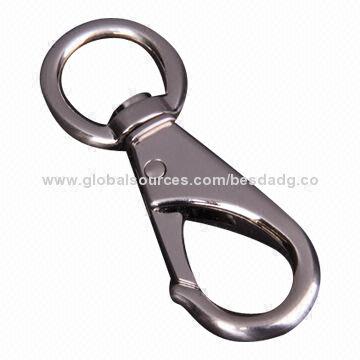
Yep. Simple hooks like that were used on sailing tethers originally - I have (but don't use for sailing) my great-aunt's old harness which has a clip like this spliced onto it:

B1084366922.jpg


However, back in the 70s or 80s it was realised that simple spring-clips can unhook themselves from a U-bolt remarkably easily, and everyone switched over to designs with some kind of secondary lock.

Pete
 
Are there any connectors rated for loading in that plane? Carabiners often have a side loading stamped but for a different axis.

Part of these threads, IMHO, point towards a more general trend in thinking that you can completely "fix" things. But the universe just doesn't work like that, ultimately it's down to probabilities. Just many are so low that they can be considered "facts". But serious offshore sailing will push everything towards the edge, all day every day for weeks on end in the Southern Ocean. One thought process I like is John Vigors "black box" idea...
http://johnvigor.blogspot.pt/2014/02/the-black-box-theory.html
Every time you check something, do some maintenance, big or small - you push the odds a bit more in your favour. The idea that you can just look on the web for a jackstay system then fit and forget and all will be well forever is going to go wrong sooner or later. Each and every one of us can sway the odds better , just don't assume something will work because it says so on the box.

I think your point about probabilities is well made.
How often do most of us fall on our tethers?
I don't think I've ever fallen on one in a way that would involve the sort of 300lb load to deform a wrongly loaded Gibb clip.
If 1% of the time your tether is going to be wrongly loaded, and you only seriously fall on it once every twenty years, you will likely die of something else.
But if people are falling on them often it gets to be Russian Roulette.
They are meant to be a last line of defence.
It's like a car seatbelt, the idea is we wear them and don't go crashing into things.
Our normal inertia reel belts in our BMW's and Fords could of course be improved to be more like multipoint rally harnesses.
That would save lives in some crashes where normal belts don't.
But learning not to crash all the time is a better way to go.

If you want to make tethers and jacklines the primary thing between you and the ocean, a complete re-think is required, not fiddling with details.
 
That is an interesting question.
The issue could equally face the designer of the yacht.

I've often wondered why new yachts may have attachments which could be used by jack stays but don't (correct me if I'm wrong ) actually have them fitted as an option. It's up to the owner to decide.
 
I've been using standard steel caribiners onboard for many years with no problems, a rinse in fresh water often and dab of oil now and again they're holding up well, Ali ones not so robust.

Yes, less corrosion problems with the steel ones (although it's been a while since I've heard steel ones called 'standard'!) But I'm not so keen to have them at the end of a tether as they can hit the GRP with some force when accidentally swung or dropped.
 
Several have stated that the edge of a yacht conditions where MOB recovery is problematic should be treated like a 500-foot cliff. Once a sailor flips over the rail on a tether there are always bruises or worse. These posters are right, and this bears repeating over and over. It is too easy to be complacent and get in a hurry. I hope no one disagrees that this is so. Staying on board is vital. Even so, accidents happen and the gear should work.

Were the main hazards known? Perhaps not to the general sailing public, but yes they were. I should add that I have been climbing ice and rock for 40 years and working at-height in refineries as a trained engineer for 35 years. I've have designed many fall protection systems, including high-line and tether systems that served for decades without incident. I also enjoy the feel of risk... but I need to know my equipment is right and that I understand how it works in concert with a dynamic situation. You need to try and understand the whole system.

I think if you showed the problem to a fall protection engineer, without prejudicing him with tradition, he would point a few things out:

* Side loading--equipment ratings. These standards (have been around for decades (UIAA 121, ANSI Z359, others). Any DIY could have glanced that the Gibb hooks and guessed that he could clamp it in a vise and bend them. I, for one, was not surprised by the failure. I have never used stamped metal or non-locking hooks. Moreover, carabiners that have been certified for side loading have been around a long time. I use Kong Tangos, as well as other Petzl and Black Diamond products. The Wichard ProClip is also rated for side loading above the forces involved in this accident (I repeated the test myself on a test stand with calibrated load cell). So anyone could have foreseen this.
* Side loading--avoiding the hazard. This has been a standard part of industrial and climbing safety forever. Yes, you look for such things. I relocated my jacklines during the trial period in part because of a spot they could side load. Also to eliminate a tripping hazard. I do not use the cleats because they are not in the right place. In fact, wouldn't it be thr greatest of coincidences if mooring cleats and jackline anchors just happened to be in the same place? I think it is only tradition and because it is easy.
* Jacklines should not go right to the edge or far ends. If they do, there should be another set farther in. You can work at the end, but the anchor point should be at least 3-4 feet back. This is obvious.
* Work station tethers. One of the sailors was clipped short and was easily recovered. Short positioning tethers must be used. Think about that 500-foot cliff thing when you say it's awkward. In fact, there have been very few falls when sailors are moving along the lines, using both hands and paying attention. It is when they stop to work that they are at greatest risk.
* Sailors need training in the systems and how to use the equipment. That these issues were surprises to manufactures and rule-making groups is obvious proof.
* Stretch must be considered in each system. There is no such thing as a one-size-fits-all design unless boats are the same size and shape This is obvious. Even lifeline diameter varies with LOA, but not jacklines specs. The materials and strength required will vary with length and deflection limits. I've seen steel cable up to 1/2" specified for strength and stretch reasons on long high line systems. For example, the proper material for the Clipper line was probably at least ~ 15,000-pound Dyneema webbing or something similar. This means stronger anchors too. Obviously.
* Energy absorption by the tether must be considered; this is in every industrial spec and recreational climbing standard, but not in the sailing standards. That is just as much a problem as the clip. Would you anchor without either a nylon rode or lots of cataenary? No you would not. The final impact on Speirs was provably about 1000 pounds--he was injured in the water, I would bet on it. (Normally the jackline would provide impact absorption, but remember that the clip was jammed.)
* Harness design needs serious research. If not a body harness (I wouldn't like that either), something that actual subjects take short falls in multiple dirrections, not dummies. I bet no one has ever taken even a 6" fall, intentionally, with a sailing harness and tether. I would ask/require the standard writers to do this, and then look at their faces. This isn't theory. An improved chest harness with leg loops could probably do it, but I don't know. This requires study. We can't just wave off the problem because we don't know the answer.

These are the basics. Then there is the detail.
 
>As for short lines they are far too restrictive as one cannot stand up, get onto the cabin top to reach the mast etc without un-clipping & re clipping.

What to do is clip the long line around the mast, which also ensures you can't go over the guardrail, then unclip the short tether then stand up. Then reverse that.
 
>As for short lines they are far too restrictive as one cannot stand up, get onto the cabin top to reach the mast etc without un-clipping & re clipping.

What to do is clip the long line around the mast, which also ensures you can't go over the guardrail, then unclip the short tether then stand up. Then reverse that.

My suggestion is to skip the short tether when moving. Sailors VERY seldom fall when moving along the deck. They are holding on with both hands and focused. It is when they are working (all of the Clipper accidents), so that is when you need the short tether. As for a hard point, as fixed loop of line around the mast at about goose neck height is very easy and secure. Clip that.
 
Top