Lilfo 105 LiFePo4 batteries flat.

Ian_Edwards

Well-Known Member
Joined
9 Feb 2002
Messages
2,227
Location
Aberdeen Scotland
Visit site
I've just visited my for the first time in a while
I have 4 Lifos 105 LiFePO4 batteries connected in parallel. They are all flat, just 0.2v per battery. The batteries have internal BMS, which are advertised as being able to protect against being flattened.
The boat is out of the water.
The batteries are normally charged with the with alternator (with a WS 500 charge controller) and a victron Multiplus 3kW 12v inverter charger, powered by shore power or a generator.
The boat has shore power.
The Multiplus won't start up, I guess because there's no 12v supply.
The battery were isolated. I don't understand why they are full discharged, I need to work on that.
There's a 12v AGM starter battery connected via a victron B to B which is OK. It should be isolated from the house bank when the house bank is isolated.
Any ideas how I can get the Lifos batteries to start charging?
The only charger I have with me is a 4amp maintance charger, and unsurprisingly, that signals an error when I connected it (it was worth a try!)
I also have a lithium emergency starter pack, which would start my old Subaru diesel.
Is that worth a go on one of the Lifos batteries?
 
Can you put the agm and the lithiums in parallel and connect the charger? This should fool the charger,

My lithiums were comply discharged once, despite the naysayers who said it's impossible to discharge them to such an extent, or that they will never recover they both seem fine now...
 
Yes, there's a massive rely (with manual override) to parallel the starter and house bank. Originally installed as an emergency start back-up.
I'm concerned that a massive inrush of current would damage one or both battery banks.
 
Can you put the agm and the lithiums in parallel and connect the charger? This should fool the charger,

My lithiums were comply discharged once, despite the naysayers who said it's impossible to discharge them to such an extent, or that they will never recover they both seem fine now...
It very much depends on what BMS you have. It also depends on whether you turned the bms off when you left the boat unattended for a while.
If you have crappy cheap Chinese drop in batteries, who know what you can achieve in terms of flat batteries
 
I've just visited my for the first time in a while
I have 4 Lifos 105 LiFePO4 batteries connected in parallel. They are all flat, just 0.2v per battery. The batteries have internal BMS, which are advertised as being able to protect against being flattened.
The boat is out of the water.
The batteries are normally charged with the with alternator (with a WS 500 charge controller) and a victron Multiplus 3kW 12v inverter charger, powered by shore power or a generator.
The boat has shore power.
The Multiplus won't start up, I guess because there's no 12v supply.
The battery were isolated. I don't understand why they are full discharged, I need to work on that.
There's a 12v AGM starter battery connected via a victron B to B which is OK. It should be isolated from the house bank when the house bank is isolated.
Any ideas how I can get the Lifos batteries to start charging?
The only charger I have with me is a 4amp maintance charger, and unsurprisingly, that signals an error when I connected it (it was worth a try!)
I also have a lithium emergency starter pack, which would start my old Subaru diesel.
Is that worth a go on one of the Lifos batteries?
What are the batteries?
 
Yes, they are Lifos 105Ah batteries, fitted in 2020, before the price of lithium batteries drop to the current levels. I don't recall the "Go" in the description, but that sounds like marketing hype.
They have worked without fault since then. During the winter I normally isolate them at about 70% charge, which is what I did this time.
I have no idea what the BMS is, other than that they work well as drop-in replacement.
I wouldn't describe then as "cheap Chinese" it seem to be a UK design.
You also have to bearing mind that China is the world's dominant supplier of lithium based batteries, by a significant margin, they have invested heavily in the techology, unlike the UK.
But that's not the question I asked!
If I need to replace them, I think there are better and cheaper options around. The critical consideration is that they must fit into the existing, built-in, battery box, which would be very expensive to modify.
 
Yes, they are Lifos 105Ah batteries, fitted in 2020, before the price of lithium batteries drop to the current levels. I don't recall the "Go" in the description, but that sounds like marketing hype.
They have worked without fault since then. During the winter I normally isolate them at about 70% charge, which is what I did this time.
I have no idea what the BMS is, other than that they work well as drop-in replacement.
I wouldn't describe then as "cheap Chinese" it seem to be a UK design.
You also have to bearing mind that China is the world's dominant supplier of lithium based batteries, by a significant margin, they have invested heavily in the techology, unlike the UK.
But that's not the question I asked!
If I need to replace them, I think there are better and cheaper options around. The critical consideration is that they must fit into the existing, built-in, battery box, which would be very expensive to modify.
It all depends on how good the BMS is. Lifos seem to 'design' in the UK but batteries seem to be assembled in China.
If it's anything like Sterling lithium batteries i would be sceptical. I have seen inside one of those AMP batteries and the construction quality was appalling. The worst I have seen. This is the problem with any cells in a box you buy. You have no idea what is inside. If they tell you the BMS is a JK or JBD you know they are looking to build a good quality battery. If they don't mention it, who knows.
Anybody looking to install lithium should be looking for an active balancer, Bluetooth and cells from a known supplier/quality.
 
Sodium are now on the market. Seen a 110a/h for £140. Apparently it's quite easy to use a li-ion production line and convert to sodium so it should get really competitive on price giving us what they claim, 60% cheaper then li-ion.
This article suggests ways to try and revive flat lithiums. Recovering Lithium-Ion Batteries
 
That's exactly what I think.
I've observed how they respond over the last 5 years using the Bluetooth link, which reports at the battery level state of charge, voltage and current, both charge and discharge.
The BMS seems to be fairly smart. They stop taking current when they they are fully charged. This can happen at anytime, and because there's no automatic equilisation between the 4 batteries, that can happen at different times. So there's a mechanism to prevent over charging which works.
There's supposed to be a mechanism to prevent complete discharge.
I'll contact Lifos today and see if they have a procedure for recovering fully discharged batteries.
 
Thanks for the link, that's based on 18650's at cell level. I've already done that successfully on a Ryobi battery pack, just have to get the cell voltage high enough for the charger to recognise that it exists.
I have no intension of deconstructing a relatively large, fully potted LiFePO4 battery.
 
Sodium are now on the market. Seen a 110a/h for £140. Apparently it's quite easy to use a li-ion production line and convert to sodium so it should get really competitive on price giving us what they claim, 60% cheaper then li-ion.
This article suggests ways to try and revive flat lithiums. Recovering Lithium-Ion Batteries
Sodium has a little way to go yet. Well, maybe the systems to go with it. The voltage change from full to discharged is too much without some form of control.
 
There will always be a parasitic load of some kind, we have about 10-15W constantly.
A battery charger with a lithium setting that can activate the BMS is needed. Most battery chargers will either not give any output if they detect no load, or the voltage is not high enough to 'wake' the BMS. A temporary connection to another battery (parallel switch) is also fine to get them started and can be disconnected once charge is flowing.
 
I've revived (20v) li-ion battery packs by hooking them up to a 0.5A 6v charger for about 10 minutes - no way it can damage anything and it was just enough to wake up the bms and accept charge from the proper charger.
 
There's a 12v AGM starter battery connected via a victron B to B which is OK. It should be isolated from the house bank when the house bank is isolated…
What happens when you start the engine? Hopefully the output from the B2B should wake up the BMS and charging should commence.
 
The boat is out of the water, so I can't start the engine.
I've been doing some research, and tried several battery chargers. So far they all fail to recognise the Lifos batteries.
Digging into the specifications, when I can find them, it seems that most won't recognise a battery if the voltage is lower than about 0.5v.
I've seen one where you can force it to recognise a battery with 0v, by breefly pressing a button. I'll probably buy one, not expensive compared to replacing 4.4kWh of LiFePO4 batteries.
It is said to be Lithium friendly.
The batteries are now in the car and I'll take them home tomorrow. I'll have more time and kit in the garage to work and understand the problem.
I'm also waiting for a call back from Lifos's technical people.
 
I'm no expert on this ... but because I have an issue with my LiFePo4 - I have been investigating all sorts of scenarios and one that came up is :

BMS sleep mode.

The battery can in fact be fully charged state - but BMS has shut off .. and can show near zero or nothing at all. Giving idea that battery is dead ... but in fact its not.

https://www.youtube.com/results?search_query=LiFePo4+BMS+Sleep+mode

I bow to others knowledge - but maybe its worth checking out the multitude of YT videos that show how to reset BMS and drag it out of Sleep mode ?
 
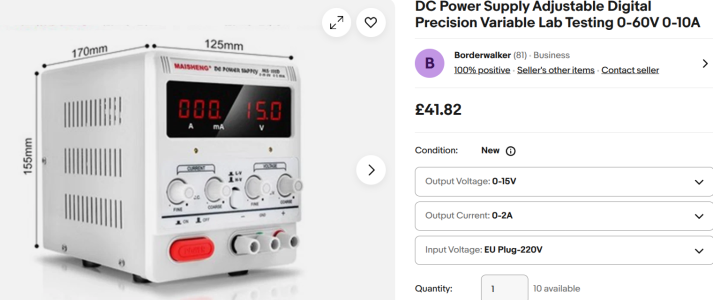
I know nothing about LifePo batteries, or their BMS systems, but do wonder if one can charge using a bench power supply, where one's able to manually set the A's & V's involved?
I've charged various other types of batteries by doing this without a problem.

1761649247800.png
 
Top