Keels

A properly engineered bolt-on keel is perfectly safe.

Providing the properly engineered bolt-on keel is designed by a proper Engineer and is constructed to the exact specification of the Engineer.

The problem with racing boats is that the owners want the boat as light as possible as weight slows the acceleration of the boat.
 
Way too much alarmist hyperbole for my taste. You could just as easily argue that going to sea in any boat that isn't unsinkable is utter madness.

A properly engineered bolt-on keel is perfectly safe.

I'd agree with that. Relying on fibreglass for the integrity of the keel doesn't always work - as Oyster found out, following a failure of the fibreglass holding the bolt-on keel.

The skeg-hung rudder design looks sound, I approve of that.

I don't know what sort of market there is for Chinese-built £1 million yachts, but I guess they'll find out.
 
I do not know why some people are so fixated on an integral keel. Back in the late 1960's or early 1970's there was a yacht that was surveyed with an integral keel, unfortunately it had repeatedly touched rocks and worn through the glassfibre to the point the ballast almost dropped out. It was not realised as the ballast had been fibreglassed over and it remained watertight. Imagine loosing your ballast would be like loosing a bolt on keel.
 
I do wonder if there isn't a question of horses for courses, and fitness for purpose. A deep blade with a sodding great lump of lead on the bottom is fine for a racing boat where speed is everything, longevity isn't an issue and the budget allows for a proper inspection following a grounding, but the stresses are huge. For a boat like that, fitness for purpose means it wins races. Of course it should be safe, but maintenance is part of the safety

A cruising boat is a different beast altogether. It's expected last for many years, be sailed by less skilled crews, can be pretty much guaranteed to be bounced off the bottom a few times, and that last half knot or degree to windward really isn't that vital. There's also a strong likelihood that things won't be checked following a grounding unless damage is obvious. For such a boat, fitness for purpose means the keel should be bomb-proof. Unfortunately, at the budget end, fashion requires imitating the racers and, as the old adage goes, fast, cheap, strong - pick any two.
 
It is me or does the Kraken look incredibly similar to a Gunfleet? Makes a few good points but trying to scare potential owners into buying your product isn't the way.

Are we looking at the new GT35?..................................................................................................................Sorry couldn't resist.
 
The other way of looking at the ocean crossing aspect of safety is to have a lifting keel whereby it swings aft should you hit any underwater objects - could have bought a Southerly or french aluminium equivalent.
 
It is me or does the Kraken look incredibly similar to a Gunfleet? Makes a few good points but trying to scare potential owners into buying your product isn't the way.


Slightly clumpier looks but I see what you mean. Can't say I'm a fan of either the design or the yard. The Owner/MD seems like an angry old bloke who spends too much time slagging off his competition, while purveying a supposedly super-secure vessel built under contract in China and Turkey. And as we know from Polina Star III and many other keel failures, an errant inadequately supervised yard can render the best of designs into a deathtrap.

Then there is the question of why a supposedly super-safe vessel has no waterproof bulkheads, stability info, etc., etc.
 
I do wonder if there isn't a question of horses for courses, and fitness for purpose. A deep blade with a sodding great lump of lead on the bottom is fine for a racing boat where speed is everything, longevity isn't an issue and the budget allows for a proper inspection following a grounding, but the stresses are huge. For a boat like that, fitness for purpose means it wins races. Of course it should be safe, but maintenance is part of the safety

A cruising boat is a different beast altogether. It's expected last for many years, be sailed by less skilled crews, can be pretty much guaranteed to be bounced off the bottom a few times, and that last half knot or degree to windward really isn't that vital. There's also a strong likelihood that things won't be checked following a grounding unless damage is obvious. For such a boat, fitness for purpose means the keel should be bomb-proof. Unfortunately, at the budget end, fashion requires imitating the racers and, as the old adage goes, fast, cheap, strong - pick any two.

The horses for courses thing is exactly correct. It's more than possible to cruise Oceans in boats with skinny bolt on keels, but as every responsible racing boat owner knows, the skinnier your keel the more it becomes a regular maintenance item. There's a huge space between a high aspect fin and bulb and a full keel though. I wouldn't want to cruise a keel like that found on the new Dehler 30 for example, but a nice slab fin keel would give me no headaches.

I do think you're wrong about the motivation of cruising designs to wards skinny keels in terms of fashion, and not simply because the buyers are demanding more performance. As I've often said on these forums, if there was still a large demand for boats with encapsulated full keels, skeg hung or keel hung rudders etc, then they would still be available in large numbers. Clearly they are now a very niche item.

Quite a few mainstream long distance cruising yards - HR for example, have now moved towards beamier designs with twin rudders and what I'd call a fairly conservative fin keel.

5_51cccb3be3.jpeg
 
I think that a lot of the attraction for manufacturers of mass produced modern boats is that they are easy to ship around the world in cradles with the keel and rudder not attached
regards Don

Have you seen many production boats shipped with keels removed? I have seen a lot of pictures of boats being shipped and never seen a new cruising yacht being shipped with keel removed. Deck space is the limiting factor, not height.

The reality is that fin keels are efficient to produce, efficient to sail, and if engineered properly extremely reliable.
But lots of people hanker after what they saw when they were younger.
 
Hi Dunedin
A friend bought a new Jeanneau 349 and it was shipped from the factory in France to Hobart in Australia in a cradle with the keel and rudders removed and the mast laying along the top of the deck
When it arrived the company who commissioned the boat on behalf of the local dealer lifted the cradle on to a high stand and fitted the keel, rudders and mast and anti fouled the hull
Regards Don
 
Last edited:
I do wonder if there isn't a question of horses for courses, and fitness for purpose. A deep blade with a sodding great lump of lead on the bottom is fine for a racing boat where speed is everything, longevity isn't an issue and the budget allows for a proper inspection following a grounding, but the stresses are huge. For a boat like that, fitness for purpose means it wins races. Of course it should be safe, but maintenance is part of the safety

A cruising boat is a different beast altogether. It's expected last for many years, be sailed by less skilled crews, can be pretty much guaranteed to be bounced off the bottom a few times, and that last half knot or degree to windward really isn't that vital. There's also a strong likelihood that things won't be checked following a grounding unless damage is obvious. For such a boat, fitness for purpose means the keel should be bomb-proof. Unfortunately, at the budget end, fashion requires imitating the racers and, as the old adage goes, fast, cheap, strong - pick any two.
Wanting 'bomb proof' in a small yacht is just delusional.
The ocean is more powerful than that.
I think it's wrong to suggest it's OK to ignore groundings just be cause you don't have a bolt-on keel.
I've seen serious keel damage on most sorts of boat.
I've seen a couple of encapsulated keel type yachts skipped beyond economical repair due to grounding.
Long keel boats have foundered, skegs have been ripped off hitting whales or flotsam.

One thing though, I think older boats were often tougher, because they were crude mouldings which weren't very stiff. You hit them hard, they didn't smash, they bent and sprang back (maybe with the odd bit of detached interior..) Modern sandwich and composite is lighter stronger stiffer and much better at doing what it's meant to, But may be more vulnerable to hard knocks. This is blatant in expensive carbon boats, but also more subtly the case in even low-end modern designs
 
Hi Dunedin
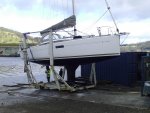
Re shipping without keel and rudders this is the new 349 in its low shipping cradle that has been lifted and sat on a high stand in the company that commissioned the boats yard to allow them to fit the keel and rudders
At this point the keel has been installed
You can see that in the low cradle it is a much more compact package to ship around the world to the dealers
regards Don
 

Attachments

  • F57DA9DD-A38D-4AAE-8A6E-01744049D02E.jpeg
    F57DA9DD-A38D-4AAE-8A6E-01744049D02E.jpeg
    312.1 KB · Views: 24
Last edited:
Wanting 'bomb proof' in a small yacht is just delusional.
The ocean is more powerful than that.
I think it's wrong to suggest it's OK to ignore groundings just be cause you don't have a bolt-on keel.
I've seen serious keel damage on most sorts of boat.
I've seen a couple of encapsulated keel type yachts skipped beyond economical repair due to grounding.
Long keel boats have foundered, skegs have been ripped off hitting whales or flotsam.

One thing though, I think older boats were often tougher, because they were crude mouldings which weren't very stiff. You hit them hard, they didn't smash, they bent and sprang back (maybe with the odd bit of detached interior..) Modern sandwich and composite is lighter stronger stiffer and much better at doing what it's meant to, But may be more vulnerable to hard knocks. This is blatant in expensive carbon boats, but also more subtly the case in even low-end modern designs
Agree with all of that.
 
Hi Dunedin
A friend bought a new Jeanneau 349 and it was shipped from the factory in France to Hobart in Australia in a cradle with the keel and rudders removed and the mast laying along the top of the deck
When it arrived the company who commissioned the boat on behalf of the local dealer lifted the cradle on to a high stand and fitted the keel, rudders and mast and anti fouled the hull
Regards Don
Fair enough - for the few boats going that far. The vast majority of large yachts are delivered with keel attached, including trans Atlantic. Suspect that the volumes of Jeanneau going to Aus /NZ didn’t influence their designer hugely about keel design though :)
 
Wanting 'bomb proof' in a small yacht is just delusional.
The ocean is more powerful than that.


Disagree, the ocean has fought and lost many a battle against steel origami boats, even when it initially gained the upper hand on a reef, etc.
?
 
Disagree, the ocean has fought and lost many a battle against steel origami boats, even when it initially gained the upper hand on a reef, etc.
?


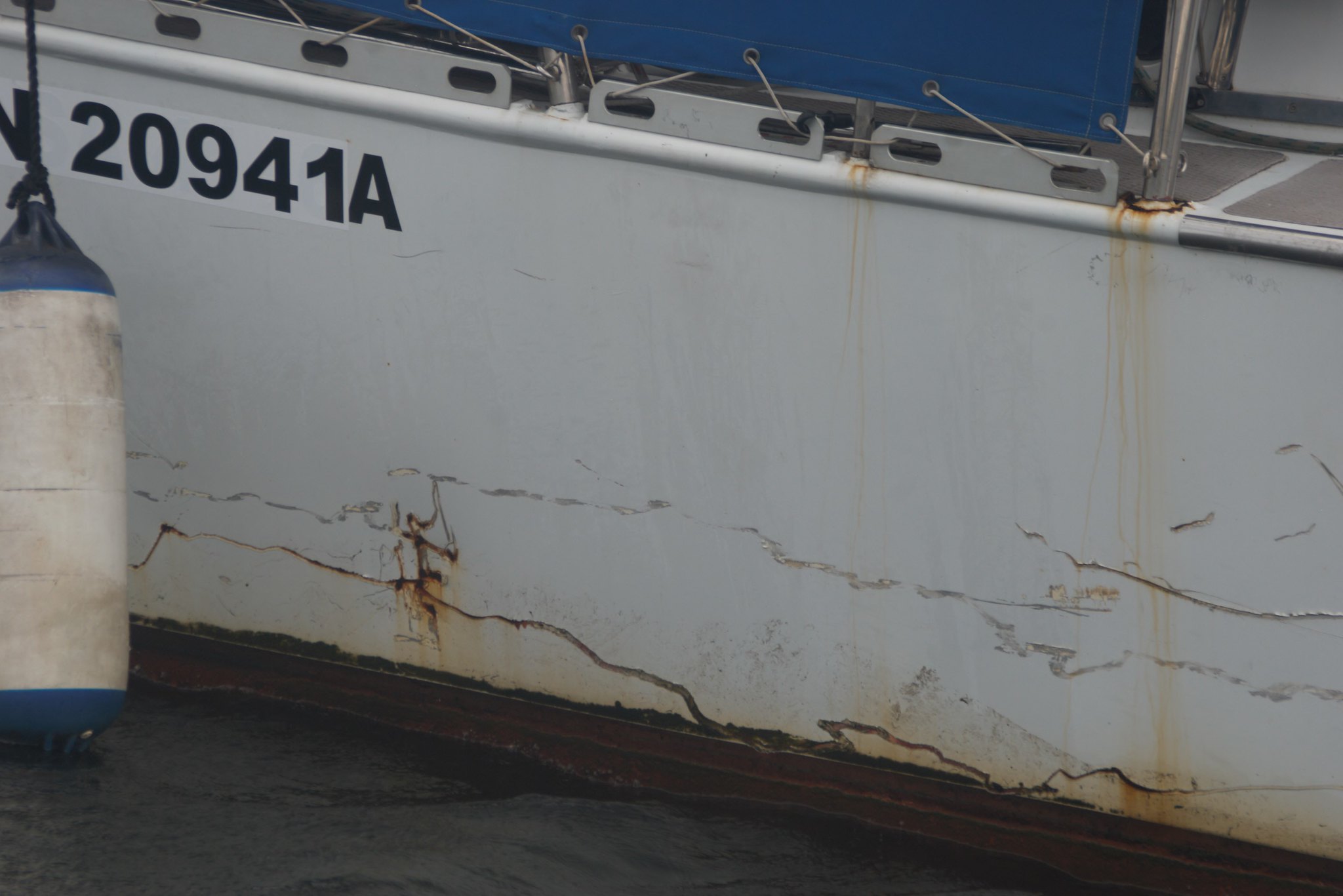
What's so special about origami boats. I have a steel boat but not origami that survived a breakup of out local marina.

They are not immune to being sunk at sea.

Several GRP boats were holed and/or sunk in the same storm

26228485268_0f3bf24205_k.jpg


That was just above the waterline.
 
Top