
JPK 39FC

How is your order going?

Did you find an alternative to the drop down bow thruster direct from the JPK team?

What's the latest update?
 
How is your order going?

Did you find an alternative to the drop down bow thruster direct from the JPK team?

What's the latest update?
I'm waiting for JPK to give me a quote for a JetThruster but may simply use a couple of big fenders!
The boat is due to be built at the end of the year so now I just have time to ponder. The biggest decision is the keel. 1.8m or 2.15m? At the moment I am leaning towards the 2.15 but that could change tomorrow.....after all it's only 14 nches difference and the extra 350-400 kg needed to maintain the rightimg moment is significant on a 5 1/2 ton boat but the extra accessability is real.
Then there's also the question of a powered halyard winch, thats a tricky one. Don't need it for raising the sail but should I need to send a body up the stick......hmmm.
 
I'm waiting for JPK to give me a quote for a JetThruster but may simply use a couple of big fenders!
The boat is due to be built at the end of the year so now I just have time to ponder. The biggest decision is the keel. 1.8m or 2.15m? At the moment I am leaning towards the 2.15 but that could change tomorrow.....after all it's only 14 nches difference and the extra 350-400 kg needed to maintain the rightimg moment is significant on a 5 1/2 ton boat but the extra accessability is real.
Then there's also the question of a powered halyard winch, thats a tricky one. Don't need it for raising the sail but should I need to send a body up the stick......hmmm.
I would suggest a definite yes on the electric halyard winch (and the retractable bow thruster!).
But agree a trickier one on the keel depth - guess depends where intend to go sailing.
I personally put a limit on 2.0m for our boat, and plenty of shallow harbours round Denmark, Sweden etc where was glad of this. But equally would the extra 15cm have been a showstopper, who knows. (2m has twice been a bit too much - oops!)
 
Not had any problems with my Sidepower retractable thruster which is now in its 6th season. You could always get Osmotech to install one later. Shorthanded with a remote control I wouldn’t be without it. Same for electric winches which allow me to put a reef in much more easily and quickly as I singlehand a lot
 
Bugger. I was thinking an electric winch was just for rich cruisers. You've all got me thinking an Electric Winch is a handy thing?

Is there any time that you have an electric winch, but wish it was manual?

eg. is there a certain job that an electric winch is bad for, or gets in the way of?

Or is there no downside to an electric winch? (other than its cost)
 
Is there any time that you have an electric winch, but wish it was manual?

eg. is there a certain job that an electric winch is bad for, or gets in the way of?

Or is there no downside to an electric winch? (other than its cost)
Since the winch can be used completely normally as a two speed winch manually, no, there is no obvious downside. If you forgive the pun, I use mine to do the heavy lifting and go to manual when fine tuning (for fear of braking something) as you can feel the resistance better. Other issues are the cabling, battery and winch itself are heavy. My only wish is that it would go a bit faster ;) but I think the new Selden one might?

When I first got my boat I thought I’d just save using the electric function for when I was tiered …in reality the only times I don’t use them are when I’m being power frugal!
 
My Dehler 35 CWS has a pair of powered Harken primaries. The boat would be difficult to sail without them as the routing of all the lines causes the most horrendous friction.

Only downside is one has to be very careful as it's dead easy to break things. Eee! He doesn't know his own strength ...
 
My Dehler 35 CWS has a pair of powered Harken primaries. The boat would be difficult to sail without them as the routing of all the lines causes the most horrendous friction.

Only downside is one has to be very careful as it's dead easy to break things. Eee! He doesn't know his own strength ...
Hence the one very strict rule on our boat is when using the electric winch - only two turns and NEVER put in the self-tailer. Then if something catches the rope slips. Can then investigated / resolve before retrying.
Then final turns applied by hand.
Seen too many things broken by people who used the self trailer and kept winching.

Other than that no drawbacks (except cost and a bit more maintenance) from having the electric halyard winch. For going up mast can route jib or spinnaker halyard to winch using the manual winch on the other side as a turning point.
With bad back we use the halyard winch as a mini crane for heavy lifting - eg dinghy into/out of stern locker, heavy sail bags on and off etc (all using the two turns and no self trailer rule!)
 
People will also remember this from some years ago:


"As reported in the current May issue of YM, the Venezuelen woman was winching her husband up the mast of their Amel 54 in Jolly Harbour, Antigua (pictured above), when a riding turn developed on the foot-operated self-tailing winch.

Trying to free the jam, one of the woman’s hands was severed and the other was crushed and John Ahlgren, a 63-year-old Norwegian sailor, who rushed to help her, also lost seven fingers. One onlooker said the scene resembled ‘an abattoir with body parts all over the cockpit’.

Lewmar‘s safety notice said: ‘Under no circumstances should any self-tailing winch be used in self-tailing mode for any lifting operation."

.
 
I'd opt for the lifting keel myself. I want my next cruising boat to have a variable draft. The Bahamas beckon.

not just the Bahamas...

many of the better boats built near where the JPK is built are available with some sort of lifting keel,, because the local sailors value them.
 
Is the lifting keel purely to get into marina's or anchorages that are shallow, or is it for sailing in shallow water?

I saw some underwater vision of a Pogo 36 sailing with her lifting keel "up" while they were flying a spinnaker ... but that just feels all sorts of wrong. Surely a lifting keel, when it is not down, has limited righting moment? (downwind I understand is possible, but as soon as things go bad and you get yourself a bit side on, it just sounds like trouble)

If you are in the Bahamas, do you sail with the lifing keel half way up, all the way up, or all the way down, and you just lift it when you get to your anchorage?

** sorry to ask if this is common knowledge ... Newbie here: bought a 1979 Sparkman and Stephens Defiance 30 two years ago. Best decision of my life. Aiming to upgrade and do some real sailing as I quickly head past my mid fifties :-) (I know it's never too late, but every day at work feels like I am missing something!)
 
Is the lifting keel purely to get into marina's or anchorages that are shallow, or is it for sailing in shallow water?

I saw some underwater vision of a Pogo 36 sailing with her lifting keel "up" while they were flying a spinnaker ... but that just feels all sorts of wrong. Surely a lifting keel, when it is not down, has limited righting moment? (downwind I understand is possible, but as soon as things go bad and you get yourself a bit side on, it just sounds like trouble)

If you are in the Bahamas, do you sail with the lifing keel half way up, all the way up, or all the way down, and you just lift it when you get to your anchorage?

** sorry to ask if this is common knowledge ... Newbie here: bought a 1979 Sparkman and Stephens Defiance 30 two years ago. Best decision of my life. Aiming to upgrade and do some real sailing as I quickly head past my mid fifties :) (I know it's never too late, but every day at work feels like I am missing something!)
It's a while since I sailed dinghies. In those it was normal to sail upwind with the centre board down and downwind with it up
 
I talked with someone who did work for a few RM owners.

He said they did sometimes sail downwind with the board up.
 
Is the lifting keel purely to get into marina's or anchorages that are shallow, or is it for sailing in shallow water?

I saw some underwater vision of a Pogo 36 sailing with her lifting keel "up" while they were flying a spinnaker ... but that just feels all sorts of wrong. Surely a lifting keel, when it is not down, has limited righting moment? (downwind I understand is possible, but as soon as things go bad and you get yourself a bit side on, it just sounds like trouble)

If you are in the Bahamas, do you sail with the lifing keel half way up, all the way up, or all the way down, and you just lift it when you get to your anchorage?

** sorry to ask if this is common knowledge ... Newbie here: bought a 1979 Sparkman and Stephens Defiance 30 two years ago. Best decision of my life. Aiming to upgrade and do some real sailing as I quickly head past my mid fifties :) (I know it's never too late, but every day at work feels like I am missing something!)
According to the gospel of JPK the lifting keel Is purely for shallow berthing. Sails should not be used with the keel up and it is not designed to take the ground. Hence my deciding not to go down that route.
Not sure I intended to stir up gruesome tales of severed limbs and powered winches but I suspect I will get one.
Still awaiting a quote for a JetThruster.
 
According to the gospel of JPK the lifting keel Is purely for shallow berthing. Sails should not be used with the keel up
pretty sure that's the case with the RM's i mentioned above.

but i think that the French sailors aren't that big on reading manuals and following the instructions.
 
The swing keel can be lighter because it's deeper (I think). Given lightness is key for performance, is there better sailing performance with the lifting keel (because it is lighter)?

The lifting keel looks "chunkier". That standard keel with the torpedo looking lead bulb looks like it will cut through the water like a knife, but the wetted surface area has to be similar?

Is the only reason to go lifting to get into a shallow anchorage, or is there a performance reason too?
 
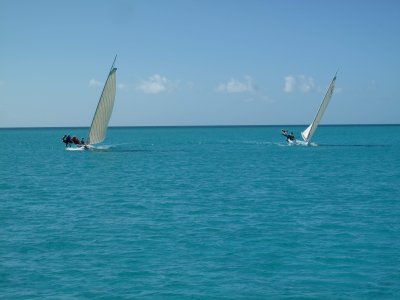
Bahamas is some of the best sailing I've ever done. Decent breeze, flat, crystal clear swimming pool blue water. The tricky bit can be getting on and off the banks as the edges are a bit shallower and the tide can rip. Generally speaking, the banks are billiard table flat and once you've got your head round sailing with very little water under the keel there's no problem.

I've sailed The Exumas with 1.8m draft, There were a few places we couldn't go.
IMG_0445.jpg
 
Hi Doris, How's the options list going?

What options are you doing with regards power generation?

Watt & Sea hydro?
Wind?
Solar? maybe on an aft Gantry with dingy davits?
Any planned options for your engine's alternator?

Cheers, Tony.
 
Top