Is This a Shoddy Repair Job???

TADTS, there is no rigidly mounted bearing to stop it wobbling. You would need a cutless bearing in your sterntube for that, or maybe an aquadrive or similar.
That is reassuring and what I was assuming, especially with flexible engine mounts and, no, no cutlass on our Jeanneau.

But without hijacking the OP’s discussion, it was more that realising how much they move around, I’m inclined to go for the best quality of seal I can find on next lift out (and keep the Michigan as a spare).
 
Well I hope my dream boat didn't just turn into a nightmare boat.
As I was pulling back the prop shaft seal to measure the stern tube I think I found a major problem :(
I loosened the clamps holding the seal and a piece fell out.
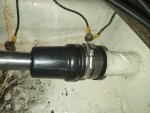
The seal felt strange, there was a bump on top. So I removed the clamps and saw this:

The prop shaft is not in the center of the tube. In the photo its more to the bottom, port side of the boat.
The tube has a bump about 2 inches long, 2 mm high. Quite noticeable, you can even see it in the photos.
The tube isn't quite round, 43mm wide and 45mm tall, because of the bump.
Neither dimension by the way seems to fit the Radice. Then again I'm using a measuring tool that's hard to hold in there so room for error.
The clamp has a rigged piece with a bend to accommodate the bump.

They told me the seal went bad when the boat sat on land and dried it out.
Now I'm thinking the seal was a cover of a bigger problem :(

Someone please tell me this is normal, or an easy fix.
Do you have a picture of the piece that fell out?
 
Is there any play in the prop shaft, can you waggle it from side to side or up and down
it will move because it is supported by the engine at one end and the P bracket at the other. The whole point of using the Volvo type seal is that it provides support in the middle (half the length is a bearing) but is flexible enough to allow some movement. Pretty idiot proof once it is set up properly - simple and elegant solution to sealing the shaft.
 
It really depends upon the boat. If you have a long keeler with the cutless bearing close to the prop and your engine is flexibly mounted, this will almost certainly be to allow the engine to "bounce" while running. 1GM10s are notarious for this. Beta 18's not so much. It does heavily depend on the nature of your flexible mountings too. If there's a good length of prop shaft showing between the hull and P-Bracket, possibly not. Someone with more experience of this sort of layout should be along soon to comment.
 
it will move because it is supported by the engine at one end and the P bracket at the other. The whole point of using the Volvo type seal is that it provides support in the middle (half the length is a bearing) but is flexible enough to allow some movement. Pretty idiot proof once it is set up properly - simple and elegant solution to sealing the shaft.

I don't know the boat but does the stern tube not also carry a bearing ?
 
All glassfibre boats have some flexibilty, some new boats can only be chocked on bulkheads. If they do not do this they can vibrate on the chocks or in the cradle and can become a risk to other boats close by. The substantial cradle used when Concerto is out of the water has sometimes had additional chocks added in windy conditions.

On my Fulmar, when out of the water the aft end of the keel pushes the hull up by about 10mm. This is the major job the surveyor indicated 8½ years ago. This can only be fixed in the water as I have to reinforce the keel rib. The delay has simply been it has lasted over 40 years, so unlikely to fail, so just needs strengthening. The later Fulmars had additional strengthing, but my early version has not been done properly, just a bodge job by a previous owner.

Re the flexing. I can confirm my boat does flex a little when on the hard.
I know this because I noticed some of the infamous overhead insulation pieces that normally sag on Westerly boats weren't quite lined up, most notable in the forward part of the v-birth, where a long seam was slightly wider at one end. Now in its new location the boat has slightly imperfect seams in other places, and the first one isn't as noticeable. But the locker hatch in the fore of the v-birth now opens cleanly and it was quite difficult before.

Never would have guessed boat flex was a thing. I did notice however that they did quite a poor job of leveling the boat at the old location, and even walking around inside I could feel a bit of wobble. They assured me it was Ok, but it feels far more stable now. In fact I noticed it was far more stable after loaded on the truck!

I remember seeing this one ages ago. Maybe it would have some tips for you?

OK. You need the 42 mm Radice seal. Remove the lump by grinding. Centre the shaft in the tube using wedges. Line the engine up to the shaft - standard procedure, just google boat engine shaft alignment and you will get plenty of written and youtube descriptions. Once engine is aligned, remove the wedges and slide the seal on and clamp. chances are the engine is already pretty well aligned as it should have been done when the engine was installed, but good to go through the process. The seal is in effect a bearing and provided the shaft is concetric to the tube when connected to the engine it should be fine - and no leaks! Make sure the 2 clamps are tightened completely.

So I called three local shops looking for a Radice. And learned that 1. they are from Italy and 2. they are not available right now as the factory is on holiday 3. mine is the less common size as it's not stocked by anyone ( I could find).

It looks like I'll have to settle for a normal Volvo model as I need it installed on the boat and ready to go in the water in one week. Dang. That's really too bad as I imagine a greased solution would be more tolerant to an imperfect installation/angle etc.

Good news is the local shop has a normal Volvo one in 25/42 size right now. But yeah kind of a disappointment at this point. Anyway... I'll try to just be happy with progress. I'll do my best to follow the steps you outline. I imagine I won't be able to sand the bump completely out but we'll see how thick the metal is I might just pull it off.

Do you have a picture of the piece that fell out?

Sure it's in the first photo. The one of the clamp. Inside the clamp if you look close is a seperate metal pice with a bump bent into it to accommodate the bump on the stern tube. From the distance it looks like one piece but it's actually two. That's the piece that fell out.

I don't know the boat but does the stern tube not also carry a bearing ?

Interesting to know. I'll check it out and see. I'm also curious if there is any torque on the prop shaft or if it holds current position when detached from the transmission coupling. Didn't get a chance to go to the boat today but I'll check it out tomorrow and hopefully get some good progress.
 
I don't know the boat but does the stern tube not also carry a bearing ?
No _ that is the whole point of the set up with the Volvo type seal - it was designed to have a solid coupling (although some fit a R&D "flexible" coupling), a Volvo bearing/seal and a cutless in a P bracket. Simple and works very well (40 years on!)
 
So I called three local shops looking for a Radice. And learned that 1. they are from Italy and 2. they are not available right now as the factory is on holiday 3. mine is the less common size as it's not stocked by anyone ( I could find).

It looks like I'll have to settle for a normal Volvo model as I need it installed on the boat and ready to go in the water in one week. Dang. That's really too bad as I imagine a greased solution would be more tolerant to an imperfect installation/angle etc.

Good news is the local shop has a normal Volvo one in 25/42 size right now. But yeah kind of a disappointment at this point. Anyway... I'll try to just be happy with progress. I'll do my best to follow the steps you outline. I imagine I won't be able to sand the bump completely out but we'll see how thick the metal is I might just pull it off.

The bit of the boat where the engine is mounted and the stern tube do not flex. It is the strongest and most stable part of the boat with the main bulkhead to the front and the glassed in engine beds going back almost to the stern tube. You are right to question the P bracket - it can get knocked out of line. However the Westerly arrangement is pretty bullet proof (compared with some others) and should be fine.

No problem using the standard Volvo seal, just remember to grease it once a year using the nozzle on the tube and "burp" it to expel air when you launch. The stern tube is short and no problems with water flowing in to lubricate and cool the bearing part.
 
The bit of the boat where the engine is mounted and the stern tube do not flex. It is the strongest and most stable part of the boat with the main bulkhead to the front and the glassed in engine beds going back almost to the stern tube. You are right to question the P bracket - it can get knocked out of line. However the Westerly arrangement is pretty bullet proof (compared with some others) and should be fine.

No problem using the standard Volvo seal, just remember to grease it once a year using the nozzle on the tube and "burp" it to expel air when you launch. The stern tube is short and no problems with water flowing in to lubricate and cool the bearing part.

OK, good to know. So the tech I had over was probably right as well.
Last Update Just Posted on Westerly Forums:

So I got a little professional help with this job and she's now done. Actually shared the work, and watched everything carefully. And I learned a lot. The engine is in fact out of alignment. The tech described it as a 'real rush job.' But he'd seen worse. So there's that... Anyway said there should be another plate or two under the engine mounts, as the engine is sitting 'obviously' too low, and is near the top of the stock Volvo engine mount range. He was confident however that a new seal would last at least 2 years before a slow leak developed and got gradually worse. Perhaps extended life by regular (1-2x per year) greasing (and he showed me a trick to open the bottom part of the grease tube and bend it in a circle, to do that), he felt going ahead without fabricating custom support plates at this point was a reasonable decision. He is keenly aware that I have many projects to get her going and wish to be in the water yes- this year ? Also I have a limited budget having just purchased the boat and a year of marina fees, only one more week on the hard so some other jobs take priority. For now. Job done and moving forward. A fantastic thing at this point! Thanks again for all the helpful responses ?
 
For sure I'm just buying time. But for one thing I couldn't help feel that there must be some kind of mass produced plates to raise the engine that fit standard Volvo mounts (saving me local shop custom fabrication fees!) and this gives me time to order the Radice seals when the Italians are back from holiday and in advance of the boat going on the hard rather than a time pressed situation like now, when the boat goes in the water next Wednesday. Anyway, all the information has been tremendously helpful, and the job is now done. Given my work list and time schedule, any progress toward me actually sailing this year, is a wonderful thing :)
 

Attachments

  • prop shaft seal.jpg
    prop shaft seal.jpg
    290.8 KB · Views: 8
Engine mounting at the forefront of my mind at the moment as just this morning I bolted the beds for my new engine into the boat! Important to get them right from the start. No need for a "mass produced" bit of kit. Every installation (almost) is different when changing engines and it really is not difficult to get it right. I assume your boat originally had a Volvo 2002 with a down angle gearbox and the D1 20 is as near a direct swap as you can get except that the mounts are higher. I see from the photo in your earlier post that whoever installed it has already put a steel plate spacer in top of the beds - just not thick enough to make up the difference in height. That is quite a legitimate way of doing it as you can tap the plate for the mounting bolts. There are other ways such as glassing a piece of timber onto the top of the existing beds which looks neater, but functionally the same.

Suggest you consider long term having a thicker plate made such that the feet on the engine fit within the limits prescribed by Volvo. Height changes the frequency of the vibration absorption, although you probably would not notice the difference.
 
Our big 50hp lump is raised on blocks of iroko hardwood. Wasn’t sure at first - but surveyor ok’d it and when we came to reinstall the engine (long story there…!) I even made up a new set to take up more height and minimise the need for adjustment at the mounts themselves. The whole fix cost a few quid (for the iroko off cuts) and a club member even helpfully cut them on his table saw for us and returned them to the boat an hour later!
 
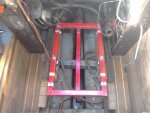
That is how the beds were raised in my GH for the last re-engine from Lister to Perkins -60*50mm iroko glued on top of the existing beds and capped with 50*50 steel angle threaded to take the mount bolts. Hard work to drill through the iroko sideways for the bolts holding the new beds inside them . the new beds can just be seen inside the old in this pic taken as a dummy run before I finished them and fixed them permanently. The framework is the jig with mounts and gearbox coupling flange for the Beta 30 IMG_20220805_110552.jpg
 
Top