Is it just me or are all modern boats completely horrible ?

The problem with a long keel boat is you can have lots of ballast but due to the relatively shallow draft the ballast is not low down so ballast ratio has less effect than a deep keel boat using a lead keel. A dont know of any modern fin keel boat that has internal ballast. The ballast is all in the cast iron keel and not much of it. The shallow bilges of most flat bottomed modern designs dont lend themselves to locating ballast
Agree. Except for the Ovni and Boreals with their unballasted centre boards. On the other hand, they have frightening AVS', to me that is.
 
Last edited:
The problem with a long keel boat is you can have lots of ballast but due to the relatively shallow draft the ballast is not low down so ballast ratio has less effect than a deep keel boat using a lead keel. A dont know of any modern fin keel boat that has internal ballast. The ballast is all in the cast iron keel and not much of it. The shallow bilges of most flat bottomed modern designs dont lend themselves to locating ballast

But, but but! Don't the cast iron keels come right up to the hull with the keel bolts located in the bilges?

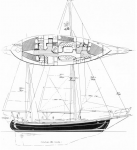
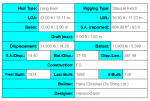
Long keel yachts don't necessarily have shallow draft. For example Hans Christian 42

Screenshot_2020-01-26 SailboatData com - HANS CHRISTIAN 43 Sailboat(2).png
Screenshot_2020-01-26 SailboatData com - HANS CHRISTIAN 43 Sailboat.png


Of course you could get the weight down lower using wings or bulbs but I don't think they have any place on a cruising yacht.
 
Last edited:
Of course you could get the weight down lower using wings or bulbs but I don't think they have any place on a cruising yacht.

Why not? .... many cast iron keels have a bulb on the bottom, mine certainly hasn't caused a problem - still attached after 20 years and still keeping my boat upright. ;)
 
Sorry to butt in ... I'll slip away after ...

I read some posts and I wonder if some actually ever look at any other type of 'keel' boat than their own ?

EG : There are plenty boats with long keel at similar LOA as a Fin keel - with similar draft. The long keeler of course then spreading its ballast in that long keel.

When you've sailed in rough waters with a spread ballast load in a long keeler - the 'smoother' pitching moment vs the concentrated fin keelers more sharp pendulum type pitch ... (flak jacket now on .....)
 
Why not? .... many cast iron keels have a bulb on the bottom, mine certainly hasn't caused a problem - still attached after 20 years and still keeping my boat upright. ;)

Yeah right! I suppose it depends on the shape of the bulb

The one at the top - no problems but the one at the bottom could cause problems.

I agree with the argument put forward in this article
Tips for Finding a Bluewater Cruiser

Screenshot_2020-01-26 bulb keel design - Google Search(1).png
 
Last edited:
I had a wander around English Harbour yesterday and walked past the Sunsail dock. There were three drop down bathing platforms in a heap that has presumably failed somehow. The boats at the dock all had bathing platform fitted so it looks like they had been replaced. Maybe not up to the abuse of charter market?
Probably the hinges - the platform itself is monstrously heavy and strained my 67 year old back to the limit - if it was mine I'd need some form of purchase.
 
Sorry to butt in ... I'll slip away after ...

I read some posts and I wonder if some actually ever look at any other type of 'keel' boat than their own ?

EG : There are plenty boats with long keel at similar LOA as a Fin keel - with similar draft. The long keeler of course then spreading its ballast in that long keel.

When you've sailed in rough waters with a spread ballast load in a long keeler - the 'smoother' pitching moment vs the concentrated fin keelers more sharp pendulum type pitch ... (flak jacket now on .....)
I dont see how spreading the keel weight towards the ends of the boat improves the motion. Common wisdom suggests keeping weight out of the ends of a hull. A boat will pitch around its centre of gravity. A long waterline will reduce the effect of pitching. I find pitching is the least uncomfortable motion in a boat. Rolling and yawing are less desirable
 
I dont see how spreading the keel weight towards the ends of the boat improves the motion. Common wisdom suggests keeping weight out of the ends of a hull. A boat will pitch around its centre of gravity. A long waterline will reduce the effect of pitching. I find pitching is the least uncomfortable motion in a boat. Rolling and yawing are less desirable
I know what you are saying but to single out the placement of the ballast without considering the shape of the hull would be a bit pointless? Maybe the designer allowed for the way he ballast was placed?
 
Reserve buoyancy is important to minimise pitching but seems to be disregarded in many modern designs with their straight stems; presumably concentrating the weight amidships makes it less necessary.
 
Reserve buoyancy is important to minimise pitching but seems to be disregarded in many modern designs with their straight stems; presumably concentrating the weight amidships makes it less necessary.
I think it has more to do with the realisation that flare isn't as necessary as it looks. The bow still has a lot of buoyancy available, and that which it has becomes ever more effective with increased immersion. If you want to reduce pitching it's a good move - dry ride not so much.
 
Reserve buoyancy is important to minimise pitching but seems to be disregarded in many modern designs with their straight stems; presumably concentrating the weight amidships makes it less necessary.


Reserve buoyance has no effect at all until called upon bu submerging that area ... look at fishing boats ... massive reserve bouyancy bows ... but they have no advantage until bow gets ploughed in.

As to spreading load ... we will agree to disagree ... I much prefer a less harsh pitching moment of a long keeler to a bulbed fin keeler ... but that's my opinion.
 
Probably the hinges - the platform itself is monstrously heavy and strained my 67 year old back to the limit - if it was mine I'd need some form of purchase.

More likely to be mooring damage to the platform. The hinges are massively constructed, and have big gas struts hidden inside the platform to assist with raising. Mine is quite easy to raise just by pulling on the wire retaining strop.
 
Reserve buoyance has no effect at all until called upon bu submerging that area ... look at fishing boats ... massive reserve bouyancy bows ... but they have no advantage until bow gets ploughed in.

As to spreading load ... we will agree to disagree ... I much prefer a less harsh pitching moment of a long keeler to a bulbed fin keeler ... but that's my opinion.
I dont see that long keelers have less pitching. Lots of traditional designed long keelers have very short waterlines and pitch terribly. It maybe your experience of a particular long keeler wasnt the norm. In my experience shallow draft boats roll more as well. The long keel tend to have lots of wetted area so can be slow unless combined with large sail area
 
More likely to be mooring damage to the platform. The hinges are massively constructed, and have big gas struts hidden inside the platform to assist with raising. Mine is quite easy to raise just by pulling on the wire retaining strop.
Out here its all about anchoring. Very few marinas so the norm is to anchor on charter or pick up a mooring. Doubt its due to collision with a wall but I could be wrong
 
Out here its all about anchoring. Very few marinas so the norm is to anchor on charter or pick up a mooring. Doubt its due to collision with a wall but I could be wrong

It's easy to unbolt the platform from the hinges, so I'd imagine the only reason the platform would be discarded is if it's damaged.
 
I dont see that long keelers have less pitching. Lots of traditional designed long keelers have very short waterlines and pitch terribly. It maybe your experience of a particular long keeler wasnt the norm. In my experience shallow draft boats roll more as well. The long keel tend to have lots of wetted area so can be slow unless combined with large sail area

Never said they have LESS pitching ... what I said is the pitch motion is different and in my opinion usually kinder.

Each to their own ...
 
I dont see that long keelers have less pitching. Lots of traditional designed long keelers have very short waterlines and pitch terribly. It maybe your experience of a particular long keeler wasnt the norm. In my experience shallow draft boats roll more as well. The long keel tend to have lots of wetted area so can be slow unless combined with large sail area

I don't have your experience so I can't comment.

I'd be very surprised if someone said the modern day fin keel boat handled better in survival conditions than the traditional long keeler. Would OP dispute this?

"Further plus factors are that they do not slam upwind, and typically enjoy more options in heavy weather survival situations. Storm tactics correctly trashed as suicidal by modern writers assuming light, fin-keeled yachts may still be safe options for traditional craft. A well designed long-keeled yacht can heave-to under short canvas in a gale of wind"

Tips for Finding a Bluewater Cruiser.

 
I don't have your experience so I can't comment.

I'd be very surprised if someone said the modern day fin keel boat handled better in survival conditions than the traditional long keeler. Would OP dispute this?

"Further plus factors are that they do not slam upwind, and typically enjoy more options in heavy weather survival situations. Storm tactics correctly trashed as suicidal by modern writers assuming light, fin-keeled yachts may still be safe options for traditional craft. A well designed long-keeled yacht can heave-to under short canvas in a gale of wind"

Tips for Finding a Bluewater Cruiser.
Yes! But first I'd like to see the writer's list of those 'suicidal tactics'. Fin keel boats can heave to but also give the option to run away fast.
 
Think its getting a bit silly and of the path ... keel types and preferences are really a personal matter and often dictated by use envisaged for the boat.

I've always had Bilge Keel boats - not because I prefer having two keels - but because I could have greater flexibility in where I moored, tied up and visited ... willing to give up some of the sailing qualities ...

For me an ideal boat would be a Moody Eclipse 43 with bilge keels ............. then I can enjoy spacious boat - but still be able to dry out without need for legs etc. !! (I know - I'm going to be riduculed for such a design now) ... but its all down to what you want to do with it.
 
Top