
Identifying a Radar Reflector

Stemar

Well-Known Member
Joined
12 Sep 2001
Messages
25,576
Location
Home - Southampton, Boat - Gosport
Visit site
Jazzcat's mast is down for all new rigging - standing and running (ouch!). When the mast was horizontal, the radar reflector started dripping - it was full of water! It's been suggested to me that the innards will be mush after soaking for who knows how many years, so I guess there's one more bill, which I didn't need, especially as the furler is knackered, which I also wasn't expecting.

It would make life easier if I can get the same one, but a Google hasn't come up with one. Can anyone help me identify it, please?
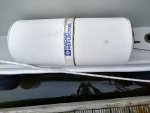
IMG_20210817_125445238_HDR.jpg

The mounting holes are about 63cm apart

Thanks
 
I think that I would drill a few holes around and let it self-drain if I wanted to put off spending money. I had a Blipper chat decayed and I’m sure the metal innards still functioned.
 
Me ... being the cheapskate ..... I would carefully cut round the case - avoiding cutting any internal items .... and open it up ... have a look-see inside.

Because you have accepted the possibility of replacing it - cutting open will not be a loss if you damage it in process.

I would put a $ down that inside is nothing like what you expect !!

If all good and not 'mush' - then I would glue / screw a strip around completely 360 inside one edge ... proud so other half of case can be re-joined ... with glue and screws. Of course adding decent drain holes to the case ..

But that's me ... ;)
 
I have nothing to envy you when it comes to the cheapskate stakes - Dad was pure-blood Yorkshire, going back several generations on both sides and Mum was of Jewish descent. I'm naturally, err, careful with money! :D

I think you're right. A slice off the bottom will tell me how much I need to spend, and I just happen to have the wherewithal to glue it back together if it's worth it!
 
Jazzcat's mast is down for all new rigging - standing and running (ouch!). When the mast was horizontal, the radar reflector started dripping - it was full of water! It's been suggested to me that the innards will be mush after soaking for who knows how many years, so I guess there's one more bill, which I didn't need, especially as the furler is knackered, which I also wasn't expecting.

It would make life easier if I can get the same one, but a Google hasn't come up with one. Can anyone help me identify it, please?

The mounting holes are about 63cm apart

Thanks
Looks like the type I had about ten years ago. I drilled a small hole in the endand poked an endoscope in and found the aluminium structure inside was still good and saw that the casing was GRP. The small hole I drilled became a drain hole.

Www.solocoastalsailing.co.uk
 
I haven't got an endoscope, but attacking the seam with a cement trowel and hammer has shown me the same thing. Ally plates in perfectly usable condition and some rather soggy foam. I'm going to clean it all up and glue the joint, which seems to be the only way water could have got in, with a variation on a theme of No More Nails.

The drain hole in the bottom will doubtless become a home to a million spiders, but I can live with that until they start landing on me while I'm putting a reef in!
 
I does seem if you just want to comply with regs then a passive one will do but if you want to be seen then you need an active one .
 
Jazzcat's mast is down for all new rigging - standing and running (ouch!). When the mast was horizontal, the radar reflector started dripping - it was full of water! It's been suggested to me that the innards will be mush after soaking for who knows how many years, so I guess there's one more bill, which I didn't need, especially as the furler is knackered, which I also wasn't expecting.

It would make life easier if I can get the same one, but a Google hasn't come up with one. Can anyone help me identify it, please?

View attachment 120854

The mounting holes are about 63cm apart

Thanks
how knackered can the furler be if you had not noticed?... i wrecked mine this year but managed to source a used drum and with a creative solution I am back in business for a few hundred euros...(more importantly i did not need to have my sails altered to suit new foil sections)...
 
It doesn't much matter - it is well-established that radar reflectors of that general type are of little use anyway! See https://assets.publishing.service.gov.uk/media/547c705540f0b6024400008d/Radar_reflectors_report.pdf

We were told that on the Yachtmaster theory course I did last November but when I fished out an old Yachting Monthly article from 2012 that I recalled I had read (and in which QinetiQ also had involvement) it concluded that they do have value - the Echomaster EM 230 coming out best of the non-active reflectors.

https://keyassets.timeincuk.net/ins...20/filebank/reflector_performance_ym_june.pdf

As has already been said, the active ones are better - though considerably more costly.
 
Last edited:
This isn't much to do with Stemar's situation, but it does seem ridiculous to me seeing modern 33'-45' AWB's, with all the trimmings & toys in them, 'proudly' sporting a '2 bob' reflector, when the best reflector in our world costs HALF the price of a Musto jacket, which he's bought for each of his family.
Form over function doesn't look so clever in fog.
 
I have always wondered about merits of active reflectors if already have ais,radar and a blippper device. If I had my mast down I might install but it really depends on where you sail and when maybe ? The active ones seem a lot but maybe I’m missing some hidden advantage . On our last boat I never inspected the blipped though for water damage but this one seems a different make/shape so maybe water ingress is not such an issue?
 
That doesn't seem to me to be what the Report concluded. :unsure:
It concluded that only the most expensive and heaviest passive reflector met the relevant standards, and that was marginal. The reflector in question (TriLens, I think) would be inappropriate for most leisure craft, being both heavy and bulky. Active reflectors (e.g. SeaMe) met the relevant standards.

There were also serious issues with passive reflectors at angles of heel typical of sailing craft.

I have experience of passive reflectors, and can also, from my own knowledge (I was involved in a specialized form of radar for many years), state that they are dependent on very precise orientation of the reflecting surfaces. The Qinetiq report used new reflectors in factory condition for testing, and only obliquely considered the effect of age on them. But you can be sure that the figures Qinetiq give are for a reflector that is in ideal condition, mounted in the ideal manner. A reflector that has been exposed to weather and the violent motion at a masthead will behave considerably worse.

I came to the conclusion that passive reflectors were only of use under ideal conditions long before the Qinetiq report came out; I have read it from end to end and it confirmed my previous estimation.
 
I came to the conclusion that passive reflectors were only of use under ideal conditions long before the Qinetiq report came out; I have read it from end to end and it confirmed my previous estimation.

Aye.
There's a huge degree of 'confirmation bias' around yotties' fanatical belief that rubbish 'raincatcher' devices provide any practical benefit in the detection/collision avoidance business.
The stark truth seems to be that "I want to believe against all science that this overpriced lump of junk will protect me from collisions in fog.... so I shall believe it. That makes me feel better about risking the lives of my family and crew in what has always been a hazardous practice - navigating in fog....
.... and no, I won't bother with the specific requirements in the ColRegs - that's for weenies!"
 
"Based on the results of this report it is recommended that yachtsmen always fit a radar reflector that offers the largest RCS practicable for their vessel.
The RCS of the radar reflector should have a minimum consistent RCS of 2m2.
The Sea-Me is the recommended product if power is available.
If power is not available then the passive Large Tri-Lens reflector is recommended
The 4” tube reflector is not considered suitable due to its poor performance. It is also recommended that the 2” tube reflector is not suitable since the performance of this target will be even lower.

It is recommended that poorly performing radar reflectors are not fitted as it is possible that the user could be lulled into a false sense of security believing that their chances of detection has been enhanced."
These are the bullet points from that report.
I'd reckon that given the majority of yachts now have ample reserves of power, given that an active reflector uses less power than 'A' cabin light, and then only desired at night or in fog, people are deluding themselves when fitting a passive, and the last point from the report is correct.
 
Aye.
There's a huge degree of 'confirmation bias' around yotties' fanatical belief that rubbish 'raincatcher' devices provide any practical benefit in the detection/collision avoidance business.
The stark truth seems to be that "I want to believe against all science that this overpriced lump of junk will protect me from collisions in fog.... so I shall believe it. That makes me feel better about risking the lives of my family and crew in what has always been a hazardous practice - navigating in fog....
.... and no, I won't bother with the specific requirements in the ColRegs - that's for weenies!"
Collisions between ships and yachts (whether in fog or not) are almost one in a generation events which might mean that either ships generally have no difficulty in "seeing" and avoiding yachts, or yachts manage to find ways of keeping clear of ships. If the former, and most yachts fit passive reflectors then they must work!
 
I haven't got an endoscope, but attacking the seam with a cement trowel and hammer has shown me the same thing. Ally plates in perfectly usable condition and some rather soggy foam. I'm going to clean it all up and glue the joint, which seems to be the only way water could have got in, with a variation on a theme of No More Nails.

The drain hole in the bottom will doubtless become a home to a million spiders, but I can live with that until they start landing on me while I'm putting a reef in!


You are very wise to keep out of the developing discussion on how best to spend your money ?

Your reflector seems in usable condition so the the question is: Do you think it is better than nothing?

If you do, unless you have special requirements, stick it back up.


.
 
Collisions between ships and yachts (whether in fog or not) are almost one in a generation events which might mean that either ships generally have no difficulty in "seeing" and avoiding yachts, or yachts manage to find ways of keeping clear of ships. If the former, and most yachts fit passive reflectors then they must work!
Not so; you are assuming that radar is a factor in all collisions, which is unlikely.

My own estimate is that in many cases, the reflection from mast, rigging and the "hole in the water" will provide a reflection of similar strength to that of a passive reflector; it will be less consistent, of course. A boat without a reflector will show on radar ALMOST as well as one with a passive reflector. An active reflector will certainly be more visible on radar; a passive reflector might be.

However, the vast majority of leisure sailing takes place in waters where radar is not the primary navigation tool, and where commercial vessels are constrained by draft to well defined and well-known shipping channels. As you say, collisions between ships and leisure craft are few and far between; but except in unusual situations, that is not because of visibility on radar, it's because of visual lookout, separation of traffic and knowledge of local shipping patterns. The benefit of being visible on radar would be away from ports in poor visibility. I'm not bothered whether I'm radar visible or not round my usual sailing ground - radar is not likely to be a factor, and I know (as do most people) where I need to take special care crossing the entrance to one of the busiest ports in the UK. The most recent collision in my sailing patch was because a commercial vessel under autopilot was making a passage outside the main shipping channel, and the yacht skipper (who was effectively single-handed) assumed the commercial vessel would move into the ship channel and went below for the critical period. Radar had no part in it at all; it was down to poor lookout on the commercial vessel's part and a misjudgement by the yacht. I don't know, but suspect that the Ouzo incident was the only recent (and it's not so recent) time where radar was a factor.

Where I'd be concerned to be radar visible would be on a passage across the North Sea (or similar) where a ship might rely on radar to a greater extent, where shipping routes are less well defined and where I or my crew might be less alert from fatigue. But yachting traffic on such routes is much lighter than in inshore regions such as the South and East coast, and so the number of incidents is low.

I did have one interesting experience that may indicate the utility of being clearly visible on radar. I was heading south from Whitby to Lowestoft, and was approaching the Amethyst oil platform during the night. They called me on VHF to warn that I was in danger of crossing their exclusion zone, and politely asked me to change course. The point being that they'd a) obviously been able to see me on radar and b) get a consistent return allowing my course to be plotted. Without the SeaMe, I think they'd have struggled to distinguish my reflection from surface clutter (there was a lively sea running) and certainly have struggled to obtain a reliable plot of my track. My lights would have been difficult to distinguish because of the motion; they'd be hidden by waves a lot of the time. Interestingly, they were not certain I was a yacht, so presumably my radar image was strong enough to make them uncertain of my size.
 
I'd reckon that given the majority of yachts now have ample reserves of power, given that an active reflector uses less power than 'A' cabin light, and then only desired at night or in fog, people are deluding themselves when fitting a passive, and the last point from the report is correct.

My yacht has sufficient power for an active radar 'reflector', but my wallet does not.

I don't doubt that the active ones are the the best, but for me the best is not practicable.

"Based on the results of this report it is recommended that yachtsmen always fit a radar reflector that offers the largest RCS practicable for their vessel.

I endeavour to follow that recommendation.

I am not, though, 'deluding' myself. I am aware of the limitations of what I can achieve.
 
Top