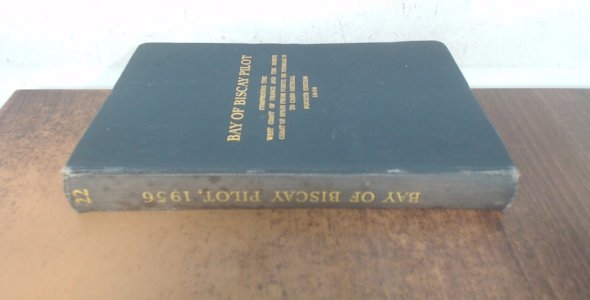
How old is too old for a Pilot Book?

I did buy pilot books for the french, belgian coasts & some for the scottish coasts when doing my round uk trips. But quite honestly they were of little use & now sit on a shelf at home. The east coast pilots are not really any good & I would not recommend them.. By far the most useful is the shell channel guide & I have 2 copies. over 24 years. Then of course the best & most up to date book ( for all its mistakes) is Reeds which I buy every year.
I have guides for the dutch canals which have been updated, along with the charts a couple of times
 
I like pilot books. There is so much information in them, generally, beyond just harbour entrances. Fascinating reading whilst on passage to somewhere new......for me. Weather, sea patterns, history, pictures, chart let's, the works. Particularly when Internet coverage is patchy....unless you got starlink or something.

For the type of book like Imray pilots that don't have yearly tide information I reckon they can last quite a few years. Things don't change too quickly. Particularly if there are ammendments available.

The pilot book we produced at Straits Sailing had tide tables for the year at several local ports and was a convenient A4 size for easy reference. Cheap enough for a one off passage through the Straits or for the year for local boats. Our rivals used it!

Diverging there a bit, so back to the main point. Lots of people, as argued on here, prefer electronic navigation. I like that too. Easy. But as a sailor I always reckon a paper back up is worthwhile. Suppose it also depends where you sail. And how you were taught.
 
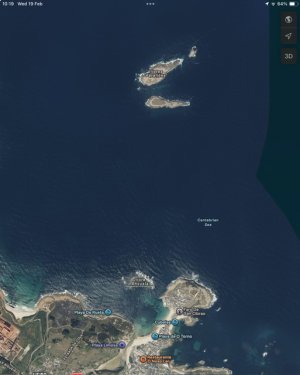
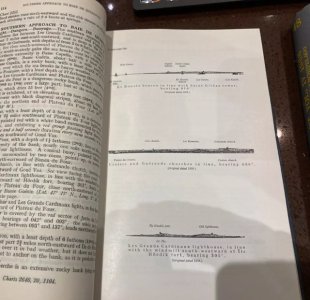
Years and years ago I used the admiralty pilot for Biscay to run off into a tiny Galician port and dodge a building autumn storm that was inexorably heading us..

Nowadays google earth shows the outlier rocks, shallow bits, breaking waves and everything! But at the time the photo-free,pithy narrative was enough. And jolly glad I was to have it.
Did the job and man were we happy to be tucked up here hanging on behind the break wall as the 8 veered to W and then NW, mid November. Daft duffers😊IMG_0642.jpegIMG_0641.jpeg
 

Attachments

  • IMG_0643.jpeg
    IMG_0643.jpeg
    110.5 KB · Views: 5
I did buy pilot books for the french, belgian coasts & some for the scottish coasts when doing my round uk trips. But quite honestly they were of little use & now sit on a shelf at home. ....
Possibly as you, quite uniquely, avoid anchoring.
The CCC Sailing Directions are essential to explore Scotland.

But as others have said, regarding age this varies by location. English East Coast has many more fast changing channels than more rocky coasts. But I still like an up to date pilot. Was glad had current charts and pilot books when had to make insurance claim for hitting drying rocks - which I could show were entireky missing from UKHO charts. If had been using old uncorrected charts to save £50 could have been more awkward.
 
Possibly as you, quite uniquely, avoid anchoring.
The CCC Sailing Directions are essential to explore Scotland.

But as others have said, regarding age this varies by location. English East Coast has many more fast changing channels than more rocky coasts. But I still like an up to date pilot. Was glad had current charts and pilot books when had to make insurance claim for hitting drying rocks - which I could show were entireky missing from UKHO charts. If had been using old uncorrected charts to save £50 could have been more awkward.
Yes I do avoid anchoring so port details are more important. But I still need to be able to get from A-B. Including across the Thames estuary
The OP was referring to pilot books
No pilot book is up to date. Your comment, line 3, about channel changes demonstrates this.
Shell Channel Pilot is useful. Perhaps because coast of the English channel is more stable than the UK SE coast
 
Last edited:
I have a wonderful tome ”ocean passages from the world”…….still has sound advice,o leaving the channel make as much westing as is possible!
I have that too.
And a month by month display of statistical weather, wind and waves for the North and S Atlantic, very very useful that one for a sense of the sailors seasons..
And now.. Possibly updated these days with the option: ‘Install large Diesel engine and tanks, await calm, and motor lickety spit across to the fleshpots of La Corunna whilst watching downloaded box sets!
 
I have that too.
And a month by month display of statistical weather, wind and waves for the North and S Atlantic, very very useful that one for a sense of the sailors seasons..
And now.. Possibly updated these days with the option: ‘Install large Diesel engine and tanks, await calm, and motor lickety spit across to the fleshpots of La Corunna whilst watching downloaded box sets!
😂………the only westingill be doing is by car 😏
 
I'm involved in editing the CCC sailing directions for Scottish waters.
It's true that "rocks don't move". But we do define their location better, and we keep discovering new rocks. Many totally uncharted until the advent of Antares Charts, and boat flown drones.
The last revision completed and printed, for the Outer Hebrides has 158 changes from the previous one. This series of books are reviewed at about 5 year intervals.
Some one said "no pilot book is up to date". That's true, but offers no alternative that is up to date. There's nothing as up to date as going there, and exploring. And surely that's what such publications are about - to facilitate going there and exploring.

It would help more to get input from those that find unlisted features, or errors in books that are published. But few do so.
 
Many totally uncharted until the advent of Antares Charts, and boat flown drones.
Which suggests they're nowhere near where people in boats are going, surely?
It would help more to get input from those that find unlisted features, or errors in books that are published. But few do so.
Yours may be different, but I've submitted errors to many publications over the years (Reeds, Imray, etc.) and all have been totally ignored, with the errors reprinted in edition after edition. In Reeds case, they've had the wrong phone number for Lulworth Ranges for at least a decade and have been told many times (twice by me!)
 
I'm involved in editing the CCC sailing directions for Scottish waters.
It's true that "rocks don't move". But we do define their location better, and we keep discovering new rocks. Many totally uncharted until the advent of Antares Charts, and boat flown drones.
The last revision completed and printed, for the Outer Hebrides has 158 changes from the previous one. This series of books are reviewed at about 5 year intervals.
Some one said "no pilot book is up to date". That's true, but offers no alternative that is up to date. There's nothing as up to date as going there, and exploring. And surely that's what such publications are about - to facilitate going there and exploring.

It would help more to get input from those that find unlisted features, or errors in books that are published. But few do so.
But if I remember rightly, the latest editions don't have all the anchorages that ancient copies like my father's do.
 
Then of course the best & most up to date book ( for all its mistakes) is Reeds which I buy every year.
I prefer the CA; firstly, I get monthly updates, secondly, the dimensions are, to me, better, and, thirdly, the tide data are on a separate book, which means I can calculate tidal curves without having to go between pages that don't want to stay open. 🙂
 
From a navigation perspective stuff that doesn't change much will probably still be okay in a 20 year old book
Stuff that changes a lot might be out of date in a brand new book.
I have a mix of some bought new and others used .
Things can and should always be checked online as part of passage planning for any particular journey.
 
Top