tillergirl
Well-Known Member
I 'did' the Little Sunk survey with Gladys in 2019. That was the time of the Sandwich Terns.
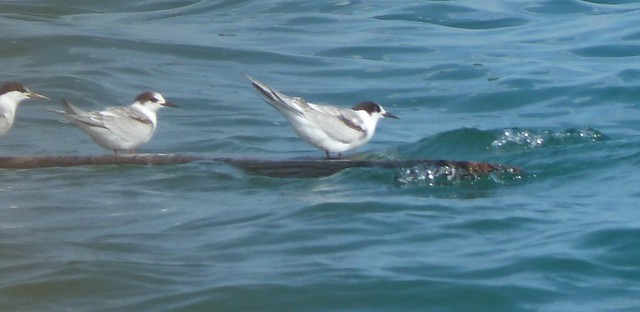 Terns by Roger Gaspar, on Flickr
I used Excel to create a profile of the Little Sunk, i.e. a slice across from the Barrow Deep to Black Deep from the NW to SE in a sort of straight line.
 Run 1 by Roger Gaspar, on Flickr
On the left, the edge of the Barrow Deep, one the right the Black Deep. The 'teeth' on the sands moving from right to left are (I think) sand waves. There is some more evidence of that available. But that isn't the question. What is that flat area left of centre. No wrecks marked on charts in that area.
I backtracked through the Excel data and I think that flat area is located where the black arrow points on the image below:
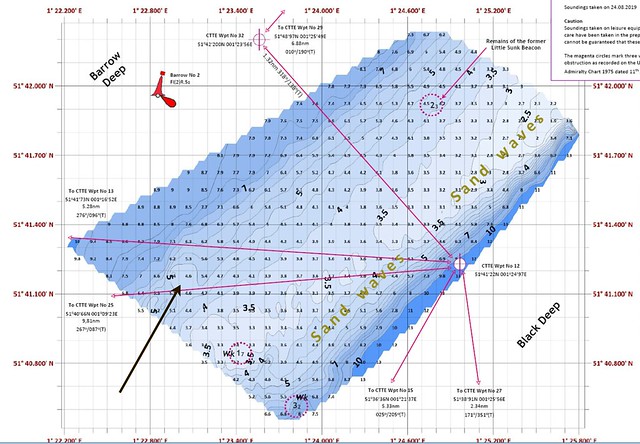 Drawing1 by Roger Gaspar, on Flickr
This is my chartlet of course so this is amateur stuff. There is no sign of anything on UKHO charts but in fairness the contour selection wouldn't bring it out. I can adjust the contours from our data so as I had used more contours I would suggest there is an obvious anomaly. Where the black arrow is pointed is approx. where the anomaly on the Excel trace is located. I will backtrack the data again in the morning but I think the centre of where I went over was 51.41.200N 001.23,003E. So there is a sort of...... well I'll call it a small plateau.
I would suggest it is manmade or
or  ?
?
I would make the opening wager by say that sort of round or rectangular area of 4.5m depth isn't right for a wreck: too large, wrong shape. or ?
So is it foundation? Nothing on the old stuff to suggest an old lighthouse, or a military thing like a Maunsell Fort. Or did they plan one but it didn't work.
What do you all think?
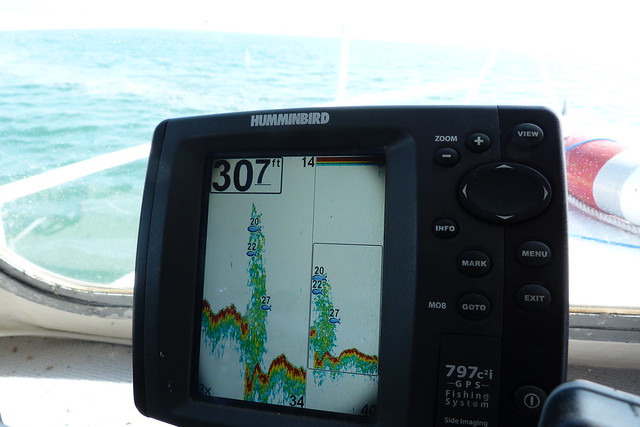
In the morning I can dig out the chart software manual (all 1463 pages!) and I can do a slice using that software but I don't think it will show much more. I can dig out the video of the Fishfinder trace of the bottom in the morning as well but I wasn't great of getting the best out of that kit at that time.
Terns by Roger Gaspar, on FlickrI used Excel to create a profile of the Little Sunk, i.e. a slice across from the Barrow Deep to Black Deep from the NW to SE in a sort of straight line.
Run 1 by Roger Gaspar, on FlickrOn the left, the edge of the Barrow Deep, one the right the Black Deep. The 'teeth' on the sands moving from right to left are (I think) sand waves. There is some more evidence of that available. But that isn't the question. What is that flat area left of centre. No wrecks marked on charts in that area.
I backtracked through the Excel data and I think that flat area is located where the black arrow points on the image below:
Drawing1 by Roger Gaspar, on FlickrThis is my chartlet of course so this is amateur stuff. There is no sign of anything on UKHO charts but in fairness the contour selection wouldn't bring it out. I can adjust the contours from our data so as I had used more contours I would suggest there is an obvious anomaly. Where the black arrow is pointed is approx. where the anomaly on the Excel trace is located. I will backtrack the data again in the morning but I think the centre of where I went over was 51.41.200N 001.23,003E. So there is a sort of...... well I'll call it a small plateau.
I would suggest it is manmade
or ?I would make the opening wager by say that sort of round or rectangular area of 4.5m depth isn't right for a wreck: too large, wrong shape.
or ?So is it foundation? Nothing on the old stuff to suggest an old lighthouse, or a military thing like a Maunsell Fort. Or did they plan one but it didn't work.
What do you all think?
In the morning I can dig out the chart software manual (all 1463 pages!) and I can do a slice using that software but I don't think it will show much more. I can dig out the video of the Fishfinder trace of the bottom in the morning as well but I wasn't great of getting the best out of that kit at that time.


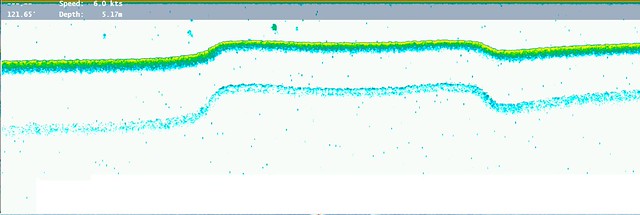 Image14
 . I am now trying to learn how to create a 'slice' through the sand with the charting software. It is gonna take a while


 P1070557