How about a maritime puzzle to lighten up the Forum? What is it?

Well yes! I reckon a 400 page thesis could be written about identifying marks in 1926 compared to 2020! The opening gambit could be based on the location of the two 1926 wrecks that the Sunk Sand has migrated north in the 90 odd years. Err, and it might! There is a survey that says in 12 years the 10 metre contours has moved 390 metres.
I spent a fair amount of time reconciling maps created using different datums and survey networks; a big problem in Antarctica! My favourite was reconciling surveys of Port Foster, Deception Island from the 1930s onward that were on different horizontal AND vertical datums!
 
This maybe a silly question but why is the estuary full of sand banks?
Were these areas of land in the past and as the Ice Age ended they flooded.

My understanding is that the estuary (and wider southern North Sea) is full of sandbanks because sediment has been eroded from (a) the coasts (e.g. the East Anglian coast has been wearing away for 10,000 years); (b) from the bottom of the sea (once 'Doggerland' was drowned by sea level rise and 'Britain' lost its connection to the continent); and (c) from inland, brought down by the various rivers, especially the River Rhine, over many thousands of years.

The total volumes of this sediment, which includes muds, sands, shingles, gravel, small boulders, etc., is absolutely staggering. The tidal flows, and to a lesser extent other currents and waves, keep shifting this sediment around the sea, both back and forth/round and round, but also from one place to another. The sandbanks are formed, variously, as plumes spreading from individual eroding cliffs and headland areas (e.g. the Naze); along raised areas of bedrock (e.g. once ranges of hills, etc.); and between stronger currents. Obviously (?) there is a complex and dynamic interaction between the currents and the banks.

I've previously posted a link to this fascinating (at least to me) summary of what's known about the transport of marine sediments around the East Coast - 'Southern North Sea Sediment Transport Study, Appendix 10: A geological background to sediment sources, pathways and sinks' .
The bit about the Thames Estuary (Orford Ness to North Foreland) starts on page 13 of this appendix.
http://www.sns2.org/Output files/EX4526-Appendix 10_ver2.pdf

Further publications from the same Study can be found here:
HR Wallingford - SNS2 - Project Outputs
 
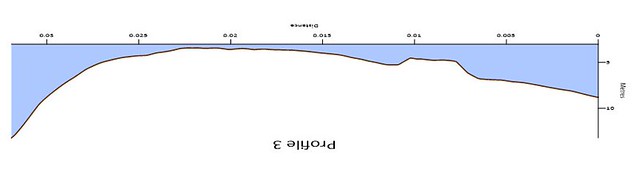
Very interesting. It will take quite a while to digest it all and I will enjoy it. Is the anomaly outcrop of bedrock or just sand? This is the profile created by the charting software: I haven't finished the 'edges' but the profile is finished.

Image17 by Roger Gaspar, on Flickr
 
Is the 'hump' necessarily an isolated feature? I notice that the shape of the bank between the two deeps is fairly regular, except along a line across it comprising your 'hump' and others around the two nearby indicated wrecks. The shallows there are, I think, wider than the wrecks themselves. I wonder whether that is perhaps a result of disrupted current flows around the wrecks leading to more deposition (i.e. shallower depth), or maybe even a linear vestigial projecting feature that snared those wrecks and extends to 'Gaspar's Hump'.

On the subject of bedrock and sediment, one thing I found interesting was to read some time ago (probably in the Report I linked above, but perhaps elsewhere) that the course of an earlier river (part of 'Thames' or 'Blackwater' predecessor?) is clearly detectable by seismic survey under the sea, where it scoured its channel into the bedrock, but not by boat echo sounders because the channel has subsequently been entirely filled by sediment along most of its path. I seem to recall that there is a short 'exposed' part of that channel, unfilled by sediment. I have a feeling that exposed section was somewhere in the vicinity of Cork Sand. (It's a few years since I read it, and my memory's not what it was. I must read up about it again.)
 
I tend to think that there are no wrecks close by as the image in #32 suggests. The wreck data suggests the wrecks are elsewhere; the 1926 wrecks have eroded away or their positions don't match modern lat/long standards or that my cross showing the position of the 'Hump' does not stand up: either the whole sand has moved significantly (which is possible) or just trying to use todays lat/long on a 1926 chart is rather optimistic. Or a combination of everything.

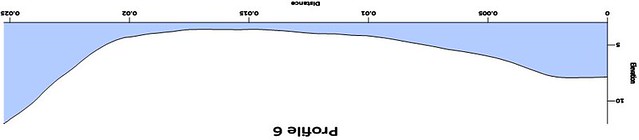
But I think that if the hump is natural it has to be 'provoked' by something. If we look at the profile once clear of the 'hump', the profile is like this all the way for a mile and half.

Image19 by Roger Gaspar, on Flickr

I go back to the SW Sunk swatch: what causes that to open and close (or just move). The Report amply illustrates the extraordinary and dramatic changes that have occured in the Estuary, albeit according to the Geology clock.
 
Is the 'hump' necessarily an isolated feature? I notice that the shape of the bank between the two deeps is fairly regular, except along a line across it comprising your 'hump' and others around the two nearby indicated wrecks. The shallows there are, I think, wider than the wrecks themselves. I wonder whether that is perhaps a result of disrupted current flows around the wrecks leading to more deposition (i.e. shallower depth), or maybe even a linear vestigial projecting feature that snared those wrecks and extends to 'Gaspar's Hump'.

On the subject of bedrock and sediment, one thing I found interesting was to read some time ago (probably in the Report I linked above, but perhaps elsewhere) that the course of an earlier river (part of 'Thames' or 'Blackwater' predecessor?) is clearly detectable by seismic survey under the sea, where it scoured its channel into the bedrock, but not by boat echo sounders because the channel has subsequently been entirely filled by sediment along most of its path. I seem to recall that there is a short 'exposed' part of that channel, unfilled by sediment. I have a feeling that exposed section was somewhere in the vicinity of Cork Sand. (It's a few years since I read it, and my memory's not what it was. I must read up about it again.)
The study you linked to (which is indeed fascinating to me as well!) mentions the buried river beds of the Orwell and Stour also. I suspect the sand and sediment depositions hide a lot of “bedrock” features some of which create turbulent flow to create anomalous humps and pits. I will read the Wallingford hydraulic report later.
 
No, and I'm afraid I don't know him. I worked at British Antarctic Survey
OK. He was Base Leader at BAS Halley 63-71 so way before your time in hindsight. A great sailor, he and his wife circumnavigated (almost) in his Halmatic 30. We met him on our travels and he and his wife Rosie became good friends and we buddy cruised quite a few times in the Pacific. He passed away last year.

You might find this of interest.
AD6-24-1-208 - British Antarctic Survey Club

Sorry for the thread drift.
 
OK. He was Base Leader at BAS Halley 63-71 so way before your time in hindsight. A great sailor, he and his wife circumnavigated (almost) in his Halmatic 30. We met him on our travels and he and his wife Rosie became good friends and we buddy cruised quite a few times in the Pacific. He passed away last year.

You might find this of interest.
AD6-24-1-208 - British Antarctic Survey Club

Sorry for the thread drift.
As you say, well before my time - I joined in 1988 (I was at Scott Polar from1979-1988), but as I didn't graduate until 1974, he was well before my time!
 
In the 1st century AD roman general Plautius reported to Emperor Claudius that the Britons had given him the slip by crossing the Thames on foot from East Tilbury to Cliffe near Higham It is said that finds Indicate frequent trading between Essex and Kent here in the Bronze age.
They also say that as well as sea level rise, the land here has been sinking since then.
I think your anomaly looks like an iron age hill fort.
 
Ah well 'tillergirl' what info did your 'Lead Line' give you, did you arm it with Tallow ?

Might mention a true tale; back in the 50s a couple of fellas from The Ferry Deben went missing enroute in the North Sea, their bodies were discovered later dressed in underwear etc, deduction at the time was that they had run hard aground on an underwater obstruction, turned in to await the tide turning, but the craft adopted a severe list on drying out so slid stern first and sank beneath the waves.

Always remembered that tale, even some many many years ago, so could they have hit a similar underwater object, poss not charted, an object hard enough to present a near vertical slope to the surrounding sea bed thus enabling the Craft to rise near vertically before sliding back down underwater, thus drowning the two fellas in their bunks ?

Will most probably never know
 
Ah. I confess my lead line - yes I have one, honest but it is not a proper one as it doesn't have a thingy in the bottom to charge it with Tallow. Just as well, you can guarantee I will be covered in Tallow in a trice.

Well quite about the steep edge. The Mi Amigo slide off the Long Sand and remains there on the side of the Black Deep right now. Fortunately is stayed on the edge of the Sand long enojugh for the Radio Caroline crew to get off. But I am reminded by the Black and White film 'the Key' in the final dramatic scenes the hero (the Captain of the wartime tug) is the last to abandon ship and he jumps into the water with his duffle coat on and no LJ. Eventually with the crew he is saved still wearing the duffle coat! I suspect the scene should really seen him just in his shreddies. But in fairness, B and W film had modesty.

Incidentally the Admiralty opinion is that it is sand and possible could be the start of a new knoll.
 
I remember it well, 23.58 on 19th March 1980, listening to the last words of Radio Caroline from Tom Anderson and Stevie Gordon, after which they abandoned Mi Amigo, and left the tape running, which IIRC ceased mid tune an hour or so later. The Caroline Roadshows of the late 70s were a thing of wonder, far more exciting than dull old Guisnes Court. Not exactly The Boat That Rocked, but an interesting film about the sinking is at
 
One aspect of the Thames that one also needs to consider is the effect of shipping and propwash on the swatchways and gats. As ships have gotten larger and deeper they have stopped using the various shallower gats .. There are also fewer ships stiring up the seabed.

Some gats have closed and others have deepened partially as a result. IIRC the South Edinburgh was buoyed back in the late 80’s?
Today the bouyage has moved to the Fishermans (sorry that should be Fisherpeoples). Meanwhile the Barrow Swatchway has almost completely filled up. I went through that back in 2006 with a 2m draft Benny.
 
It is usually difficult to agree with you Toma :eek: but the point is certainly valid, certainly as a general point. And as a general point I think we need to consider dredging. I recall (correctly I hope) that when the Princes Channel was dredged the disposal of spoil included some around the North Edinburgh Channel. One wonders the extent of the impact of traffic. In our lifetimes, most shipping had avoided the South Edinburgh and favoured the North Edinburgh. Then a 'bar' at the south end of the North Edinburgh contributed to laying buoyage in Fisherman's Gat (I don't speak 'BBC'). But with the controlling depth on Fisherman's only being 8.summat metres, Princes Channel needed some attention. And the one after the other buoyage went from the South Edinburgh first, then the North later.

The latest dredging was the Deep Water Channel in the Black Deep and I think it is clear that the PLA are constantly checking on the depth of the SW channel (but haven't dredged again). I regret I don't recall where the spoil from that went.

There is a nice quote (well I like it) from W.G. Arnott 'Suffolk Estuary:

“We are so apt to think, if we think at all, that our English countryside is natural and unspoilt and that our rivers, particularly the East Coast ones, have always run in the same course as they do now. But actually most of our countryside is man-made and it was only until the last few hundred years that the rivers [were] contained within their present walls”

He is referring to the Orwell and Deben in particular but it is surely applicable to the Estuary?

I received an email from the Port Hydrography Officer of the Port of London Authority and he favours it as an outcrop of bedrock. But it is outside of the PLA area and so he has no definitive data other than to confirm the depth in that spot is 4.summat metres.
 
There is a nice quote (well I like it) from W.G. Arnott 'Suffolk Estuary:

“We are so apt to think, if we think at all, that our English countryside is natural and unspoilt and that our rivers, particularly the East Coast ones, have always run in the same course as they do now. But actually most of our countryside is man-made and it was only until the last few hundred years that the rivers [were] contained within their present walls”
Very true of much of the north Kent coast too - it's obvious that many of the creeks we know today were simply deeper gullies through saltmarsh, and only became defined as land reclamation proceeded and sea walls were built.
 
Top