How about a maritime puzzle to lighten up the Forum? What is it?

Could be any of the suggestions. On the basis of the information available I quite like the idea of a foundation for an AA site that never got finished. But didn't the Maunsel Forts just (!) dig piles into the seabed.

Did any of the Mulberry Port sections get built/moved in the Estuary? I guess there might have been some practising sinking a caisson?

I think the Maunsel Forts were floated out on a concrete base/barge and then sunk, but even their bases weren't as big as 200+m. Perhaps the same case for the Mulberry theory. 200ft perhaps. Mind you, it could always be a trial base which didn't turn up in the final design.

Interesting.
 
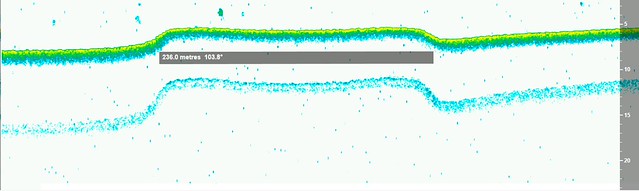
As regards the dimension, I am pretty certain as to the height of the edge beccause I had two systems collecting data at the time. As to the width, I have no idea how the measuring tool in the Reef Master software works or how accurate it is. But looking at the chart the length is certainly as long as 0.1 of a minute of latitude - which as we all know is 185 metres. So it certainly would be at least 185m across and up to the 236 metre quoted on the software.

Here is the 'measuring tool in action:

Image15 by Roger Gaspar, on Flickr

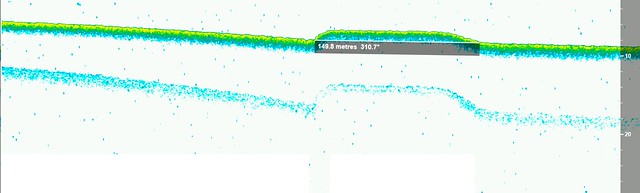
And then I have trundled through 3 or so hours of unexciting bottom watching. The first run was as we approach the Little Sunk from the west. The following is taken from the last run as we come off the Little Sunk. This run was about 280 metres west of the first one. Note that the two runs are not exactly parallel. But I would suggest it is still there as well.

Image16 by Roger Gaspar, on Flickr

Remember that we were going back so we were heading to the right towards the Barrow Deep. That is a little disorientating but I would argue it is there, extending quite far to the west. I think I fancy having a day out next season! And I shall try and see if the UKHO are happy to see if there are any old records.
 
This maybe a silly question but why is the estuary full of sand banks?
Were these areas of land in the past and as the Ice Age ended they flooded. I know the action of the tides/current would scour out channels through the area over thousands of years so we end up with what we have today. I wonder if is the raised remains of a settlement?
 
This maybe a silly question but why is the estuary full of sand banks?
Were these areas of land in the past and as the Ice Age ended they flooded. I know the action of the tides/current would scour out channels through the area over thousands of years so we end up with what we have today. I wonder if is the raised remains of a settlement?
Not entirely silly, the Goodwins were once inhabited as was Doggerland.
 
The Thames is estuary is only the shape it is because the Dover Straits allow the tide to flow through. Were the Dover straits closed, the Thames would form a classic delta of marshes and channels.
 
I need to refer to a book I have that explains the Channel. Broad brush stuff now: As the Ice Age retreats (are we still retreating from an Ice Age or have we just started the beginning of the next Ice Age), melt water accumulates in what is the bottom of the North Sea. The Rhine and other European rivers add more water and eventually the chalk dam twixt Gris Nez and the Foreland collapses and the Channel is formed. I have read somewhere that it has been claimed that the Thames was a tributary of the Rhine and the Channel was part of the Rhine. Until of course Doggerland got drowned and we became an Island and we could claim the Channel. But frankly a lot of the south-east is getting washed away - evidence of the Suffolk Estuary and the Norfolk coast abounds. But as Habety said there have been some hard stuff.

Quite a lot of changes have happened in the Estuary in the last 2000 years which is but is a twinkling of time. 500 years ago, Harwich, Felixstowe was dramatically different. 150 years ago channels in the Long Sand were dramatically different. I hope the Wind Farms peeps did their research. The Maplin Lighthouse was built on piers into the sand. In time, the sand moved and it fell over.

AP can tell us more aboutthe geology et al.
 
If it were a wreck it would show multiple jagged and uneven protrusions, surely?
Wouldn't a wreck show quite a different signature to the sand surrounding it?
If it were a wreck it would be known and charted.
It is far - far too big to be a wreck in any case, unless it's the upturned hull of a supertanker, or rather three or four of them side by side. But no wreck of that size could be unknown. 240m square, nigh on 800ft! It cannot possibly be a wreck, there is nothing remotely that large 'lost' in the Thames estuary. Anti-aircraft batterys were only a fraction of that size, and would in any case be recorded.

In a sea of sand what is the most likely material for it to be made of, especially if it looks identical to sand? Penny to a pinch of sand it's just...er... sand.

As to how it was formed, well, that's quite another thing. But waterflow would seem the most likely culprit...

As to it's being mudstone or part of the Walton banks, anyone with drilling/piling dredging experience in the Estuary able to say how deep the solid stuff generally is below the sand? Might be instructive to know? Are there known outcrops out in the estuary?
 
Last edited:
The Geology link of Habebty is interesting. I don't favour the outcrop the argument on the grounds that the anomaly is at 4.6m CD. I just think that there would have been some evidence of an outcrop over the past 120 years of charts.

If it's just sand I am questioning how there is a quite distinct relatively steep edge. A regular shape might just be pure chance? If it is just sand, could it be suggesting a knoll is forming. Pondering how the current SW Sunk swatch formed is interesting. This year it was perfect weather to survey except that I regret I couldn't have Larry with me because of the virus rules. That meant I couldn't take photos (to busy) and thus I missed pictures of a very interesting tide rip around the SW knoll.

The flood tide was through the swatch from east to west. Half way through the swatch there is a natural venturi in the shape of the swatch bottom and there was evidence from the increase of speed over ground that the tide ran through at that point quite hard. And then at the western entrance of the swatch, the tide met the flood tide down the Barrow Deep. There was minimal wind so there was ample evidence (if only I could take a photo) that the tide exiting the swatch was squeezed against the steep edge of the knoll which at the time was covered - hence the steep edge. I think that shows good news; the tide will maintain that swatch for some while. But how did the swatch open in the first place and how in the past the swatch has come and gone over the years? 15/20 years ago the swatch wasn't there and had at least a metre drying at CD. It would be the tide that forms it (+ weather?). Could this anomaly be forming a new knoll but why would the tide pick there. Certainly in 1908 we would not have had a LIttle Sunk crossing point as (arguably based upon 1908 lat/long accuracy) an extensive drying knoll extended from where the anomaly is found to opposite the No 3 Black Deep.

I have sent an email to the UKHO to ask if they could say whether there is anything in the database.
 
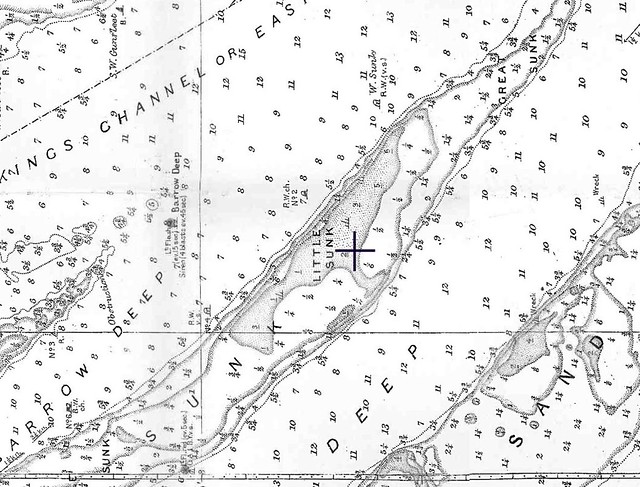
Here is the anomaly marked on a 1926 chart

1926 anomaly position by Roger Gaspar, on Flickr

I note Foulger's Gat had opened out in 1926 but not that the Little Sunk is a substantial knoll. We must appreciate that Lat/Long was not a precision thing in those days. So the cross cannot be regarded as definitive.

Not sure it helps. :) . Wonder if my boat is ashore today. I can do something then.
 
I need to refer to a book I have that explains the Channel. Broad brush stuff now: As the Ice Age retreats (are we still retreating from an Ice Age or have we just started the beginning of the next Ice Age), melt water accumulates in what is the bottom of the North Sea. The Rhine and other European rivers add more water and eventually the chalk dam twixt Gris Nez and the Foreland collapses and the Channel is formed. I have read somewhere that it has been claimed that the Thames was a tributary of the Rhine and the Channel was part of the Rhine. Until of course Doggerland got drowned and we became an Island and we could claim the Channel. But frankly a lot of the south-east is getting washed away - evidence of the Suffolk Estuary and the Norfolk coast abounds. But as Habety said there have been some hard stuff.

Quite a lot of changes have happened in the Estuary in the last 2000 years which is but is a twinkling of time. 500 years ago, Harwich, Felixstowe was dramatically different. 150 years ago channels in the Long Sand were dramatically different. I hope the Wind Farms peeps did their research. The Maplin Lighthouse was built on piers into the sand. In time, the sand moved and it fell over.

AP can tell us more aboutthe geology et al.
Re the river Thames and river Rhine; i know its a TV programme, but the Open University were involved in its production; in that the prog on our East Coast refers to the Thames joining up with the Rhine and the Thames entering what we now know as the North Sea through what we now know as East Anglia, but something drastic happened to our islands Geology and the Thames was diverted southwards into roughly into the route that we know now
 
Any kind of outcrop is not likely because the anomaly is ABOVE the general level of the sandbank. If it was an outcrop, it would a) be a permanent feature at at least that height and b) it would be smaller as time went on. Something like this that appears to have no previous history and which is well above the level of the sand really can't be an outcrop. You can get features like that, but it would imply a previous continuous feature at the same level as the observed feature. Things like the tilt of the strata would make a difference, but tectonic effects in this area are small. There is no significant near-surface faulting, either, which would be another possible geological explanation.

In general, you won't find "solid" geology offshore in the Thames Estuary and the East Coast. The whole area is mainly depositional - that is, sediment from various sources (mainly places like the coast of Lincolnshire and Yorkshire and the eroding parts of the Norfolk coast) is being moved by currents and dropped in just the wrong place for us sailors who would prefer deep water!
 
Here is the anomaly marked on a 1926 chart

1926 anomaly position by Roger Gaspar, on Flickr

I note Foulger's Gat had opened out in 1926 but not that the Little Sunk is a substantial knoll. We must appreciate that Lat/Long was not a precision thing in those days. So the cross cannot be regarded as definitive.

Not sure it helps. :) . Wonder if my boat is ashore today. I can do something then.
I note that there's a wreck shown less than a cable from your cross. Given that a) the chart wouldn't be on the WGS84 datum and b) that as you say, absolute position fixing wasn't the exact science it is today, could that be the nucleus of the feature you're seeing? A difference in absolute position of less than 200m could easily result from the two things I mention.
 
In the geology of the cliffs along Sheppey and Reculver, and at the Naze for instance, amongst the soft stuff there are large plates of a harder sandstone material called 'Dogger', hence Dogger Bank presumably.
I would guess that what you are seeing, Roger, is such an area.
 
Well yes! I reckon a 400 page thesis could be written about identifying marks in 1926 compared to 2020! The opening gambit could be based on the location of the two 1926 wrecks that the Sunk Sand has migrated north in the 90 odd years. Err, and it might! There is a survey that says in 12 years the 10 metre contours has moved 390 metres.

I had sent in an email and the preliminary comment is that it is probably natural. There is a survey that is available on line: Thames Estuary - Kings Channel - Area TE7

The purpose of the survey is to assess whether the area selected needs a regular full 12 survey. The Area is focussed on the Kings Channel but it just includes soundings and not wrecks. There is a comparison of 1994, 2000 and 2012 surveys. It has isolated a number of precise comparison locations - two on the Sunk Sand and are:

1. 2.4m in 1994, 7.6m in 2000, 2.7 in 2012
2. 0.4m in 1994, 0m in 2000, 5.5m in 2012

Gosh. And I claimed the Little Sunk is a stable area. Those spots are not relevant to the discussion about the anomaly but I think the survey is relevant showing the extent of change that can occur. Incidentally there is an interesting illustration (Page 10 &11) which perhaps shows that rivers were created under the Ice Cap!

There might be some further comment from the UKHO and PLA.

Dick: the comment from the UKHO suggests not viz: "theoretically, if there was a ‘hard’ feature there then it would be more pronounced but nothing is shown. So we can only assume it is a recent feature and given its size I would assume it is not man made as we would all have heard about it".
 
Top