Hot Water Tank

We have solar water heating for our swimming and in the summer, we get nice warm swimming. friend of mine fitted some black PVC piping to his wheelhouse roof to circulate through his clarifier to hear his water when engine is not running.

I have a LPG instant water heater and well as engine and mains power water heating
Careful Roger - many on here will tell you they are the work of the devil, will poison you with CO, will blow up or blow your boat up.

I, however, have used EXACTLY the same thing on several boats, without any issue at all.
 
Careful Roger - many on here will tell you they are the work of the devil, will poison you with CO, will blow up or blow your boat up.

I, however, have used EXACTLY the same thing on several boats, without any issue at all.
We had one on our GK29, installed for more than 10 years with no problems. On having it surveyed the guy nearly had a fit and we were told it had to be disconnected immediately due to its intrinsically unsafe condition.
I cannot see why it is any different from a kettle on the stove although far more convenient.
 
Rotex and Vyv I know about those scare mongers but it's like everything that uses any form of energy can be dangerous if not installed correctly and maintains correctly. Petrol Engines (outboards) can be a danger it not maintained, and the petrol is stored correctly. I never use LPG when sleeping and have lots of ventilation as it never cold where I sail so little of CO poisoning.

Having spent many years in Engineering Design, Installation, Fabrication and maintenance I consider that I am a competent person in most things mechanical and electrical Engineering.

Having mains electricity and a boat emersed in a conductive medium could also be considered dangerous but installed correctly considering the potential dangers but installed correctly by knowledgeable and competent people will be file but you will have different who scare mongers have different motives to try to scare the unexpended to use their services.

Thee point we all have different knowledge and experience and just need to know who is who like I would not challenge Vyv on metallurgy or you Rotex and motorcycle racing and maintenance.

I too am of a similar vintage as you Rotex
 
What do people intend to do with all the plumbing coming off (and back into) their existing engine ?

Mine has been blanked and valved ...

dApSjBpl.jpg
 
Most of the trouble caused by gas water heaters was a result of poor maintenance, allowing the pilot light to burn yellow. This produced enough CO overnight to kill in a small boat. That said, I had a few of these over the years and loved them! If I didn't ave a working calorifier I'd fit one again, but would aim to get one with battery ignition and without a permanently lit pilot light.
 
Most of the trouble caused by gas water heaters was a result of poor maintenance, allowing the pilot light to burn yellow. This produced enough CO overnight to kill in a small boat. That said, I had a few of these over the years and loved them! If I didn't ave a working calorifier I'd fit one again, but would aim to get one with battery ignition and without a permanently lit pilot light.

My gas water heater does not have a permanent pilot light, the pilot lights lit with a battery igniter the starts the pilot light when the water starts to flow. This then starts the main flame that heats the water and when the water flow stops all the gas is turned off automatically
 
Most of the trouble caused by gas water heaters was a result of poor maintenance, allowing the pilot light to burn yellow. This produced enough CO overnight to kill in a small boat. That said, I had a few of these over the years and loved them! If I didn't ave a working calorifier I'd fit one again, but would aim to get one with battery ignition and without a permanently lit pilot light.
I found myself sorting large numbers of gas heaters in the Algarve. Pre electric ignition. People were a bit dim about how much air flow they needed and, in one case, stuffed up the air intake area 'as the pilot light kept blowing out' This was after they were banned from being in kitchens and bathrooms..... Before that
I knew plenty of people who had lost family members to CO poisoning. Most common problem was lack of decent airflow as 'it made the room cold'...
The Sunday Times ran several pieces about the dangers of the rented houses in the Algarve, but didn't mention the then current problem of student bedsits with gas fires in UK.
 
We have solar water heating for our swimming and in the summer, we get nice warm swimming. friend of mine fitted some black PVC piping to his wheelhouse roof to circulate through his clarifier to hear his water when engine is not running.

I have a LPG instant water heater and well as engine and mains power water heating
We have used two 6m x 0.5m solar panels to heat our 75cubic meter swimming pool since 2007, with them we could get the pool up to 35c+ most years, and when we had a 25cu m pool it could get to over 40c with those two panels. This is the first year we have not used them we bought a heat pump which does an excellent job of heating the pool with the excess electricity we generate during the summer.

We have a gas on demand water heater (geyser) on the boat and we won't/don't use it as we do not trust the installation, I'm now looking at 230V 800W immersion heater tanks as we have an 2kW inverter and not much drawing electricity off of it.

There is no flue on top of the water heater and about a 30cm gap between the top of the heater and the extraction duct/fan above it, I have shut off the gas to the heater as I do not want it used, when the weather warms up a bit I will be removing it and installing electrical heater, I don't see me routing the the engine cooling through a calofier.
 
Last edited:
We have used two 6m x 0.5m solar panels to heat our 75cubic meter swimming pool since 2007, with them we could get the pool up to 35c+ most years, and when we had a 25cu m pool it could get to over 40c with those two panels. This is the first year we have not used them we bought a heat pump which does an excellent job of heating the pool with the excess electricity we generate during the summer.

We have a gas on demand water heater (geyser) on the boat and we won't/don't use it as we do not trust the installation, I'm now looking at 230V 800W immersion heater tanks as we have an 2kW inverter and not much drawing electricity off of it.

There is no flue on top of the water heater and about a 30cm gap between the top of the heater and the extraction duct/fan above it, I have shut off the gas to the heater as I do not want it used, when the weather warms up a bit I will be removing it and installing electrical heater, I don't see me routing the the engine cooling through a calorifier.
It’s definitely worth configuring the calorifier for engine heating! I have a 120 litre calorifier with twin coils. One heated by the port engine and one heated by the wet 9kw diesel heater. An hour of cruising or the diesel heater being on and we have loads of hot water for showers etc which will last for the day. The diesel heater is set up to always heat the calorifier, with a 24v two port valve which enables flow to the space heating (5 x heater blower units). My engines are the same as yours.
 
It’s definitely worth configuring the calorifier for engine heating! I have a 120 litre calorifier with twin coils. One heated by the port engine and one heated by the wet 9kw diesel heater. An hour of cruising or the diesel heater being on and we have loads of hot water for showers etc which will last for the day. The diesel heater is set up to always heat the calorifier, with a 24v two port valve which enables flow to the space heating (5 x heater blower units). My engines are the same as yours.
Perkins HT6.354M engines? ✔️
Son and I were just discussing how we could do it on the boat earlier today, looking for a place to break into the cooling circuit. He works for a mechanical/electrical company that makes pipework and machinery for various industries from medical through food and to waste products so should be no problem for him.
This was just as a side conversation as we need a bit of welding done on the radar arch and that lead to discussions about the engines. His comment was that the welding on the radar arch hinges is sub par and that's why one broke.

Edit: just going back over your build thread again... :)
 
Last edited:
Perkins HT6.354M engines? ✔️
Son and I were just discussing how we could do it on the boat earlier today, looking for a place to break into the cooling circuit. He works for a mechanical/electrical company that makes pipework and machinery for various industries from medical through food and to waste products so should be no problem for him.
This was just as a side conversation as we need a bit of welding done on the radar arch and that lead to discussions about the engines. His comment was that the welding on the radar arch hinges is sub par and that's why one broke.

Edit: just going back over your build thread again... :)
Remember, it’s going to make the engine run cooler. This may sound like a good idea...but there are some who argue that marinized engines already run cooler than the manufacturer originally envisaged
 
Remember, it’s going to make the engine run cooler. This may sound like a good idea...but there are some who argue that marinized engines already run cooler than the manufacturer originally envisaged
Yes, that had crossed my mind too, the engines run cool enough as it is without extra cooling, when spring comes round again I was going to see what the temperature of the raw water is coming off the manifold and into the exhaust, it was one of the places that would be easy to break into the cooling circuit.
 
Remember, it’s going to make the engine run cooler. This may sound like a good idea...but there are some who argue that marinized engines already run cooler than the manufacturer originally envisaged
Yes, that had crossed my mind too, the engines run cool enough as it is without extra cooling, when spring comes round again I was going to see what the temperature of the raw water is coming off the manifold and into the exhaust, it was one of the places that would be easy to break into the cooling circuit.
Doesn't make any sense, the engine thermostat will keep the engine temperature at whatever it's supposed to be.
 
Remember, it’s going to make the engine run cooler. This may sound like a good idea...but there are some who argue that marinized engines already run cooler than the manufacturer originally envisaged

That would /could be true for raw water-cooled engines that do not have a thermostat, but indirect cooled engines hove a thermostat that will control the temperature cooling water in the freshwater circuit
 
Perkins HT6.354M engines? ✔️
Son and I were just discussing how we could do it on the boat earlier today, looking for a place to break into the cooling circuit. He works for a mechanical/electrical company that makes pipework and machinery for various industries from medical through food and to waste products so should be no problem for him.
This was just as a side conversation as we need a bit of welding done on the radar arch and that lead to discussions about the engines. His comment was that the welding on the radar arch hinges is sub par and that's why one broke.

Edit: just going back over your build thread again... :)
Yes, I have HT6.354s although both of mine are normal rotation and I reverse the rotation through the gearbox (PRM500) on I think the starboard unit.
The raw water temp as it exits the exhaust manifold on its way to the injection elbow is still much too cool for heating the calorifier.
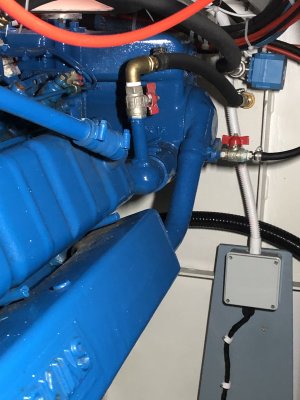
You need to tap into the closed cooling circuit on the engine. There is a 1/2”BSP plug in the cylinder head near to the temp sensor which can be removed and used as a connection point for the flow to the calorifier coil. I tapped into the outlet elbow from the heat exchanger for the return connection. The original elbow was alloy and I replaced this with a steel one which I could weld a connection onto. The photo below shows the flow and return lines as they leave the engine and go through a bulkhead to the calorifier and a two port valve which I fitted to prevent a thermosyphon existing between the calorifier and engine when the calorifier is hot and the engine is cold. I felt that at these times I was losing heat into the mass of the engine. The valve is powered to open, spring closed. Open when the engine is running, closed when not.
I can get a better photo of the connection on the cylinder head when I’m at the boat tomorrow.

I’m just at this time about to amend this arrangement as I want to include the exhaust manifold cooling as part of the closed circuit rather than having raw sea water running through them.

IMG_6723.jpeg
 
Yes, that had crossed my mind too, the engines run cool enough as it is without extra cooling, when spring comes round again I was going to see what the temperature of the raw water is coming off the manifold and into the exhaust, it was one of the places that would be easy to break into the cooling circuit.

Remember, it’s going to make the engine run cooler. This may sound like a good idea...but there are some who argue that marinized engines already run cooler than the manufacturer originally envisaged
In reality, when starting from cold, it does take the port engine an additional 20mins to get up to normal running temp over the starboard unit. But at our displacement speed, we’re cruising at 1000RPM so the engines are not working very hard at all.
 
In reality, when starting from cold, it does take the port engine an additional 20mins to get up to normal running temp over the starboard unit. But at our displacement speed, we’re cruising at 1000RPM so the engines are not working very hard at all.
Thanks for the above pictures, we will have a look in to that next time we are back at the boat, but as the wife says, hot water is way down on the list of must haves onboard :)

The starboard engine on Hunter is of opposite rotation, they both take a fair while to get up to temp and as you say running at 1000/1100rpm as what we do they are at the lower end of the temperature range, 1000rpm gives us around 12km/h which is a good speed along the canals here, any faster and the wake reaching the bank is too high.

On the Maas we were doing about 1500rpm giving a speed over the ground against the flow of the river of just over 15km/h, for the branch canal we are on, having both engines ticking over in gear gives us a bit over 8km/h which is breaking the speed limit. At those speeds the engines don't use a lot of fuel at all.
 
Top