
Have you given up on a through-hull paddle log?

I replaced the paddle wheel on my boat last winter and it all worked fine when testing on a trailer with a leaf blower.

When we put it in the water it read, for about a quarter of a mile, then stopped. On occasion I've chucked my son over the side to clean it and it works, but again, for a pitiful distance of easily under a mile!

We've solely relied on SOG on the chart plotter (which of course is different) - has anyone got any suggestions or also just relying on GPS speed?

Yes I have given up with the paddlewheel. As I have a Raymarine ST60 display I fitted the NASA EML-3 transducer unit. This version has an interface that outputs pulses so it can be used with the displays of older type units (not just Raymarine) that require a pulsed input. The NASA interface box connects to the electromagnetic transducer and I connected the existing Raymarine transducer wiring from the display to the interface under the chart table.

I think it is a fantastic piece of kit, where previously the paddle wheel would be fouled up after two weeks on the mooring, the NASA EML has now gone two seasons without ever stopping working.

I am sure that the EML-2 is just as good for those who require a NMEA-0183 output.
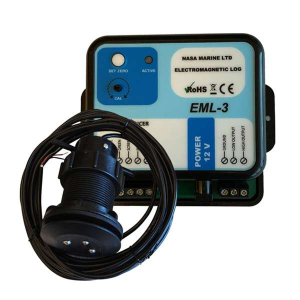
1760119788167.png

Nasa Electgro Magnetic Log & Data Box (EML3-PULSE)
 
May I ask (I gave up with my paddle log and simply used SOG and other data) why trailed logs became out of favour?

Bicycle magnetic computers for £5 can be adapted and calibrated to become trailing logs (3D printer needed in my case).

Or perhaps people do use such things?

It is a PBO thing for me, but post 21 at only £150 seems reasonable for people that do not wish to fliff and flaff as I have done.
 
I also fitted the Nasa electromagnetic log - just bought the log unit and box of electronics, came as a kit & didn't have to replace the display. About 4 yrs ago. Seems to work most of the time, sometimes no reading... Can read the tide speed if on our mooring. Much better than the paddle wheel which regularly needed cleaning.
 
Finally given up on paddle wheel logs. Before gps , they were the only game in town though and things have now moved on. A towed log might be fun though. Used time and distance when anchored sometimes.

I have purchased the NASA electronic log and will fit when the chance comes. Probably more for interest though.
 
Last edited:
I replaced the paddle wheel on my boat last winter and it all worked fine when testing on a trailer with a leaf blower.

When we put it in the water it read, for about a quarter of a mile, then stopped. On occasion I've chucked my son over the side to clean it and it works, but again, for a pitiful distance of easily under a mile!

We've solely relied on SOG on the chart plotter (which of course is different) - has anyone got any suggestions or also just relying on GPS speed?
Agreed. A total waste of space. I had them on two boats; I pulled them and put the plugs in for good.

Yes, I know SOG is not speed through water, and I don't care. I can correct if I want. But my sailing is just not dependent on instruments. Anywhere near enough to shore to be affected by tide you will be able to see that your course through the water is significantly different from you bearing and will figure out that the difference is tide, no GPS required. Offshore the difference between track and course will be obvious and the trig is not that hard to do in your head. That's how it was done back in the day, although I doubt they thought of it as trig. They thought of it as seamanship.

If I raced I might care. Maybe. But I couldn't ever fully trust the paddle wheel data.
 
Yes I gave up on paddle wheel log 30 years ago. Tried leaving paddle out until I went sailing. Worked out ok but just too tedious to refit before each sail. So GPS or just gut feeling. ol'will
 
I found the new log interesting to check against sog. I am not a gadget man and sailed many years log-less but sometimes I find tide against me when I thought it would be with me.
 
I gave up with mine about 10 years ago. Just use the SOG from the plotter now, which works fine.
Well, that doesn't work fine for true wind, or for knowing whether you're sailing as you should.

Speed through the water is the hardest thing to measure, of those things you need to know for sailing. Racers spend a lot of time and money getting this right.

The best approach is to pull out the speed log transducer when you're not using the boat, and put in the blanking plug. Keep it clean. Calibrate it.

The standard Airmar ones (often stencil branded with Raymarine, Garmin, etc.) are pretty poor. A cheap and excellent substitute is the Garmin GST43 which is NOT an Airmar one, and which has much larger vanes than the Airmar ones. Downside is the housing is a different size from the standard 2" Airmar so you can't just pop it into your old housing.

Otherwise you can go with an ultrasonic one, which is less sensitive to fouling. I used an Airmar CS4500 for years and it was pretty good; they are no longer made.

I'm experimenting this year with an NKE ultrasonic speed log, but I'm drilling an extra hole in the hull for a GST43 so I'll have two.

It's a fair amount of work and expense but once you have well-calibrated speed through water then you can know exactly how well you're sailing, and you can have accurate true wind.

With accurate true wind, you can figure laylines and know when you can and cannot tack. This is critical for racing and optional for cruising, but in my opinion sailing well makes cruising much more fun.
 
Last edited:
Yes I have given up with the paddlewheel. As I have a Raymarine ST60 display I fitted the NASA EML-3 transducer unit. This version has an interface that outputs pulses so it can be used with the displays of older type units (not just Raymarine) that require a pulsed input. The NASA interface box connects to the electromagnetic transducer and I connected the existing Raymarine transducer wiring from the display to the interface under the chart table.

I think it is a fantastic piece of kit, where previously the paddle wheel would be fouled up after two weeks on the mooring, the NASA EML has now gone two seasons without ever stopping working.

I am sure that the EML-2 is just as good for those who require a NMEA-0183 output.Nasa Electgro Magnetic Log & Data Box (EML3-PULSE)

My log hasn’t worked in ages and reading the posts on this thread, I think I might be guilty of a pressure washer incident….

The EML-2 looks like a great solution, I’m not sure how I would wire it into my TackTick system though. Anyone done this?
 
My log hasn’t worked in ages and reading the posts on this thread, I think I might be guilty of a pressure washer incident….

The EML-2 looks like a great solution, I’m not sure how I would wire it into my TackTick system though. Anyone done this?

Many people have done the - see how fast they can get it to go - then ended up with nothing !!

You can in fact replace the magnets ... with the rare earth magnets available online - all you need do is buy correct size and you can glue them in yourself .. but the paddlewheels themselves are cheap enough .. just press out the axle pin .. change weheel .. press pin back in ...

No need to change whole unit.
 
The eml can be bought as a nmea or pulse output. It always works but as the hull gets growth the reading on the log drops. You can run a scrubbing brush under the hull to clean it which you can't do with a paddle wheel. The eml even measure water speed sideways ie when your on a pontoon.
 
I replaced the paddle wheel on my boat last winter and it all worked fine when testing on a trailer with a leaf blower.

When we put it in the water it read, for about a quarter of a mile, then stopped. On occasion I've chucked my son over the side to clean it and it works, but again, for a pitiful distance of easily under a mile!

We've solely relied on SOG on the chart plotter (which of course is different) - has anyone got any suggestions or also just relying on GPS speed?
I gave up my paddle wheel log decades ago. I still have a trailed log, just in case, but never use it.
 
Yes, I got fed up with trying to keep it clean and not trusting it when it did occasionally give a reading. Removed it and filled the hole some years ago.
It now lives in a box in the garage marked "Stuff that doesn't work but is too expensive to chuck"
 
I was recently given an Airmar paddlewheel unit and was thinking about fitting it. But maybe I won't bother...
The only thing I miss about not having one is that my wind instrument can no longer display TWS.
Is there any way I can get it to calculate this using GPS SOG instead? Which would surely be more accurate anyway?
(It's Raymarine by the way, if that matters).
 
My paddle wheel works fine for the first two months but thereafter needs cleaning every few days. I have an old Stowe trail log for those times - very accurate and has a lovely analogue speed meter!
 
Liability to fouling seems to vary by manufacturer. The Navico paddle that we had from the '80s was always getting fouled, mostly by stringy little bits of weed, but the Raymarine one we have on our current boat doesn't get blocked so easily by weed, presumably because of the side panels, though it will foul gradually as the season progresses. I generally start the season with it as clean as possible and smear silicon grease over as much as possible. When we were always on the move, especially if visiting the Baltic, it would work 100% for three months or more, but when only used occasionally maybe around six weeks before cleaning was needed. Generally, it is easier to retract it when not in use. If nothing else, this make it less likely that you will forget to withdraw it during a boat lift and end up with major damage.
 
So one school says the data is invaluable. Another school says they foul all the time. So let's say, for the sake of discussion, that the data may be off by 5-10% if a bit of algae or fishing line lodges somewhere. I've worked with MANY industrial flow meters.

Data that is off by 5-10%, when what I am correcting for (tide) is only on the order of 10%, is basically useless. I don't KNOW it is right, I just hope it is, and I can probably guess the tide with similar accuracy.

The only racing that ever interested me was strict one design. Too many games and too much or an arms race in any rating-based system. I recall one regatta where we had to swap boats based on a drawing between races. I liked that. You had 15 minutes to tune it to your weather expectations.
 
We have given up on the paddlewheel log. Not because the paddlewheel has given up but because the display has died. The display must be a really simple device that just counts pulses per second and scales them by a scale factor and displays a number. But because it is made by a Marine company it is sold at marine prices that has no connection to the cost or complexity of the electronics involved.

The chart plotter (Open CPN on a large tablet for same reasons) displays SOG but the reading jumps around a lot and has defied any attempt to find a setting to smooth it out.

So for £10 I have bought a "boat speedometer" that is an LCD display, it's own GPS receiver and it will display speed in Knots, course and distance travelled. It will work independent of the plotter and has a larger easier to see display.

I won't know until next season if it gives a nice steady reading or not (just craned out today)

In true PBO fashion I might bring the paddlewheel home over the winter, try and figure out the wiring what pulses it outputs, and think about a DIY display for it.
 
Top