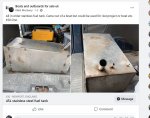
Fuel tank leak

We are awaiting the new tank...I have no more information at present...I’m hoping it will arrive very soon..we were quoted 10 days for its fabrication...but is that ten business days? (there was a very long weekend break that’s just finished)...we just wait for that telephone call
Nice to see the French celebrating the jubilee, ps we arrive tomorrow in Nice at 2pm
 
Better a replacement tank than a hydraulic locked block…
Its not a binary either or choice. I do not see the connection ? Are you saying better leave water sitting at the bottom of your tank ?

Diesel fuel water dispersant tech has been around a few decades.It’s widely used in industry and agriculture.

By dispersant its not mixing H20 its reacting it into anther substance that dissolves ( normally but not exclusively alcohol) that goes through the pump and injector tips normally uneventfully .

Theres zero neat H2 O which is how it protects .

Any neat H2O as I said gets split into Hydrogen and oxygen .It the then burning H that’s melts the tips .

Its actually if you think about it NOT using generic water a dispersant that increases the chances of your hypothetical “hydrolock “.
Certainly risks Bouba tank issue thats a given the watery sludge is corrosive even to SS never mind aluminium- Bouba*

Assuming water accumulates at the base ( it heavier than diesel so sinks ) remember the pick up pipe should be a few inches above the tank floor .So if this is breached as the sludge level risers then fortunately it should clogg the filters and normally stops the motor .
There certainly shouldn’t be a run of neat hydrolocking water getting in sufficient volume to bend a rod or send it flying through the crank case .
That kinda hydrolock is from busted charge air coolers or run back from poor design exhaust systems. Whereby nest water enters the open cylinder and fills it , or part fills it sufficiently on a induction stroke .

Water in fuel alarms theses days are common , I have them on a 2002 engined none CR boat .Every CR boat from circa 2005 ? Will have some sort of dash WIF / auto cut out electrotwackery.

I can’t see any down sides to regularly using water dispersants with long term diesel fuel storage in a boat .

This does not include your car left at an airport for 2 weeks .Talking fill up boat Sept and it’s still got same fuel in by May .

You can still use biocides as well if you wish .
 
Do you know if the corrosion started outside the tank or inside the tank?

I wonder if due to the way the tank just seems to sit directly on the hull , could the tank end up sitting in a pool of water corroding away from the outside
?

If so,you probably need to address that otherwise you'll have the same issue again in a few years.

Probably need to go on some bearers like portofino keeps mentioning.

The issue of external crevice corrosion is a valid point with both SS and alloy tanks. Many tanks were designed to sit on a rubberised compound which accelerated the crevice corrosion, but it seems HDPE plastic blocks may be the answer.
 
The issue of external crevice corrosion is a valid point with both SS and alloy tanks. Many tanks were designed to sit on a rubberised compound which accelerated the crevice corrosion, but it seems HDPE plastic blocks may be the answer.

It might be possible to extend the plastic until it covers the entire base and then upwards over the sides and around the top. It wouldn't matter if the metal tank leaked eventually. In fact you could probably dissolve the metal with acid to simply leave the plastic in place without a useless inner metal lining.

There might be a simpler way of arriving at this final stage.:D:D
 
Top