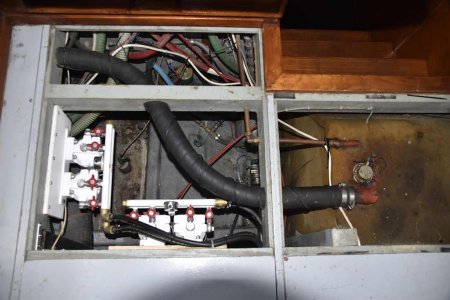
Fuel filter/water separator choice

There was another thread on this recently - honestly a winter job for every boat should be to ditch the CAV/Delphi (296 type) filter and fit a Racor 500 style where there is room. Since the patent expired a complete filter assembly can be had for £30/40 (or less in some cases), if in doubt rebuild with genuine Racor seals and filter, and away you go.
The first time you change the filter or drain the bowl will be a revalation if you have been used to the 296 type. So much easier and cleaner and this comes into it's own if there is any type of movement - or when you have to do it on a harbour approach at night!
As mentioned above, the ultimate solution for peace of mind is the change-over type, you can easily make one yourself if the price of a genuine one puts you off. That said, i've not found much need for a change-over Racor 500 on a small yacht engine - the flow rates are so low compared to what the filter can handle that if it blocks up that quickly and the problem is not a lack of maintenance then the fuel contamination is so significant that the second filter will become overwhelmed quickly too. Personally I chose to mount my filter in a very accessible place and I carry spares - I can pop in a new filter in a few minutes if needed.
 
I wholeheartedly agree with the general sentiment around Racor-clones. On our old cav type, replacement meant bleeding the engine, a task that used to take about an hour all in and meant lying atop an engine…

This winter I fitted a racor-clone with a priming bulb in the cockpit locker. Looks like I will be able to change out a blocked filter in minutes now. First impressions are very favorable
 
I wholeheartedly agree with the general sentiment around Racor-clones. On our old cav type, replacement meant bleeding the engine, a task that used to take about an hour all in and meant lying atop an engine…

This winter I fitted a racor-clone with a priming bulb in the cockpit locker. Looks like I will be able to change out a blocked filter in minutes now. First impressions are very favorable
You can get CAV housings with a priming bulb built in. But a Racor with a bulb would be even better!
 
I will only add that the Raycor/Parker type are universal in the US. They work.

Also, for those who do not know (off topic a little--not the OP's issue):
  • Clear bowls are not permitted below decks for gasoline.The filter housing must be metal.
  • Separators don't work with ethanol gas (the membrane can't reject the 80% ethanol separated phase, and the difference in specific gravity between gasoline and the separate 80% ethanol phase is too small). You just need to keep the gas dry (filler cap o-ring).
 
I will only add that the Raycor/Parker type are universal in the US. They work.

Also, for those who do not know (off topic a little--not the OP's issue):
  • Clear bowls are not permitted below decks for gasoline.The filter housing must be metal
Funnily enough I was reading another thread about fuel pipes which discussed use of non-metal pipes in relation to fire. I would have thought that a plastic filter housing would be a similar risk. Maybe the cheap Racor clones use a less fire-resistant material?

On a similar line I’m not that keen on a bulb type priming device. I was thinking of one of these - CAV Spares, Hand Primer Pump (M14, Inlet Side) - in preference, I don’t see why it can’t be plumbed in alongside a Racor style filter/separator.

My intended installation is in the same compartment as the tank, accessible from the rear quarter-berth, wherein also sits a Fischer Panda gen set (rarely if ever used - it came with the boat and has had very little running). It will be very easy to view and access.

The Racor FG500 style copies linked to earlier in the quote 30 microns but I guess a genuine 10 micron FG500 filter could be fitted.
 
Funnily enough I was reading another thread about fuel pipes which discussed use of non-metal pipes in relation to fire. I would have thought that a plastic filter housing would be a similar risk. Maybe the cheap Racor clones use a less fire-resistant material?

On a similar line I’m not that keen on a bulb type priming device. I was thinking of one of these - CAV Spares, Hand Primer Pump (M14, Inlet Side) - in preference, I don’t see why it can’t be plumbed in alongside a Racor style filter/separator.
I can definitely see the point but, since my fuel tanks are GRP, and in the engine bays, I don't think a bulb primer will make a lot of difference. If I can't get an engine fire out PDQ, we'll be heading for the dinghy a bit smartish.
 
On a similar line I’m not that keen on a bulb type priming device. I was thinking of one of these - CAV Spares, Hand Primer Pump (M14, Inlet Side) - in preference, I don’t see why it can’t be plumbed in alongside a Racor style filter/separator.
I'm not 100% but I am pretty sure that the hand pump you identify fits onto the side of a normal CAV head, I don't believe you can use it as a standalone without the head unit (happy to be corrected).
 
I'm not 100% but I am pretty sure that the hand pump you identify fits onto the side of a normal CAV head, I don't believe you can use it as a standalone without the head unit (happy to be corrected).
I’ve emailed ASAP to ask. It has 14x1.5mm ports, the same as the filter, so am thinking that it could be mounted separately and plumbed in. Maybe there just isn’t a way of mounting it separately.
 
The Racor FG500 style copies linked to earlier in the quote 30 microns but I guess a genuine 10 micron FG500 filter could be fitted.
Correct, any Racor 500 element (or pattern) will fit. My engine does not have an on-engine secondary filter, so I have two Racor 500 clones, one with a 30 micron as a pre-filter, and the other with a 2 micron element. They are identical filter housings.
 
ASAP have responded thus:

1. A primer pump isn't required for an FG500 - presumably because it has a check valve and you can manually pour diesel in the top to fill it although I don't fancy decanting some fuel from the tank and pouring it into the filter if I have to change it when under way.

2. The CAV primer pump I quoted above could be used to prime the filter, with approprate fittings/adaptors.
 
ASAP have responded thus:

1. A primer pump isn't required for an FG500 - presumably because it has a check valve and you can manually pour diesel in the top to fill it although I don't fancy decanting some fuel from the tank and pouring it into the filter if I have to change it when under way.

2. The CAV primer pump I quoted above could be used to prime the filter, with approprate fittings/adaptors.
You should always completely fill the Racor FG500 housing with diesel before replacing the lid otherwise, because the ports are not at the top and the exit hole in the central riser is not at the top, there will remain an air pocket in the top of the filter housing. This will not stop the engine running but the top half of the filter element will have no diesel passing through it so you will only be using half the surface area of the filter, although ok to get you out of trouble until you can fill it.
 
Last edited:
I once managed to put mine together wrongly and the resulting air leak led to engine failure on final approach to a pontoon. Could have been much worse.

A kind friend gave me some CAV296 filters they had lying around. The metal rim was slightly rusty, and to get a good seal I tightened the centre bolt a little more than might normally be necessary.

I ran the engine for ten minutes, and there were no leaks. Delighted, I poured 20l of diesel into the nearly empty tank and went shopping.

Imagine my delight when we returned to the boat to find ALL our diesel in the bilge. The glass bowl had cracked while we were away!

I still have the CAV, but without the glass bowl. In the forseeable future it will be replaced with a Chinese Racor copy.

- W
 
The question about priming & filling isn’t necessarily straightforward as it will depend on where the pump is being located. If a “traditional” on engine primer is used, the filters are always under vacuum so filling the FG500 is recommended.
If the pump is before the filter, it will usually have sufficient flow to purge air so filling won’t usually be needed. Having changed as many of these as I’ve had hot lunches, I don’t subscribe to the theory that they trap air in the top unless the filter is mounted significantly higher than the fuel tank.

If changing a 296 type filter for one of these, a cheap and easy addition would be to fit an electric diesel pump inline before the filter. A bit of wiring and a momentary switch gives you a built in priming pump. I did exactly this for our boat so I have means to purge the filter if needed. The pumps don’t restrict the flow when off so they don’t need to run constantly. This is the setup I went for.


1. A primer pump isn't required for an FG500 - presumably because it has a check valve and you can manually pour diesel in the top to fill it although I don't fancy decanting some fuel from the tank and pouring it into the filter if I have to change it when under way.

…..
For that reason, as well as to assist during servicing, we keep a small metal can with fresh diesel (plus a nee filter and disposable gloves) beside the Racor. Something like this https://www.amazon.co.uk/VGEBY1-Alu...1744151423&sprefix=fuel+bottle,aps,146&sr=8-9
 
A kind friend gave me some CAV296 filters they had lying around. The metal rim was slightly rusty, and to get a good seal I tightened the centre bolt a little more than might normally be necessary.

I ran the engine for ten minutes, and there were no leaks. Delighted, I poured 20l of diesel into the nearly empty tank and went shopping.

Imagine my delight when we returned to the boat to find ALL our diesel in the bilge. The glass bowl had cracked while we were away!

I still have the CAV, but without the glass bowl. In the forseeable future it will be replaced with a Chinese Racor copy.

- W
Yes I think I remember that...
I brought a bunch of 296 filters with me to the new boat, because at first glance our primary filter looked the same. Imagine my delight when I discovered that they were not, in fact, compatible. I was at the time completely becalmed in the lee of Guadeloupe, with a 90m superyacht thundering towards me from astern, and did I mention my stern light wasn't working? All part of the fun.
 
If changing a 296 type filter for one of these, a cheap and easy addition would be to fit an electric diesel pump inline before the filter. A bit of wiring and a momentary switch gives you a built in priming pump. I did exactly this for our boat so I have means to purge the filter if needed. The pumps don’t restrict the flow when off so they don’t need to run constantly. This is the setup I went for.

A bulb type hand pump is cheaper and can't go wrong!

— W
 
A bulb type hand pump is cheaper and can't go wrong!

— W
I think that is opinion, not fact. Cheaper maybe, but only by a fiver, and i've seen plenty of those leak air or go hard and stop working. I'd say it's a tie at best, and as it's only a priming pump - caveat emptor & freedom of choice.
 
Top