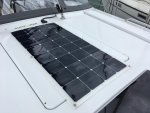
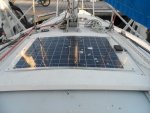
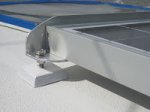
Fixing flexible solar panel to the coachroof

Polysulphide. That will retain them in position and avoid the mistake of using Sikaflex. Sikaflex is an adhesive and if you need to replace the panel it can only be removed by mechanical means. Removing the polysulphide would not damage the boat.

This is on my other boat:
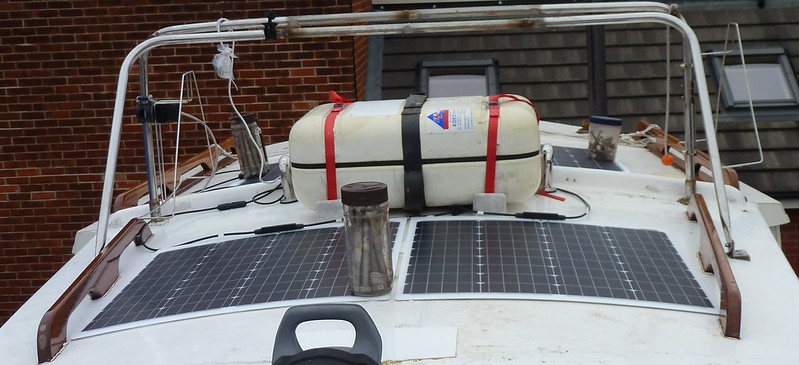
solar panels ext by Roger Gaspar, on Flickr

The weigh is to help the panel to the curve until the first stage of the cure. Note the second large panel at the back also retain the curve for the panel. You don't need screws etc. For Tiller Girl I have used Velcro which has work fine.
 
We had flexible panels on our coachroof. They lasted about 2 years due to corrosion. I will never go flexi again. Useless compared to framed panels with regard to power output and durability

Might I suggest you spend a little more money?

Sunbeam System flexible panels have a bigger output than most rigid panels of the same size, can be walked on and have a 5 year warranty.
http://www.sunbeamsystem.com/en/marine/

- W
 
I used 3M VHB (very high bonding) double sided tape to fix 2 flexible panels on. No problems so far, but I'm not sure what removal would involve. Probably a thin, sharp blade between the panel and coachroof to cut the tape, then clean up with a solvent.
 
We had flexible panels on our coachroof. They lasted about 2 years due to corrosion. I will never go flexi again. Useless compared to framed panels with regard to power output and durability
100% agree. Not the panel that fails, but the connector box.
 
We had flexible panels on our coachroof. They lasted about 2 years due to corrosion. I will never go flexi again. Useless compared to framed panels with regard to power output and durability

That's a bit of a nonsense. There is absolutely no difference in output from a semi flexible panel vs a rigid one.

If you do buy a semi flexible panel, get one with ETFE coating rather than PET. The latter are more likely to delaminate and haze over time. PET also offers less physical protection for the cells too.
 
Have used Sikaflex on a previous boat and was able to remove the panel with reasonable ease when it died, without damaging the hatch garage underneath. So have used Sikaflex on the new panel :-)

Like you I didn't want to use screws (in a cored deck)
 

Attachments

  • Solar panel 2.jpg
    Solar panel 2.jpg
    486.9 KB · Views: 7
3M Dual Lock works great and peals off cleanly. However, it is about 1/8" thick, so if you step on the panel near the Dual Lock you could crack a panel. It is best if the support is 100% uniform and you don't walk on them. You see, the cells are they same as those on rigid panels, but without the glass, so they cannot stand any flexing. Even vigorous polishing can ruin them; it's happened.

I've bolted them down. I've also used Dual Lock and just avoided walking on them. Worked fine. I've also used rigid panels; they are my first choice, where they work, since they last longer.

1.%u00252Bthe%u00252Bcompanion%u00252Bway%u00252Bcover%u00252Bis%u00252Ba%u00252Blow%u00252Btraf.jpg
http://sail-delmarva.blogspot.com/2017/10/super-simple-solar.html

Last time I fitted rigid panels I used glue on studs which allowed for compound curvature. No holes!
solar+panel+foot+low+wres.jpg
 
Last edited:
I used small countersunk stainless screws at each corner and halfway along each side. GRP is thick so the screws don't go all the way through. Seems ok so far but only been fitted for a year.
 
That's a bit of a nonsense. There is absolutely no difference in output from a semi flexible panel vs a rigid one.

If you do buy a semi flexible panel, get one with ETFE coating rather than PET. The latter are more likely to delaminate and haze over time. PET also offers less physical protection for the cells too.

What we find in the Caribbean is that the flexible solar panels suffer from overheating as they are close fitted to the deck. The deck and panel gets hot. This reduces the output considerably. This doesnt happen to the same extent on framed panels due to air flow over the rear of the panel.
Flexi panels suffer from UV deterioration as you say. Front fixed terminals are more vulnerable to failure from salt water. This is what happened to mine. Sailing in the Caribbean you get lots of salt water flying about. Its windy and seas can be narly at times. This does tend to ensure they are always coated in salt. Our friends flexi panels on their bimini warped badly due to overheating in the sun. This may not be relevant on UK based yachts but worth noting.
Us and a few of our sailing friends here have all moved away flex panels as they just dont do it compared to framed panels.
 
What we find in the Caribbean is that the flexible solar panels suffer from overheating as they are close fitted to the deck.

That is just a user installation error. Install them in a manner in which they can cool down a little.

ETFE panels aren't affected by UV. Cheap PET panels are, and likely to only last a couple of years. ETFE is so resistant to weather, chemicals, and UV that is now commonly used in cladding on buildings worldwide.
 
Top