Fire safety sticks

howardclark

Well-Known Member
Joined
16 Sep 2001
Messages
400
Location
S. Wales
Visit site
I’ve got several powder extinguishers which are approaching the ends of their lives. I have in the past been on a fire course where I got to use extinguishers so feel I have some faint idea of what I would do if there were a fire on board, but these fire safety sticks are new to me.
Has anyone actually used one - in anger or as a trial?
pros and cons?
 
Those amongst us who like reading technical descriptions will be pleased with the article put out by Fire Safety Stick on How It Works.

About - Fire Safety Stick


Read it carefully and then imagine using one of these fireworks within a boat cabin. An extinguisher which cannot be switched off, and which creates " potassium radicals (K+) that capture the Oxygen of the combustion thereby extinguishing it. " And presumably removes oxygen from the air mass in the cabin as well.

And check out the various classes of fire for which the firesticks are, or are not, "approved". The classes vary from web-site to web-site.

I am sure they have their uses; perhaps in a car where you can stop and step out onto solid ground. I cannot help but think there are better types of extinguisher available for boats.
 
There were powder extinguishers in Aldi or Lidl recently. Your local one may have some left. I rather think I'm with Praxinoscope, and get water mist when mine get past it.

OK, the main fire risk on a boat seems like it would be fuel, but diesel doesn't burn very well, and gas tends to go bang rather than sizzle. Then there's the cooker; I have a fire blanket, but the main use of that seems to be for fat fires, and I can't imagine ever making chips on board. Are there any figures on actual causes of fires on boats?
 
I have herd comments that you need to get quite close to the seat of the fire for the fire sticks to be best effective which IMHO is not a good Idea.

I also have been looking at water micro mist and would like to get technical info about the cylinder as to investigate if dry powder cylinders could be used together with the special nozzle
 
In my experience dry powder is pretty effective on most things, but very messy. Co2 is also good but more expensive. I have three powder ones and one Co2 on the boat so ready for most types of fire. I would think the fire stick useful for a small compartment, for example if you had an engine on fire and a hatch to lob it into safely it should do the job, but I don't think chucking one in the cabin if that is on fire would be too clever. And if the boat is ablaze that much then abandon ship would be better, assuming you have a life raft ! The point is it may cost a few bob to have a few fire extinguishers aboard of different types but the one time you need them you'll be glad you had them.
 
In my experience dry powder is pretty effective on most things, but very messy. Co2 is also good but more expensive. I have three powder ones and one Co2 on the boat so ready for most types of fire. I would think the fire stick useful for a small compartment, for example if you had an engine on fire and a hatch to lob it into safely it should do the job, but I don't think chucking one in the cabin if that is on fire would be too clever. And if the boat is ablaze that much then abandon ship would be better, assuming you have a life raft ! The point is it may cost a few bob to have a few fire extinguishers aboard of different types but the one time you need them you'll be glad you had them.
Dry powder is also not a good idea in the vicinity of a running engine - the engine will ingest the powder, doing it no good at all. There have been reports of engines being seriously damaged by dry powder extinguisher.
 
Dry powder is also not a good idea in the vicinity of a running engine - the engine will ingest the powder, doing it no good at all. There have been reports of engines being seriously damaged by dry powder extinguisher.
Good point hence having a Co2 on board. there are automatic systems at a reasonable price that can be installed into an engine compartment, better to get a fire as soon as it starts rather than try to fight it later. But even so if you only have a powder better to knacker the engine than lose the boat !
 
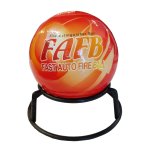
What about this thing, they are about £12 on ebay, maybe worth having in a hard to reach place?
The first and only fire extinguisher in the world that activates automatically when it comes in to contact with a fire

Model: 0.5kgs

Activates within 1 / 2 seconds - no other model compares

Loud fire alert sound to warn everyone in the surrounding areas

Place on top of bracket were needed or simply roll into fire for immediate response

Ideal in high risk or difficult to reach areas

No maintenance or service ever required

Environmentally friendly non-toxic dry powder chemical

Suitable for Class A - B - C - E and F fires
fireball.jpg
 
Those amongst us who like reading technical descriptions will be pleased with the article put out by Fire Safety Stick on How It Works.
I am not a chemist, but I strongly suspect that description to have been written by a cut-price AI system. The basic message seems to be that they heat up potassium nitrate (a common oxidiser due to its ability to release oxygen when heated) and thereby reduce the amount of oxygen in the air.
 
I am not a chemist, but I strongly suspect that description to have been written by a cut-price AI system. The basic message seems to be that they heat up potassium nitrate (a common oxidiser due to its ability to release oxygen when heated) and thereby reduce the amount of oxygen in the air.
I'm sure that you're quoting the description correctly, but that doesn't make sense! It would INCREASE the amount of oxygen available and thereby promote fire! Potassium or Sodium Nitrate were common ingredients in my schoolboy attempts to make gunpowder, providing the source of oxygen to combine with sulphur and carbon (I never succeeded in getting it to go bang, only fizzle and burn, because making gunpowder is a bit harder than just mixing the ingredients together)
 
Dry powder is also not a good idea in the vicinity of a running engine - the engine will ingest the powder, doing it no good at all. There have been reports of engines being seriously damaged by dry powder extinguisher.

The old chestnut. If I had an engine fire, first thing I'd do would be shut it down.
 
The powder extinguishers on my boat are due for replacement, having looked around and read the various threads on the forum concerning extinguishers I have decided to go for Water Mist, they seem to be a sensible replacement on a boat.
I was offshore Africa and the dip shit of a safety officer decided that we should test the central point powder system by firing it! . Basically a BIG tank of powder with some serious CO2 bottles to drive it. You have never seen such a mess in all your life!
 
Guys, Google pyrotechnic fire extinguishers. The chemistry is well established and it really does work. No gimmick, I assure you. It is not oxygen reduction and they do not add oxygen. They interrupt the chain reactions.
For example: PYROTECHNIC AEROSOL EXTINGUISHING FOR AFV ENGINE BAYS

That said, whether it is what you want or what you want on your boat I am not wading into. There are also other brands.
 
The old chestnut. If I had an engine fire, first thing I'd do would be shut it down.
Of course, but the problem isn't confined to engine-room fires. Given that many of us have engines that can draw air from the cabin, even letting one off in the cabin could result in powder getting into the engine space. Few engine spaces are sealed off from the cabin on sailing boats, at least not well enough to stop powder. The pervasive nature of powder extinguishers is well-documented - see the crash test boat videos, for one. If I let a powder extinguisher off below decks I couldn't be certain that powder hadn't got into the engine. And there are many circumstances where stopping the engine might not be a good idea; there are plenty of waters where not having steerage way could result in disaster, too.

If there is an engine-safe option (such as water mist extinguishers), then surely they are to be preferred to a type known to have the potential to cause damage - possibly fatal damage - to an engine? I will certainly not replace my existing powder extinguishers like for like when the time comes.
 
Top